

In This Edition of
The BookBrowse Review
Contents
Highlighting indicates debut books
Discussions are open to all members to read and post. Click to view the books currently being discussed.
Literary Fiction
Historical Fiction
Short Stories
Essays
Poetry & Novels in Verse
Thrillers
Romance
Fantasy, Sci-Fi, Speculative, Alt. History
Biography/Memoir
History, Current Affairs and Religion
Literary Fiction
Fantasy, Sci-Fi, Speculative, Alt. History
Graphic Novels
Biography/Memoir
History, Current Affairs and Religion

| BookBrowse: | |
| Critics: | |
| Readers: |
Like a sober, millennial Jesus' Son, Michael Deagler's debut novel is the poignant confession of a recovering addict adrift in the fragmenting landscape of America's middle class.
Don't worry about what Dennis Monk did when he was drinking. He's sober now, ready to rejoin the world of leases and paychecks, reciprocal friendships and healthy romances—if only the world would agree to take him back. When his working-stiff parents kick him out of their suburban home, mere months into his frangible sobriety, the 26-year-old spends his first dry summer couch surfing through South Philadelphia, struggling to find a place for himself in the throng of adulthood.
Monk's haphazard pilgrimage leads him through a city in flux: growing, gentrifying, haunted by its history and its unrealized potential. Everyone he knew from college seems to be doing better than him—and most of them aren't even doing that well. His run-ins with former classmates, estranged drinking buddies, and prospective lovers challenge his version of events past and present, revealing that recovery is not the happy ending he'd expected, only a fraught next chapter.
Shot through with humor, hubris, and hard-earned insight, Early Sobrieties charts the limbos that exist between our better and worst selves, offering a portrait of a stifled generation collectively slouching towards grace.

PASSYUNK
News of my sobriety had spread throughout the land, at least among a certain subset of individuals for whom sobriety was a rare and ill- considered state. It was Oktoberfest at the Brauhaus, which, in the name of public merriment, had shut down a block of South Street in order to validate a lot of debased and antisocial behavior. Not that such conduct didn't occur nightly on South Street, but the Brauhaus had welcomed it into the reputable light of day—to the accompaniment of Schlager and Volksmusik no less—which surely represented, if not an act of outright delinquency, at least some form of civic negligence. I came for a soft pretzel and to reaffirm my own constructive life choices.
Philadelphia was a small town when you got down to it, particularly if you sifted out those people for whom the Brauhaus Oktoberfest held little appeal. I ran into a number of acquaintances. Katie Doran was working the pretzel stand, and I imagine she mentioned my presence to Lilah Noth in the beer tent, who likely tipped off Rob Gill and his troop of inebriates, who accosted me outside the vegan café from which I was contemplating the purchase of a bubble tea. Gill had Sean Culp with him, and Sean Porth, and between the two of them they carried Mildew Hannafey like the crucified Christ, buttressing his slack, skinny arms with their shoulders. They cast the drunk man at me, repeating my name as though they believed it held incantatory properties. "Dennis Monk! Dennis Monk! Dennis Monk!"
"What?" I said. The lax face of Hannafey was pressed against my shirt. His flaccid limbs draped themselves around my neck.
"He's overserved!" cried Gill. Gill, too, was overserved. The whole group of them was overserved. They continued to overserve themselves from the plastic beer steins germinating from their hands. "You're sober, Dennis Monk! You need to take him home!"
"Is that Dennis Monk?" muttered Hannafey. "I know Dennis Monk."
"I don't know where he lives," I said, turning my face away from the semiconscious reveler nuzzling at my sternum. He smelled strongly of beer and slightly of vomit. I knew very little about Hannafey. He was around twenty-two, on the shorter end of average height, with elfin features that suggested intoxication even when he was sober, which he rarely was. I'd only ever encountered him in low-lit bars, where the regulars evolved a sort of cave- blindness toward one another. I was alarmed to see him in daylight.
"He lives way down Passyunk!" Gill had sardine eyes, eyes terrified of ever missing a thing that happened in the world. "Down past Nineteenth!"
"I'm not going to take him there," I said. "I don't even have a car. Just put him on a bench for a while."
"He'll get sunstroke and die!" wailed Gill. "He'll putrefy like a jack-o'-lantern!"
"Jesus, just put him in the shade," I said, though already the old guilt was revving in my chest. I wanted nothing to do with the chemically impaired—they annoyed the fuck out of me, in a way that only those exhibiting my own inadequacies could—but for that same reason I felt an obligation toward them. They brought to mind all the people who had aided me when I had been in similar states of degeneration. All the people, too, who hadn't bothered. Part of what impelled a person to substance abuse in the first place was the hope that, if he forfeited his faculties and lay himself before the mercy of his fellow man, some reluctant Samaritan might come along and look after him for a little while. I had once wobbled so discomfitingly before a bar in Callowhill that a woman invited me into her car and dropped me off at a friend's place in Fairmount, asking nothing of me other than a promise that I would go straight to bed and take better care of myself in the future. Another time, a group of college students five years my junior—not one of whom I'd met before or since—bought me a late- night doughnut in Old City before sticking me in a cab bound for an address I ...
Excerpted from Early Sobrieties by Michael Deagler. Copyright © 2024 by Michael Deagler. Excerpted by permission of Astra House. All rights reserved. No part of this excerpt may be reproduced or reprinted without permission in writing from the publisher.
Please be aware that this discussion guide will contain spoilers!
Unless otherwise stated, this discussion guide is reprinted with the permission of Astra House. Any page references refer to a USA edition of the book, usually the trade paperback version, and may vary in other editions.
Dennis Monk is sober now, and he expects some applause. Or at least some recognition that he's changed and on his way to becoming a wiser, better person than when he was drinking. Instead, his Irish Catholic boomer parents, who've gritted their teeth to do what needed to be done their whole lives (and had their own set of unhealthy habits regarding substances), kick their unemployed son out of the house. He finds no closure with his ex-girlfriend, who has moved on and is now engaged, living in a much nicer neighborhood than the one they shared. Nor does he get any sympathy from his former friends, who vacillate between wondering why he quit drinking and how long he's going to stay on their couch. Early Sobrieties recounts what it's like to rejoin the world and learn how to behave like a functioning adult again, or perhaps for the first time.
This is Michael Deagler's first novel, told in a series of vignettes, each highlighting a different dimension of getting sober. It draws heavily on Deagler's personal experience and reads like a memoir. Both Dennis Monk and Deagler grew up in Bucks County, Pennsylvania, both have aspired to write for a living, both have struggled with alcohol and sobriety. Perhaps because of this autobiographical similarity, and because I do not know Michael Deagler as a person at all, it feels a touch judgmental to admit that Monk is not a likable character. He cannot seem to understand how or why things go wrong for him when he's just trying his best to do the right thing. This may be a self-deprecating move on Deagler's part.
Each story, told from Monk's perspective, recasts his perception in a different light. Take the chapter "Kid Stuff," where he finds himself living with Tara Cudahy, a previous acquaintance and herself a recovering addict. He and Cudahy abide by a code she has tacitly set for them: pacifism, no meat in the house, alternative weeklies instead of Big Publishing, no corporate chains, no smoking. Monk willingly adopts Cudahy's requirements, ready to try on a new adult style of living that doesn't involve bad decisions. But because giving up so many vices at once is darn near impossible, and because he's still largely unemployed and broke, he causes a scene at the local grocery store trying to use a two-for-one coupon to buy some cigarettes. Afterwards, he encounters the young salesclerk on the street corner. They're headed in the same direction and she keeps glancing back nervously at him as she walks. He doesn't understand who she's looking at and wants to yell, "Yo, Pathmark girl, what are you afraid of?" Cudahy is not amused at this anecdote. How does he not see the intimidating situation for a young woman who was just harassed during her shift by the same customer who now appears to be following her? He — a tall, white, somewhat shifty-looking man — is what she is afraid of. But in Monk's world, all he's trying to do is live by Cudahy's rules, stay sober, and get home.
Despite the frequent urge to grab Monk by the shoulders and give him a good shake, his character grew on me. His various escapades earn him wisdom, insight, and move him further along in his recovery. The book begins with him at a few fragile months of sobriety, and one would be mistaken thinking this was a sort of turning point in his recovery, as if everything before the start was old/drunk Monk and everything after a happy ending. As Deagler illustrates for us, and as anyone who has ever supported themselves or a loved one through recovery can confirm, there is no narrative turning point that marks the before and after of sobriety. If there was any such moment, one could call it the day that Monk decided to get sober. But how did he know that this time it would stick? He recounts to us his past attempts at quitting drinking. On the last attempt, he ended up at the zoo after riding the bus all night and the night of no drinking somehow melted into the next day of no drinking and then the next and so on and so forth. Early Sobrieties highlights poignantly that in the battle against addiction, each day is an ongoing fight to stay away from your drug of choice and to continue the process of rebuilding your life.
Monk's adventures are set across South Philadelphia (see Beyond the Book). Within his gripes about the gentrification of certain neighborhoods is an ode to the city he knows and loves, where all his former social circle — suburban childhood and college alike — has been inevitably drawn. He tours the area as he couch-surfs through the summer, takes part in traditions like cheesesteak and the Mummers, and dreams about what his life could be like there. Deagler's debut reflects a vivid sense of South Philly as a backdrop to this intimate story and I look forward to what comes next for (and from) him.
Reviewed by Pei Chen
 Aimee Bender, author of The Butterfly Lampshade
Percival Everett, 2023 Windham Campbell Prize recipient and author of Dr. No
Aimee Bender, author of The Butterfly Lampshade
Percival Everett, 2023 Windham Campbell Prize recipient and author of Dr. No
Rated 4 out of 5
by Lovandraa
Philadelphia in the Mist: Monk's Footsteps in Early Sobrieties
Early Sobrieties is the first novel by Michael Deadker. It tells the life of a 26-year-old young man named Dennis Monk who is trying to survive the early days after quitting alcohol. Dennis Monk is trying to understand who he is without alcohol, while dealing with memories, shame and boredom. Each page of the novel tells the story of Dennis's journey of quitting alcohol and trying to become a better person, the expulsion by his parents, conflicts with ex-girlfriends and not getting sympathy from his friends. Dennis continues to move from place to place, staying on friends' couches and making strange connections and living life day by day.
The novel's episodic and observational style has a narrative pace that is not hyper-dramatic, just the reality of the everyday life of a person who is trying to recover, but still presents strong emotional details that really describe a Quarter-life Crisis. This book is highly recommended to readers who enjoy deep characterization and are interested in recovery and identity crisis in their late 20s.
Rated 3 out of 5
by Margot_Polley
Falls short
This was pretty good for a first novel and shows a lot of promise for future books. I think Deagler pretty accurately describes the challenges of an alcoholic’s first year of very fresh sobriety. Dennis couch surfs from one friend to another’s, failing over and over to make any lasting connections. I know there are other paths to sobriety besides 12 step programs, but if ever there was someone who needs AA, it’s Dennis. The ending is clever and does have a hint of optimism.
 After Michael Deagler's protagonist Dennis Monk in Early Sobrieties is ejected from his parent's house in suburban Bucks County, he drifts, as many former small-town and suburban kids do, to the nearest big city. As much as Early Sobrieties is a book about new starts to life, it is also an ode to South Philadelphia, which officially became included in the city proper starting in 1854 and has changed in many ways since then. South Philly neighborhoods feature prominently in chapters of Deagler's novel, from Southwark ("Southwark") to Grays Ferry ("Kid Stuff") and Moyamensing ("Moyamensing").
The area that is now South Philadelphia was first inhabited by the Lenape, then by Dutch settlers, and over time took on the cultural identities of various groups that arrived there. In the early 19th century, free Black Americans and Irish immigrants formed the largest communities. In an atmosphere of tension due to competition over jobs, Black residents were targeted by white mobs during riots that took place in the 1830s and '40s, and continued to face threats later on. By the early 20th century, Russian Jews, who had fled oppression under the tsar, and Italians comprised the largest populations. In the 1970s, Vietnamese refugees began to settle. By the time of the 1990 census, the ethnic makeup of the area was approximately 31% African American, 31% Italian, 10% Irish, 5% German, 4% Asian, and 3% Hispanic.
In this place of historical racial, ethnic, and cultural diversity, denizens have had one trait in common until recently: class. South Philadelphia's economic mainstay was traditionally blue-collar jobs supplied by the nearby factories, ports, and waterways, including the Navy Yard, which closed in 1995 and was eventually converted into offices. With the revitalization of Center City Philadelphia, the adjacent northern neighborhoods of South Philadelphia began to see an influx of young urban professionals and rising housing prices.
Deagler's character Dogman, an accountant, lives in Bella Vista ("New Poets") and Monk stumbles upon his old friend Kevin Mangan in East Passyunk, a neighborhood of high-end vintage shops and pet supply emporiums whose "gentrification needle [has] recently ticked from up-and-coming to no vacancy." Philadelphia magazine lists the East Passyunk restaurant boom in 2009, a weathervane indicator for gentrification, as a historical marker in South Philly's timeline, along with significant events like the first official Mummers Parade in 1901, the opening of Pat's King of Steaks (the originator of the cheesesteak sandwich) in 1930, and the election of two-term mayor Frank Rizzo in 1971.
South Philadelphia from One Liberty Observation Deck in May 2017, by Dough4872 (CC BY-SA 3.0)
Filed under Places, Cultures & Identities
By Pei Chen


From bestselling and award-winning author Patrick deWitt comes the story of Bob Comet, a man who has lived his life through and for literature, unaware that his own experience is a poignant and affecting narrative in itself.
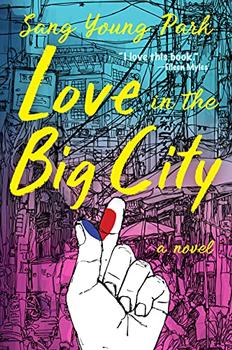
A funny, transporting, surprising, and poignant novel that was one of the highest-selling debuts of recent years in Korea, Love in the Big City tells the story of a young gay man searching for happiness in the lonely city of Seoul.
Your guide toexceptional books
BookBrowse seeks out and recommends the best in contemporary fiction and nonfiction—books that not only engage and entertain but also deepen our understanding of ourselves and the world around us.


