

In This Edition of
The BookBrowse Review
Contents
Highlighting indicates debut books
Discussions are open to all members to read and post. Click to view the books currently being discussed.
Literary Fiction
Historical Fiction
Short Stories
Essays
Poetry & Novels in Verse
Thrillers
Romance
Fantasy, Sci-Fi, Speculative, Alt. History
Biography/Memoir
History, Current Affairs and Religion
Literary Fiction
Fantasy, Sci-Fi, Speculative, Alt. History
Graphic Novels
Biography/Memoir
History, Current Affairs and Religion

| BookBrowse: | |
| Critics: | |
| Readers: |
From the International Booker Prize-winning translator and Women's Prize finalist, an utterly beguiling novel about eight translators and their search for a world-renowned author who goes missing in a primeval Polish forest.
Eight translators arrive at a house in a primeval Polish forest on the border of Belarus. It belongs to the world-renowned author Irena Rey, and they are there to translate her magnum opus, Gray Eminence. But within days of their arrival, Irena disappears without a trace.
The translators, who hail from eight different countries but share the same reverence for their beloved author, begin to investigate where she may have gone while proceeding with work on her masterpiece. They explore this ancient wooded refuge with its intoxicating slime molds and lichens and study her exotic belongings and layered texts for clues. But doing so reveals secrets-and deceptions-of Irena Rey's that they are utterly unprepared for. Forced to face their differences as they grow increasingly paranoid in this fever dream of isolation and obsession, soon the translators are tangled up in a web of rivalries and desire, threatening not only their work but the fate of their beloved author herself.
This hilarious, thought-provoking debut novel is a brilliant examination of art, celebrity, the natural world, and the power of language. It is an unforgettable, unputdownable adventure with a small but global cast of characters shaken by the shocks of love, destruction, and creation in one of Europe's last great wildernesses.

Please be aware that this discussion guide will contain spoilers!
Unless otherwise stated, this discussion guide is reprinted with the permission of Bloomsbury Publishing. Any page references refer to a USA edition of the book, usually the trade paperback version, and may vary in other editions.
Eight translators, each rendering Polish into a different target language. One globally adored, eccentric author, thought to be in line for an "inevitable Nobel Prize." The eccentric author's tall house of "undulating, unscathed oak" stuffed with various aged knickknacks, large enough to accommodate all eight translators as they gather to usher her latest book, believed to be her masterpiece, into their respective tongues. Poland's ancient Białowieża Forest (see Beyond the Book), lurking on the edge of the author's village near Belarus, an intense place crawling with death, life, and fungi.
These frankly grandiose elements make up Jennifer Croft's debut novel The Extinction of Irena Rey. A reader who hasn't seen the Białowieża Forest can easily imagine it to be as stunning as it appears here, but the way the first-person narrator, Spanish-language translator Emilia Martini (aka Emi), introduces eponymous author Irena Rey and the fictional world of literary celebrity she embodies is already a bit much: "Many tried to describe her indescribable aura. Some said it was akin to fine filaments of strummed silver that hovered over her dark cascading hair. Others were reminded of the southern lights, brilliant streaks that hissed across her deep-sky eyes." Luckily for the reader who is already rolling their own eyes, Croft, herself the Booker-winning translator of Nobel laureate Olga Tokarczuk, has built a story containing layers of skepticism and wavering reality.
This is partly evident in how it is impossible to refer to the "author" of this "book" without raising the question of whether this means Croft, Irena, Emi, or Alexis Archer, who has the first word in a translator's note, explaining that the following text is a novel written in imperfect Polish by an author whose first language is Spanish (Emi) and then translated into English by Alexis. Alexis is herself the foundation of a character (Irena's English-language translator) in Emi's novel, supposedly based on events they both experienced. Furthermore, Emi considers Alexis a kind of nemesis, and Alexis admits to having taken some liberties to correct the "atmosphere of wrongness" created by Emi's Polish, claiming that every original sentence "becomes a kind of tiny haunted house."
Into this layered linguistic fort springs the story's plot. Shortly after arriving at Irena's, the translators, accustomed to working with their author in a cultish, retreat-style format, notice something is amiss. Irena's husband, Bogdan, appears to have vanished, and Irena is behaving strangely. Soon, she goes missing herself, and the translators are faced with solving the mystery of her disappearance, while also working on their translations and trying to save her beloved Białowieża Forest from increased logging activity.
This story offers several points of metaphorical intersection on themes such as the destruction and creation of writing and translation, the toxic nature of celebrity, and the invisibility of the translator and artist. Croft's novel is genuinely clever in a way that is often delightful. It also, at times, creaks under the weight of its construction. Understanding that there are reasons behind certain strange tediums doesn't keep the prose from sometimes feeling as inscrutable and overwrought as Irena's weird house; one can't help but think that Alexis, who according to Emi believes translation to be a kind of editing, wasn't brutal enough.
Still, the construction holds, and the slow revelation of Emi's humorously flawed character, checked and balanced by footnoted comments from Alexis, is worth the ride. Emi is appalled by Alexis's philosophy, believing that translation should preserve the purity of the author's original intent. She is naive in her ideals but cynical about human relationships, constantly flickering between fickleness and suspicion. She becomes romantically obsessed with Freddie, the Swedish translator, while thinking he may have been having an affair with Irena, is devastated to find he is married, then learns he is in an open marriage, after which she begins having sex with him but thinks he is also sleeping with Alexis, even while knowing that Alexis is not generally interested in men. Emi's views on translation are tied to her insecurities; she makes choices based on her idea of what others find desirable, seeking out competition and conflict at all turns, a trait that eventually culminates in her challenging Alexis to a literal duel.
These characteristics make Emi a perfect acolyte for Irena, as well as something of a reflection of her. Croft's novel is full of playful jokes about the nature of translation and art, but the fire that fuels it is its exploration of power and convenience. It becomes apparent that Irena, who hangs over the plot like a specter, present even in her absence, is using the translators to maintain her own influence. They are also using her, to derive a sense of purpose and significance. But this doesn't make their relationship with her equal, nor does it make it sustainable as it stands. The millennia-old forest, hovering nearby with its ever-present exchanges of birth and demise, serves as a reminder that change is inevitable.
Reviewed by Elisabeth Cook
 Katie Kitamura, author of Intimacies
Megha Majumdar, author of A Burning
Nana Kwame Adjei-Brenyah, author of Chain Gang All Stars
Katie Kitamura, author of Intimacies
Megha Majumdar, author of A Burning
Nana Kwame Adjei-Brenyah, author of Chain Gang All Stars
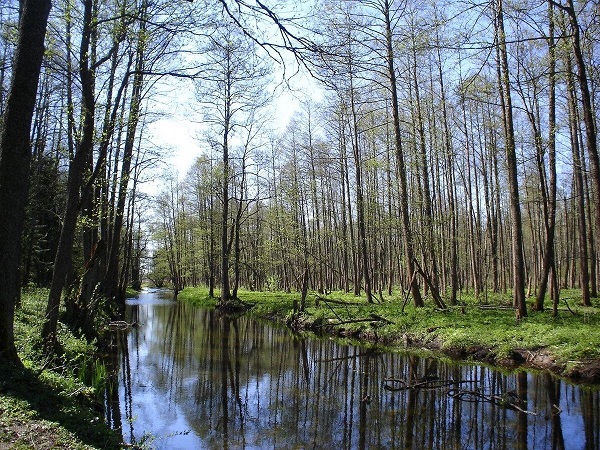 In Jennifer Croft's The Extinction of Irena Rey, humans' domestic and professional concerns mix with those of the natural world against the background of the vast Białowieża Forest, beside which the titular author lives and hosts a personal entourage of translators. The Białowieża Forest is a complex of woodland covering 141,885 hectares (almost 550 square miles) across the border between Poland and Belarus. Located on the watershed of the Black Sea and Baltic Sea, it consists of a mix of the remaining parts of several primeval forests. Due to its unique preservation status and biodiversity, it has been designated a UNESCO World Heritage site. According to the World Wildlife Fund, Białowieża is "the best preserved forest ecosystem and the last low-land deciduous and mixed old-growth forest in Europe."
The Białowieża Forest is home to 59 mammal species, including the world's largest population of free-ranging European Bison, which were extinct in the wild by the early 20th century but reintroduced from captivity in the 1950s. It also houses numerous species of birds and some amphibians and reptiles.
One of the most notable qualities of the forest is its dead wood, which makes up a quarter of the total tree mass in the area due to the land having been left undisturbed. This large amount of decaying trees and plant matter makes Białowieża a place where fungi (3-4,000 species) and invertebrates (over 12,000 species) thrive, many of them in danger of extinction. Croft makes humorous reference to one of these rare species, the Goldstreifiger (Buprestis splendens) beetle, which Emi, Irena's Spanish-language translator, attempts to preserve only for it to be eaten by Quercus, Irena's pet parrot.
Roughly a third of the Polish part of the forest is established as a national park and strictly protected reserves, but the other two-thirds have been subject to increased logging in recent years, an issue raised directly in Croft's novel. In 2016, the Polish Environmental Minister announced plans to triple logging in the Białowieża Forest District, with the reason given that it was necessary to contain a bark beetle outbreak. Environmental groups disagreed with this logic, pointing out that such outbreaks and the dead wood they produced were a natural process that had been taking place in the forest for thousands of years. Emi explains the position of those opposed to the logging: "The forest had always found a way to heal itself, but in order to do so, it had to have biodiversity: a variety of plants, animals, and fungi that only in cooperation with each other were able to perpetuate the cycle of life. No one species could do this on its own; no two or three species could, either."
Following local and worldwide pressure from environmental groups and the media, legal action was taken by the EU Commission in 2017, and Poland was ordered by the European Court of Justice to stop logging in Białowieża until a final ruling was reached. In 2018, the court ruled the increase in logging illegal, as felling trees older than a hundred years broke EU law. However, forestry experts and others have continued to express concerns about subsequent logging and related issues, including the building of a border wall through protected areas of Białowieża ordered by Polish authorities in response to Belarus becoming a destination for refugees, a move that is both hostile to residents and migrants and disrupts the natural movement of wildlife.
In early 2024, Poland's new climate minister pledged to "get saws out of Polish forests," starting with halting planned logging in some of the country's oldest woodland areas. Augustyn Mikos, writing for Climate Home News, urges people to remain conscious of the environmental challenges Poland still faces, while also suggesting that this development is evidence that "concerted civil society pressure really works" and that "Poland's transformation can be a beacon for others: showing how people can successfully mobilise to protect the ecosystems that humanity's survival depends on."
The Białowieża Forest, courtesy of Robert Wielgórski CC BY-SA 3.0
Filed under Nature and the Environment


A brilliant dark comedy about love and ambition, failure and reinvention, and the racial- identity-industrial complex from the bestselling author of Caucasia.

From the bestselling author of The Garden of Evening Mists, a spellbinding novel about love and betrayal, colonialism and revolution, storytelling and redemption.
Books with similar themes
Your guide toexceptional books
BookBrowse seeks out and recommends the best in contemporary fiction and nonfiction—books that not only engage and entertain but also deepen our understanding of ourselves and the world around us.

