

In This Edition of
The BookBrowse Review
Contents
Highlighting indicates debut books
Discussions are open to all members to read and post. Click to view the books currently being discussed.
Literary Fiction
Historical Fiction
Short Stories
Essays
Poetry & Novels in Verse
Thrillers
Romance
Fantasy, Sci-Fi, Speculative, Alt. History
Biography/Memoir
History, Current Affairs and Religion
Literary Fiction
Fantasy, Sci-Fi, Speculative, Alt. History
Graphic Novels
Biography/Memoir
History, Current Affairs and Religion

| BookBrowse: | |
| Critics: | |
| Readers: |
A spellbinding novel of literary and psychological suspenseabout the dark secrets that surface after the shocking disappearance of a charismatic, mercurial teacher at an elite boarding school—by the legendary author "who is surely on any shortlist of America's greatest living writers" (The New York Times Magazine)
Who is Francis Fox? A charming English teacher new to the idyllic Langhorne Academy, Fox beguiles many of his students, their parents, and his colleagues at the elite boarding school, while leaving others wondering where he came from and why his biography is so enigmatic. When two brothers discover Fox's car half-submerged in a pond in a local nature preserve and parts of an unidentified body strewn about the nearby woods, the entire community, including Detective Horace Zwender and his deputy, begins to ask disturbing questions about Francis Fox and who he might really be.
A hypnotic, galloping tale of crime and complicity, revenge and restitution, victim vs. predator, Joyce Carol Oates's Fox illuminates the darkest corners of the human psyche while asking profound moral questions about justice and the response evil demands. A character as magnetically diabolical as Patricia Highsmith's Tom Ripley and Vladimir Nabokov's Humbert Humbert, Francis Fox enchants and manipulates nearly everyone around him, until at last he meets someone he can't outfox. Written in Oates's trademark intimate, sweeping style, and interweaving multiple points of view, Fox is a triumph of craftsmanship and artistry, a novel as profound as it is propulsive, as moving as it is full of mystery.

Please be aware that this discussion guide will contain spoilers!
These are original discussion questions written by BookBrowse.
Characters
Francis Fox (née Frank Farrell) — A pedophilic English teacher at Langhorne Academy who is murdered
Paige "P." Cady — The headmistress of Langhorne
Eunice Pfenning — A student at Langhorne who Mr. Fox despises
Martin Pfenning — Eunice's father, a pharmaceutical executive
Demetrius Healy — A shy, religious young man from a working-class family
Mary Ann Healy — Demetrius' cousin who attends Langhorne on a scholarship
Genevieve Chambers — A student at Langhorne and Mr. Fox's favorite victim
Katy Cady — P. Cady's niece, a student who is smitten with Mr. Fox
Imogene Hood — A librarian at Langhorne who takes a liking to Mr. Fox
Horace Zwender — A detective investigating Mr. Fox's death
Unless otherwise stated, this discussion guide is reprinted with the permission of Hogarth Books. Any page references refer to a USA edition of the book, usually the trade paperback version, and may vary in other editions.
An Acura is found half-submerged in the wetlands of southern New Jersey; inside is the animal-eaten corpse of Francis Fox, an English teacher at Langhorne Academy, an elite boarding school in the fictional township of Wieland. Fox was handsome, charismatic, and nurturing towards (some of) his students; he was also a manipulative pedophile, plying his favorite pupils with drug-laced treats and molesting them in his office. As his death sends shockwaves through the community, Fox haunts every single character, from the detective investigating his murder to the headmistress who unknowingly hired a sexual predator—to say nothing of his victims.
Fox hops from perspective to perspective, allowing us to get to know a broad ensemble as the narrative jumps back and forth through time. There's pharmaceutical executive Martin Pfenning and his autistic daughter Eunice, with whom he has a strained relationship; there are the Healys, a dysfunctional "poor white" family who struggle to make a living in a rapidly gentrifying Wieland; there's Paige Cady, Langhorne's headmistress, whose icy, WASPish demeanor belies a writhing mass of neuroses.
And, of course, there is Fox himself, one of the most odious characters you're likely to meet for a very long time. A cross between Humbert Humbert and Tom Ripley, Fox is a well-educated con artist who idealizes the young female form—he's fixated on the prepubescent nudes of the French painter Balthus, as well as Edgar Allan Poe's marriage to his thirteen-year-old cousin Virginia Clemm (see Beyond the Book). When he's with his victims, he refers to himself sometimes as Big Teddy Bear, and other times as Mr. Tongue.
What makes Fox's passages illuminating rather than gratuitously ugly is how clearly Oates sees him as the pathetic wretch he is. When we watch Fox connive his way into the tony confines of Langhorne Academy, we receive no vicarious, Ripley-esque pleasure from the process—only frustration and disgust at the naivete of people who should know better. His inner monologue alternates between maudlin self-pity ("my heart is in tatters, my life is in ruins"), delusional infatuation (like his endless cooing over his "little kittens"), and sneering cruelty, directed especially at young Eunice Pfenning. He relishes how he can manipulate his students by granting or withholding praise and good grades, describing himself as a "puppet-master"—as though we're supposed to be impressed by how skillfully he can emotionally abuse a bunch of twelve-year-olds.
It should come as no surprise that Oates, the author of novels like Blonde and Zombie, goes to some very dark places here. There are passages describing Fox's abuse, both from his point of view and that of his favorite victim, which will paralyze you with hatred and despair. And his evil, dangerous behavior is not limited to sexual abuse: his treatment of Mary Ann Healy, a troubled girl whom Fox nurtures then spurns, and Eunice Pfenning, whom Fox goes out of his way to torment, is just as upsetting.
Fox will not be a book for everyone. Oates has many virtues as a writer—her gothic sensibility, her gift for evocative imagery, her fearlessness to go where others won't dare—but restraint is not among them. (For the most part, anyway—the fates of at least a few characters are left hauntingly unresolved.) Even those who can stomach the subject matter may find Fox exhausting. But if you're on Oates' wavelength, you will be richly rewarded with a dense, twisty mystery that is unafraid to gaze into the void.
Reviewed by Joe Hoeffner
Rated 4 out of 5
by techeditor
Great concentration on characters but too wordy
FOX is about a pedophile. It is also about the 12- and 13-year-old girls, their parents, and, in one case, extended family whose lives are affected by the pedophile. It is not a spoiler to tell you that he dies in an apparent car accident.
Francis Fox has changed his name and come to another school to teach junior-high English. Descriptions of his secret life are accurate descriptions of a pedophile. He's such a nice, handsome fellow. Everyone loves him, especially his students, especially 12-year-old girls. His death devastates everyone, especially those 12-year-olds.
Then comes Part 2 and the police investigation.
Joyce Carol Oates gets five stars for her concentration on characters, their thoughts, especially as they are affected by Fox. Of course, one of her characters is Fox, himself. His secret thoughts, those that are so often the opposite of what he portrays, are not only hateful; they are also what he WANTS to think rather than what is real (which is also an accurate description of how a pedophile thinks).
But Oates is too wordy. This is her writing style. It was the same in another book of hers I read. This is a tiresome writing style, and for this I downgrade those five stars.
I was also unhappy with the inaccurate maturity levels of 12- and 13-year-old girls. They seemed more like 7-year-olds. I remember being 12 very well, and I remember my friends at that age. I know that, if a man I had trusted tried anything like Fox did, I would have known it was wrong, and I would have told my parents. And those girls' parents: most treat their 12- and 13-year-old daughters as if they are 7.
Another thing maybe someone can explain: Oates interjects her name into the Epilogue. Why? Just for the heck of it is the only reason I can come up with.
This book is saved from a three-star rating by its exceptionally good mystery: so many people had reason to want to murder Fox; but who did it?
I won this book through firstlookbookclub.com.
 Edgar Allan Poe looms over Fox—quite literally, in fact. Mr. Fox has a large bronze bust of Poe with a raven on his shoulder, a prize for winning a poetry contest, displayed in his office. But even beyond the bust, Poe recurs throughout the narrative. Not only does Fox become a detective story, a form Poe invented, Mr. Fox idealizes the many dead women in Poe's fiction (Annabel Lee, the lost Lenore) and in his life: specifically, Poe's marriage to his cousin Virginia Clemm.
Virginia Clemm was the daughter of Poe's aunt Maria, and first met her cousin and future husband in 1829, when she was seven years old. Her father died when she was four, and for a while the Clemms supported themselves through their grandmother's government pension (her husband fought in the Revolutionary War) and through Maria taking sewing jobs and housing boarders. In 1832, Poe came to live with their family in Baltimore for a few years, before moving to Richmond in 1835 for a job. Also in 1835, Virginia's grandmother died, leaving the Clemms bereft of a major source of their income—and leaving Virginia with no choice but to find some other source of stability, which came in the form of a proposal from her older cousin.
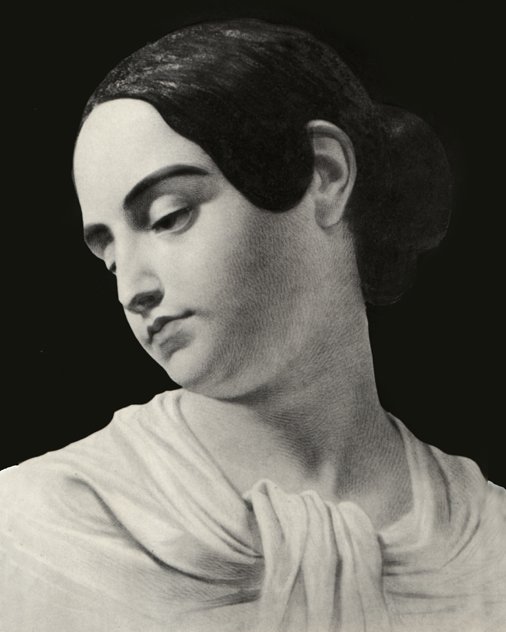 Not that Edgar Allan Poe was exactly what you would call "stable." Upon hearing that Poe and Clemm were to be married, a wealthy cousin by the name of Neilson Poe wrote to Virginia offering to send her to school so that she wouldn't have to marry so young. Poe flew into a hysterical rage, beginning to drink heavily and losing his job. Despite this, the two of them soon married. Poe was twenty-seven; Virginia was thirteen.
The exact nature of their relationship remains controversial to this day. Some insist that Poe and Virginia were more like siblings than husband and wife; he affectionately called her "Sissy," and she called him "Eddy." There is plenty of disagreement as to when the pair consummated their marriage, if, indeed, they ever consummated it at all. (Mr. Fox, referring to their marriage as a mariage blanc, seems to believe they didn't.) At the very least, Poe seemed to be conscious of the age gap, often misrepresenting Virginia's age (or even his own age) to make it less pronounced.
Although Poe was affectionate towards Virginia, he was dogged by rumors of infidelity which troubled his wife greatly. Sickly and suffering from tuberculosis, she died in 1847, devastating Poe and casting a long shadow over his remaining work. "Annabel Lee," one of his most famous poems, was reportedly inspired by her death; it was published two days after Poe's own death in 1849.
Images of Edgar Allan Poe and Virginia Clemm courtesy of Wikimedia Commons.
Filed under People, Eras & Events
By Joe Hoeffner

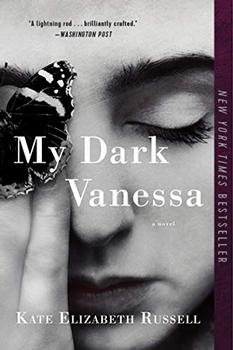
Exploring the psychological dynamics of the relationship between a precocious yet naïve teenage girl and her magnetic and manipulative teacher, a brilliant, all-consuming read that marks the explosive debut of an extraordinary new writer.

Your guide toexceptional books
BookBrowse seeks out and recommends the best in contemporary fiction and nonfiction—books that not only engage and entertain but also deepen our understanding of ourselves and the world around us.


.jpg)
