
-
Your next favorite book
is waiting.
Summary | Excerpt | Reviews | Beyond the Book | Readalikes | Genres & Themes | Author Bio
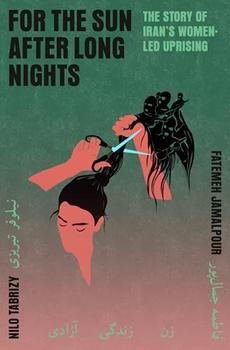
The Story of Iran's Women-Led Uprising
by Nilo Tabrizy, Fatemeh Jamalpour Book Reviewed by:
Over time, I got to see a lot of Ms. Sedaghat and her collection of bright scarves, which highlighted her monochrome jackets and pants. She never wore makeup. Her hijab was always open enough so that I could clearly see her face: She had low-arched dark eyebrows that she left unplucked and unshaped, a slightly elongated nose, dark skin, and thin lips. I learned that we were the same age, and that she was married with a son. Once, we talked about feminism, and it seemed as if she were really reflecting on the injustices I was describing. There had been moments when I wondered if I was getting through to her.
But I realized in this final interrogation that any understanding she seemed to show was all a charade, not a genuine show of friendship or kindness. So I smiled coldly and, in response to her question about visiting me in prison, said, "No, ma'am. I don't want to see you anymore."
"Is meeting with me so annoying for you?" she asked. "I thought we had had friendly conversations?"
At this point, I had had enough of her pretending that our interactions were not built on an imbalanced power dynamic. "My problem is not meeting you. It is your position; my life is in your hands, and we both know that whatever you and your bosses decide, the judge will issue it," I said. "Let's switch positions. Then we will see if you like it. I have nothing to lose. Send me to prison," I said.
Ms. Sedaghat stood and said, "You will be in jail soon, and I don't have any regrets about it, because I did my best to lead you. It seems you are watching the news from women's revolution pages. You have been radicalized again. But I will meet you on Sirat Bridge."
According to Islam, after we die, there is a bridge over which every person must pass to enter paradise. It's thinner than a strand of hair and sharp as the blade of a knife. Below it are the flames of hell that envelop the bodies of sinners. It was another moment of insanity and absurdity for me: While the regime is killing people on the streets, its representatives are talking to me about theological legends. I longed to help us out of the living hell we were living through every day in Iran.
At the end of this meeting, it was my turn to manipulate her. "May I hug you for the first and last time?" I asked. That's my technique, either a last-minute ceasefire or a fight to the end. "Goodbye, Ms. Sedaghat," I said as I hugged her.
But as I opened the door to leave, I turned back and asked, "Do you know what the difference is between my generation and Generation Z?"
"What?" she asked.
"We defended, but they attacked," I said, before looking her in the eye for the last time and closing the door.
Leaving the building where my interrogation took place, I became more and more enraged. Thoughts raced through my head. Being threatened in this way and living a new life of imprisonment had begun to suffocate me. My rage propelled me forward. I decided that if I was going to prison anyway, I was going to do something meaningful for my people and myself first.
Excerpted from For the Sun After Long Nights by Nilo Tabrizy and Fatemeh Jamalpour. Copyright © 2025 by Nilo Tabrizy and Fatemeh Jamalpour. Excerpted by permission of Pantheon Books. All rights reserved. No part of this excerpt may be reproduced or reprinted without permission in writing from the publisher.

L.A. Women by Ella Berman
Two ambitious writers in 1960s LA face betrayal when one writes a novel based on the other's life.







Your guide toexceptional books
BookBrowse seeks out and recommends the best in contemporary fiction and nonfiction—books that not only engage and entertain but also deepen our understanding of ourselves and the world around us.


