
-
Your next favorite book
is waiting.
Summary | Excerpt | Reviews | Beyond the Book | Readalikes | Genres & Themes | Author Bio
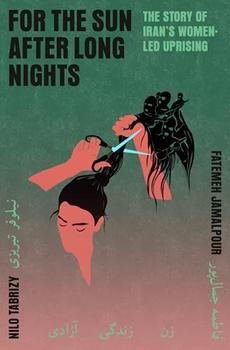
The Story of Iran's Women-Led Uprising
by Nilo Tabrizy, Fatemeh Jamalpour Book Reviewed by:
NILO
FOR STUDENTS. FOR THE FUTURE.
On September 26, 2022 , I got my first email from Fatemeh in nine months. She had just been summoned and interrogated by the Ministry of Intelligence, who had threatened her with two years of jail time for her journalism at the BBC that was critical of the regime. "I am not scared," Fatemeh wrote. "Something like hope is rising among us, hope for changes, for woman, life, freedom, for you visiting me in Tehran soon."
The last time I had heard from her was in 2021, when she was preparing to return to Iran after a stint in London and told me she was cutting off contact with me completely. "It's not safe to communicate with you. You won't hear from me. Take care, abji joon. Boos boos," she wrote, calling me abji, her sister, and sending digital kisses my way. She knew that her return meant that intelligence and security forces would snatch her up and start interrogating her about her work as a journalist abroad, which had become common practice for the regime in our increasingly dictatorial homeland.
I got her email in the middle of my workday at The New York Times, for which I had begun to cover the protests surging in Iran. I was working on my first story: a visual analysis of the themes of the demonstrations that were yet to swell into an uprising. My days were spent meticulously researching, organizing, and archiving videos and images shared by Iranians on social media as the street protests started to take shape. In the beginning, everything felt like a fever—nonstop, urgent, and somewhat surreal. I slept poorly and woke up with a heaviness in my body each morning, stopping myself from falling into a deep sleep for fear of missing something from a handful of time zones away. When I saw Fatemeh's name in my inbox, I couldn't believe that it was her. If the Islamic Republic found out that she was communicating with a Western journalist, Fatemeh could have been imprisoned for years for conspiring with "the enemy." But like other Iranians who were flooding the streets at the time, Fatemeh was evolving into a more defiant version of herself—one who was willing to accept the very real cost of risking her life and freedom.
By November 2022, social media continued to be full of footage of the protests. Iranians were ripping and torching posters of the Islamic Republic's cultlike leaders, women were cutting their hair while weeping in the middle of crowds, and mourners held funerals for people killed by the state during protests. In Tehran, the country's capital, elderly women marched up to the police, daring them to put them in handcuffs; members of the brave working class led historic strikes that shut down the northwestern city of Tabriz's grand bazaar; and even in Mashhad, a religious city in the northeast that has historically supported the regime, Iranians were chanting, "Death to the Islamic Republic!" in the streets.
Led by young women and other members of Gen Z, at least two million Iranians poured into the streets in the largest and most widespread uprising that the Islamic Republic has seen in its forty-six-year history. The government responded by restricting internet access to cut Iranians off from the outside world and by killing and mass arresting their own people. Since 2009, when Iran experienced nationwide protests over claims of electoral fraud, the regime has blocked access to YouTube, Twitter, Facebook, and countless other platforms. As a result, Iranians have for decades been forced into a game of cat and mouse with regime censors, finding creative ways to be online freely by using VPNs to change their IP addresses.
From afar, I monitored the drips of videos and information that Iranians managed to get out. On Telegram, an encrypted messaging app where many Iranians communicate with each other, I was particularly shocked at videos showing the rebellion of young schoolgirls across the country. One video showed a group of girls booing a member of the Basij, the feared volunteer paramilitary unit of the Islamic Revolutionary Guard Corps (IRGC), who was giving a speech about the protests at their school. The country's most powerful security, military, and intelligence institution, the IRGC was created following the Iranian revolution in 1979 to protect the new Islamic Republic and its religious ideology. Now it's a force loyal to Iran's supreme leader with massive influence over economic and political affairs. As the Basiji spoke, the schoolgirls shouted over him, chanting, "Get lost, Basij!"
Excerpted from For the Sun After Long Nights by Nilo Tabrizy and Fatemeh Jamalpour. Copyright © 2025 by Nilo Tabrizy and Fatemeh Jamalpour. Excerpted by permission of Pantheon Books. All rights reserved. No part of this excerpt may be reproduced or reprinted without permission in writing from the publisher.

L.A. Women by Ella Berman
Two ambitious writers in 1960s LA face betrayal when one writes a novel based on the other's life.






Your guide toexceptional books
BookBrowse seeks out and recommends the best in contemporary fiction and nonfiction—books that not only engage and entertain but also deepen our understanding of ourselves and the world around us.


