
-
Your next favorite book
is waiting.
Summary | Excerpt | Reviews | Beyond the Book | Readalikes | Genres & Themes | Author Bio
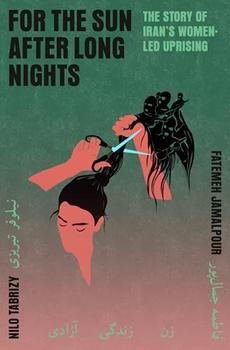
The Story of Iran's Women-Led Uprising
by Nilo Tabrizy, Fatemeh Jamalpour Book Reviewed by:
On the Monday after Jîna's death, women activists called for a protest against the regime at the intersection of Keshavarz Boulevard and, ironically, Hijab Street. I did not go, but friends told me that the demonstration turned into a confrontation between several thousand people and the riot police. Keshavarz Boulevard was divided into two sides: On one side were protesters standing hand in hand, among them women and men of all ages, religious and nonreligious, facing off against a line of riot police. Late that night, after the protests had died down, I went to Laleh Park on Keshavarz Boulevard. The cats that typically roamed had been attacked by so much tear gas that their eyes would not open. One day, an old woman who went to feed them every week showed up as usual but could not find them. Even cats are not safe from the regime's cruel repression.
When the interrogators summoned me a couple of days later, it caught me off guard. I didn't think that they would summon me amid all this chaos. The day before the interrogation, my father texted me asking me not to go out. I responded that I would not, because I had an interrogation session the next day. "Good!" he responded. In my father's eyes, being interrogated was better and safer than going to protest! The session took about four hours, and it did not go well.
Ms. Maryam Sedaghat, my main interrogator from the Ministry of Intelligence or, as she called herself, "the expert of my case" at the time, started the session by saying, "Your life will be divided between before and after this moment."
"My life has been full of these moments," I replied, laughing.
"Will you decide that you are pro–Islamic Republic or an opposition?" she asked. "I need your answer to decide about your future."
"It's so unfortunate that, after all, you have not realized that I am a journalist and cannot be pro or against it," I said. I viewed my role as reflecting and reporting the truth of what I witnessed.
She never discussed Jîna by name; she talked vaguely about someone who had died and claimed that there was no evidence to back up the brutal murder. I lost my cool and yelled in response that she was killed. She did not die a passive death. In response, my interrogator tried to humiliate and belittle me, calling me an extremist for contradicting the regime's account.
She told me that she and her colleagues had spoken about observations I had shared in response to a question about what had changed in Iran in the year I was away. I had told them that the number of women without hijab I saw on the street had increased by four or five times. When I had shared my vision for a freer Iran for women, my interrogators had only listened in silence, but it seemed they were finally ready to respond, nine months later.
"Our religious husbands fall into sin when they see women without hijabs," Ms. Sedaghat said.
"Well, the husbands should not look," I replied.
"First, you request an optional hijab," Ms. Sedaghat said. "Later, you want to get naked and walk down the street, and then you demand a sexual revolution." She seemed to be trying to reason with me—to show me I was mistaken in calling for women's bodily autonomy.
Then Ms. Sedaghat changed course. With an expression of feigned concern, she asked, "May I come to visit you in prison? Can we see each other after your imprisonment?"
I was shocked. I recognized a new level of manipulation in her words. It was a veiled threat. So she finally decided to send me to prison, I thought. I was suddenly filled with hatred for Ms. Sedaghat. During our conversations, I had gone back and forth between feeling angry with her and feeling a sense of allyship with a fellow woman. When she was assigned to my case, I worried that the interrogations would become more difficult for me. When my interrogators had been men, it had been easy to lie and play the part of a blushing, subordinate little woman for protection. But it was harder to do this with Ms. Sedaghat, because I value sisterhood, solidarity, and the collective power of women. I knew it would be more challenging for me to sit in front of a woman and lie to her directly, especially one who would undoubtedly try to find common ground and build rapport and friendship with me, even if it was all an act.
Excerpted from For the Sun After Long Nights by Nilo Tabrizy and Fatemeh Jamalpour. Copyright © 2025 by Nilo Tabrizy and Fatemeh Jamalpour. Excerpted by permission of Pantheon Books. All rights reserved. No part of this excerpt may be reproduced or reprinted without permission in writing from the publisher.

L.A. Women by Ella Berman
Two ambitious writers in 1960s LA face betrayal when one writes a novel based on the other's life.







Your guide toexceptional books
BookBrowse seeks out and recommends the best in contemporary fiction and nonfiction—books that not only engage and entertain but also deepen our understanding of ourselves and the world around us.


