
-
Your next favorite book
is waiting.
Summary | Excerpt | Reviews | Beyond the Book | Readalikes | Genres & Themes | Author Bio
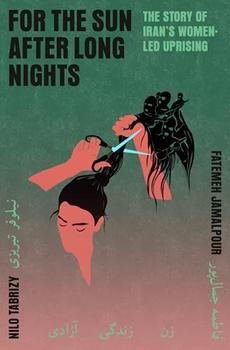
The Story of Iran's Women-Led Uprising
by Nilo Tabrizy, Fatemeh Jamalpour Book Reviewed by:
In Karaj, a big city half an hour from Tehran, a group of elementary school girls without hijabs threw paper and trash at a school administrator, yelling, "Bisharaf!" (without honor) at him as they forced him out of the building. In a culture immensely concerned with honor and dignity, bi-sharaf is an incendiary phrase that cuts to the very core of our being. The morality police killed Jîna because of an improperly worn hijab, a perceived act of dishonor. And now these schoolgirls denounced their oppressors as dishonorable. In real time, I saw these tiny bodies rebelling against an oppressive system known for its cruelty and suffocating repression. I felt conflicted watching this from afar—proud to share a heritage with these powerful young girls but also aggrieved and resentful that their environment forced them into resiliency so early.
Watching the protests made me think and worry about Fatemeh, who I knew was at risk by virtue of her profession in a country hell-bent on suppressing the diffusion of information or any form of dissent. Fatemeh endured countless interrogations after returning to Iran, and she told me that in the last one, four days after Jîna's death in September 2022, one of the intelligence officials told her that they would send her case to the often relatively harsher Revolutionary Court, which would likely imprison her for two to five years. The Revolutionary Court operates parallel to but separately from the regular judicial system, and its focus is on protecting Iran's system of clerical rule. Political prisoners are often charged through the Revolutionary Court, facing vague charges such as "waging war against God" or "corruption on Earth."
I felt helpless watching from afar. Then and now, I want to be in Iran. I don't want to be in the diaspora, watching the cruel way that we fight with one another, blaming different factions for the current regime or being judgmental when some people don't feel comfortable sharing protest videos on social media. I don't want to play diaspora literature bingo with cheesy poems about my grandmothers and kebab and saffron and the idea of home. I want to finally learn Azeri, the language of the ethnic minority to which I belong. I want to trace my father's steps in Tabriz, the place that is my namesake and the beginning of my story. I want to lose the Western accent that pains me when I speak Persian. Instead, I am banished to a digital-only sisterhood with Fatemeh. I decided that if I could not go, the least I could do was bring you their voices, their stories. I could make sure people like Fatemeh and our fellow Iranians are heard.
FATEMEH
FOR NOT BEING AFRAID ANYMORE
For the first three days following Jîna's death, I didn't attend any protests. My family and friends all worried about me, given the risks. In the Islamic Republic of Iran, journalism is like tightrope walking. In the view of the state, I've committed infraction after infraction when it comes to adhering to the rules of its society. I worked for the Los Angeles Times without official media credentials, wrote tweets critical of the regime, studied in the United States, and was a journalist for BBC Persian. The regime considers diasporic Persian-language media its enemy. Above all, I am a feminist, and the regime hates us.
I asked my lawyer what would happen if I was arrested at the protests. "Well, you would get fifteen years in prison," he responded. Though I hid it from my family, I was concerned.
Those days, walking around Tehran was fascinating. Graffiti was visible all over, each day painted over by officials, only to be rewritten again and again by young protesters. In the alley in front of my sister's place, someone wrote "Jîna Amini." After the officials covered it, the graffiti writer came back and scrawled "Woman. Life. Freedom. For Freedom" where Jîna's name had been. It was like a hidden war on our city's walls.
Excerpted from For the Sun After Long Nights by Nilo Tabrizy and Fatemeh Jamalpour. Copyright © 2025 by Nilo Tabrizy and Fatemeh Jamalpour. Excerpted by permission of Pantheon Books. All rights reserved. No part of this excerpt may be reproduced or reprinted without permission in writing from the publisher.

L.A. Women by Ella Berman
Two ambitious writers in 1960s LA face betrayal when one writes a novel based on the other's life.







Your guide toexceptional books
BookBrowse seeks out and recommends the best in contemporary fiction and nonfiction—books that not only engage and entertain but also deepen our understanding of ourselves and the world around us.


