
-
Your next favorite book
is waiting.
Summary | Excerpt | Reviews | Beyond the Book | Readalikes | Genres & Themes | Author Bio
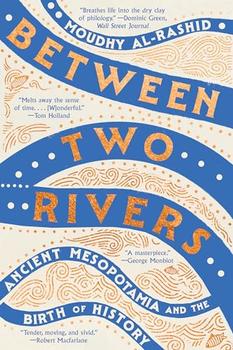
Ancient Mesopotamia and the Birth of History
by Moudhy Al-Rashid Book Reviewed by:
Finkel told us how he had essentially completed a clay puzzle and fixed together a fragmented part of this object to help reveal an ancient bird's-eye-view map of Babylonia and Assyria, empires that were criss-crossed by the Tigris and Euphrates rivers and encircled with a sea (the circle), surrounded by eight mythical regions (the triangles). This map, I later realised, told a long and ongoing story that begins with its maker in ancient Mesopotamia and finds new life millennia later with Hormuzd Rassam, the Mosul-born archaeologist who dug it up in 1881. The map's history eventually became intertwined with the bearded British curator standing before me, who helped piece parts of it back together. Its story and the story of Babylon get retold in every new interpretation of the schematic map of the ancient city (and there have been many interpretations).6 Indeed, every object we looked at that day told such a tale, traceable from its inception in the ancient world to the moment it landed in a museum, whether abroad or closer to its original home.
Among the other artefacts I saw that summer morning – and have revisited since – was a foot-long clay barrel covered in neat cuneiform handwriting. Tucked in a crowded display case, that barrel-shaped clay 'document' records the rebuilding of the stepped pyramid at Ur by King Nabonidus, the last independent Babylonian king and father of the same princess who had lived in the palace where that mysterious collection of objects was found jumbled together in the 1920s. When I first saw the clay barrel that day, 3,000 miles from its original home, I did not know I would one day try to tell the story of the mismatched objects from that princess's palace at Ur, and, through them, a history of ancient Mesopotamia. I did, however, know that after just a few hours, I had fallen for cuneiform and was ready to sack off law school to read clay tablets for the rest of my life.
As well as the earliest known writing system, ancient Mesopotamia saw the birth of the world's first cities, the first historical records, some of the first large-scale agriculture and much else that went on to revolutionise societies around the world. The objects found in the princess's palace give us a unique lens onto this all-important region in human history. Each item from the mysterious collection reveals an aspect of society and culture, from early warfare to women's rights, and from the basics of early language to the foundations of science through complex communication with the gods. In each of the chapters that follow I will take one object from the collection as a way into a particular aspect of the region's history. This range of objects, each from a different era, will introduce the history of ancient Mesopotamia, and how its people understood their own history, allowing us to reflect on how we understand our own.
The idea of the museum and its place in Ur's history deserves some reflection, and Chapter 1 takes us through this ancient setting and its modern interpretation. The small clay cylinder, or 'clay drum', seen by the excavators as the world's first museum label dated to the 600s BCE, actually describes another object: a mud brick dated to 2100 BCE from the era of King Amar-Suen. This 'label' reproduces the extremely ancient inscription – ancient even to the clay cylinder's creator – that would have been stamped into the brick, although the brick itself was nowhere to be found in the collection. In Chapter 2, studying the supposed museum label and the long-dead language it reproduced introduces us to cuneiform as a writing system, to the languages cuneiform was used to write, and to the birth of written history. In Chapter 3, considering Amar-Suen's (now missing) brick itself takes us into the architecture of Mesopotamia's cities, the literal building blocks of social and political innovation and the symbolic power behind the humble brick. In Chapter 4, the remains of the statue of an ancient king provoke questions about the nature of leadership, both real and legendary. The school tablets found scattered throughout the palace will open a window onto education and the anxieties of student life in Chapter 5. Through the clay cone in Chapter 6, we explore how people communicated with divine forces and how they received messages from the gods in return – a constant dialogue that allowed people to build knowledge and lay the foundations of science. In examining the engraved stone obelisk in Chapter 7, we see that there's nothing new about the complex economic interplay of people, property, and profit. There, we bear witness to stories on each end of the socio-economic spectrum, from a royal crony who receives land from the king to a mother who fights for her enslaved children's freedom. In Chapter 8, the plain granite mace head that might have been older than everything else found in the princess's palace has much to tell us about violence, warfare, and death, and how people memorialised and made sense of conflict.
Excerpted from Between Two Rivers by Moudhy Al-Rashid. Copyright © 2025 by Moudhy Al-Rashid. Excerpted by permission of W.W. Norton & Company. All rights reserved. No part of this excerpt may be reproduced or reprinted without permission in writing from the publisher.

L.A. Women by Ella Berman
Two ambitious writers in 1960s LA face betrayal when one writes a novel based on the other's life.






Your guide toexceptional books
BookBrowse seeks out and recommends the best in contemporary fiction and nonfiction—books that not only engage and entertain but also deepen our understanding of ourselves and the world around us.


