
-
Your next favorite book
is waiting.
Summary | Excerpt | Reviews | Beyond the Book | Readalikes | Genres & Themes | Author Bio
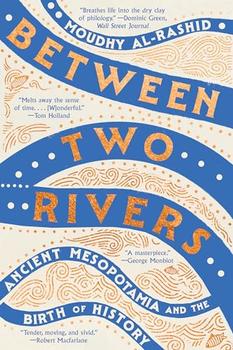
Ancient Mesopotamia and the Birth of History
by Moudhy Al-Rashid Book Reviewed by:
A broken chunk of clay preserves part of a story about Babylonian students sitting an exam at school around the same time the princess's palace was built in Ur. I can imagine them squirming on their wooden benches with wet tablets and reed styluses in hand. Even thousands of years later, it is hard not to relate to their stress. 'Do not constantly be afraid, do not let your throat tighten,' their teacher advises. 'Your mouth should not be full of complaints, your attention should not be directed toward the door.'5 Moments like these forever live in the little wedges pressed into clay that historians piece together to let the people of ancient Mesopotamia speak. The past may be a foreign country, but these moments don't feel far away. They don't feel like they belong to strangers.
Cuneiform is a reminder that if I can find something in common with someone who lived well over 2,000 years ago, then I can certainly find something in common with almost anyone alive today. Cuneiform is a reminder of all the big and little things that go into our shared humanity. We are more than the sum of our differences.
The earliest cuneiform tablets come from the city of Uruk, not far from Ur, and were written in roughly 3350 BCE, around the time that Stonehenge might have been built and seven centuries before the great Pyramid at Giza. At the other end of the scale, the most recent cuneiform tablet that we know of is an astronomical almanac from 79–80 CE, also found in Uruk. This sweeping span of time also gives a sense of the huge scale of history we're talking about when we consider Mesopotamia. Thanks to the durable nature of clay, hundreds upon hundreds of thousands of such tablets, covered in the tiny tetrahedrons that make up cuneiform script, have survived the millennia that separate their ancient makers from their modern readers. However, those modern readers have to do a lot of work to make sense of the stories left behind. We have to reconstruct the history of ancient Mesopotamia from eroded fragments scattered throughout multiple museums and collections. Even for those broken bits of clay that do fit together to tell something of a coherent story, large gaps remain, and countless more tablets lie beneath the unexcavated mounds of modern Iraq and Syria. It's like assembling a multi-million-piece puzzle with missing parts and no final image to work from.
Most of these tablets, broken or not, would fit comfortably in the palm of your hand, but some are as small as a thumb and others as large as a laptop. If you look closely enough – I mean, really closely – you can see the parallel grooves of a sharpened reed stylus pushed into the clay to make the impressed wedge of any cuneiform sign. Although sometimes compared to the footprints of a chicken, I think the script's geometry is beautiful and the myriad stories it tells us of those who lived and died along the banks of the Tigris and Euphrates thousands of years ago even more so.
I first learned about cuneiform as an awkward pre-teen in a history class at my elementary school in Saudi Arabia, and just over a decade later it re-entered my life quite by chance. I was in the process of applying to law schools when, on a whim, I attended a week-long course on ancient books in London. My little brother and I had to stop in London anyway en route home to the Middle East from America's East Coast, where we both lived at the time. We decided to turn our day-long layover in London into a week, so, like any normal twenty-something, I randomly signed up to an intensive course called 'The Book in the Ancient World', not expecting it to change my life.
On the first day an energetic man in a purple corduroy suit with a white beard down to his chest walked us through two rooms at the British Museum. His name was Irving Finkel, and he tapped his fingertip alarmingly hard on one glass display case in particular to point out a clay tablet that was about the size of his hand. On the little lump of dried clay was a drawing that looked to me like a circle with a bunch of triangles sticking out of it, interrupted here and there by brief lines of tiny triangle-shaped characters.
Excerpted from Between Two Rivers by Moudhy Al-Rashid. Copyright © 2025 by Moudhy Al-Rashid. Excerpted by permission of W.W. Norton & Company. All rights reserved. No part of this excerpt may be reproduced or reprinted without permission in writing from the publisher.
Theo of Golden by Allen Levi
One spring morning, a stranger arrives in the small southern city of Golden. No one knows where he has come from…or why…






Your guide toexceptional books
BookBrowse seeks out and recommends the best in contemporary fiction and nonfiction—books that not only engage and entertain but also deepen our understanding of ourselves and the world around us.


