
-
Your next favorite book
is waiting.
Summary | Excerpt | Reviews | Beyond the Book | Readalikes | Genres & Themes | Author Bio
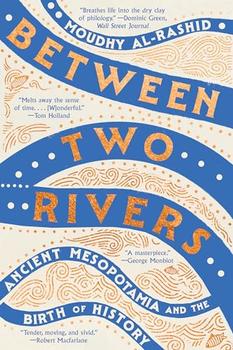
Ancient Mesopotamia and the Birth of History
by Moudhy Al-Rashid Book Reviewed by:
Someone recently asked me why people today should care about ancient Mesopotamia, and my brain did this helpful thing that it does when too many thoughts crowd together at once. It froze. Why should we care about the region that gave us some of the world's firsts, like writing and the wheel?
For thousands of years, the civilisations of ancient Mesopotamia shared the world's earliest known writing system, cuneiform, which gets its name in English from the Latin cuneus, meaning 'wedge', for its wedge-shaped characters. It's thanks to this early writing system that we know so much about the people who lived and died in this part of the world, and its inception marks a turning point in human history. Before cuneiform begins to preserve moments in the lives of people in ancient Mesopotamia, people left behind a multitude of things to give us insights into their lives and values. From the tiniest stone tools and fragments of pottery to megaliths that may have once formed the world's first temples, we can learn a lot about the inhabitants of the distant past. Writing overlays a whole new dimension onto what we can learn about them in their own words. It marks the beginning of written history, the transition from what has sometimes been called 'prehistory', a dated term for periods that pre-date writing, and the beginning of 'history', the point at which things begin to be written down.
To some, cuneiform marks the birth of 'history' understood in this way. Personally, I think that anything that came before us is history, written or not, but cuneiform does mark a birth of history in one important sense. Writing allowed the people of ancient Mesopotamia to begin to record their own past, to put into words a collective memory of people, places, and events. They made lists of their kings, including kings so ancient they live on only in legend, and they memorialised their wars. They left behind the first rough drafts of economic history in their unremarkable receipts, as well as self-conscious accounts of their deeds for posterity. Writing gives birth to a written record of their past, which even expands to include eras so ancient to them that no memory of them survives – a primeval past populated by deities and an earlier iteration of humanity, a Mesopotamian 'prehistory' of life between the two rivers. In this sense, the birth of cuneiform is also the birth of history.
Cuneiform preserves almost all aspects of life in ancient Mesopotamia. This wedge-shaped writing preserves historical turning points, such as some of the earliest known diplomatic correspondence (which included the famous boy-king Tutankhamun) and the death of Alexander the Great. Alongside these turning points appear traces of people's everyday lives, like advanced maths, tax evasion, a bickering couple, a midwife's presence at the birth of a baby boy, and a rollercoaster ride of a horoscope for a child born in April 263 BCE.3 We can read a princess's letter to her sister-in-law telling her to do her homework, or an astronomical textbook that records observations of lunar eclipses, or a lapis lazuli cylinder that immortalises the name of a Sumerian queen, as well as countless receipts for beer. This random list barely scratches an obscure square inch of the top of a sizeable iceberg. It actually beggars belief just how much we can learn about the people of ancient Mesopotamia.
From the stories and snapshots left behind in clay, we know that these ancient people were not so different from any of us. A beautiful Babylonian lullaby finds a parent desperate to comfort a crying baby:
Little one, who dwelled in darkness,
now you've come and seen the sun.
Why the crying? Why the worries?
What has made your peace undone?4
Excerpted from Between Two Rivers by Moudhy Al-Rashid. Copyright © 2025 by Moudhy Al-Rashid. Excerpted by permission of W.W. Norton & Company. All rights reserved. No part of this excerpt may be reproduced or reprinted without permission in writing from the publisher.
L.A. Women by Ella Berman
Two ambitious writers in 1960s LA face betrayal when one writes a novel based on the other's life.






Your guide toexceptional books
BookBrowse seeks out and recommends the best in contemporary fiction and nonfiction—books that not only engage and entertain but also deepen our understanding of ourselves and the world around us.


