
-
Your next favorite book
is waiting.
Summary | Excerpt | Reviews | Beyond the Book | Readalikes | Genres & Themes | Author Bio

A Novel
by Charlotte Runcie Book Reviewed by:
His mother bought a theatre programme in the foyer. The booklet was bigger than any of his reading books at home and filled with shiny black-and-white pictures of the actors in rehearsals, somersaulting and gesticulating and laughing with scripts in their hands. His thumb found a page with more weight than the others, and here was a sheet of penguin and snowflake stickers, opposite a puzzle section with a themed wordsearch about Antarctica.
The theatre was full of children just like him, except not like him, because they didn't have his mother. Alex and Judith sat in a row towards the front of the stalls on the scarlet fold-out seats. Using the fountain pen, he had just circled the words COLD and SOUTH POLE and PENGUINS in the wordsearch when the house lights went down, like the blowing out of a candle.
His mother smelled like a shimmer of flower petals and slightly of whisky. She squeezed his hand and he squeezed hers. The cur¬tain drew back, and the stage lights came up, and there were people up there, real grown-ups, confident and loud and alive, with snow falling on the stage as they pretended to be anything other than who or what they really were. There was nothing between him and the actors. They could touch him if they wanted, and he would let them. All they wanted in return was his applause. This meant they wanted his love. (It was only much later that he would realise he had the power to keep his love from them.)
He didn't remember much about the show itself, as an adult. He only remembered, as he told me when everything was falling apart, the moment when his mother's world became his world, too. The fear and wonder of it. He remembered the applause, and how it connected the audience and the performers in a sacred pact of pleasure. He remembered it every time he reviewed a show.
* * *
When I first made the connection between Alex's surname and his mother's, I wondered why Alex hadn't turned out to be the¬atrical in the way his mother was. In choosing to be a critic, he'd chosen to be an outsider, half in showbusiness and half out of it. And I wondered if there was, within him, a spark of resentment at a world that he knew to be less magical than it looked. But which still, despite everything, bewitched him.
Dame Judith is now in her seventies and, as it said in the BBC news article when she received her damehood, she is one of this country's finest living interpreters of Shakespeare. She was a single mother, and Alex, who was an only child, grew up in a house full of stars: his mother's famous and semi-famous lovers and friends drifting in and out of his life. His mother's world was self-consciously artistic and outsiderish, he told me, a place where you were free to speak on anything as long as it was entertaining. His mother and her friends had money, but they weren't business¬people. They set themselves morally apart from people who made a living in conventional, corporate ways. His mother used to say they were like nineteenth-century opera singers, who'd been born in the gutter and risen to dine with kings.
I liked Alex. As hard as that is to admit now, back then, I couldn't help liking him. And if that sounds defensive, there are good reasons. But something drew me towards him with a quiet, addictive dread.
* * *
Alex cut across town. He had to wait to cross the road, and he used that time to check one of the dating apps he'd been on since he'd got to Edinburgh. The apps always exploded during the festival. So many unmoored, excitable and creative people all in one place. He scrolled through some pictures, deciding who he'd message when he got back. The lights changed. Because he was hungry, he changed direction towards the Traverse theatre bar, which might still be serving food, and kept walking.
The subterranean Traverse bar, near the flat in Edinburgh that the paper had paid for Alex and me to stay in, was still open, but half-empty. It held the resonance of a place that had recently been packed full of people who'd just now moved on elsewhere, to some other bar, some other show, a bed that wasn't their own. He ordered a Guinness and a steak pie from a boy in a branded shirt who looked about fifteen, and the boy said sorry, but they'd stopped doing food half an hour ago.
Excerpted from Bring the House Down: A Novel by Charlotte Runcie. Reprinted by permission of Doubleday, an imprint of the Knopf Doubleday Publishing Group, a division of Penguin Random House LLC. Copyright © 2025 by Charlotte Runcie.
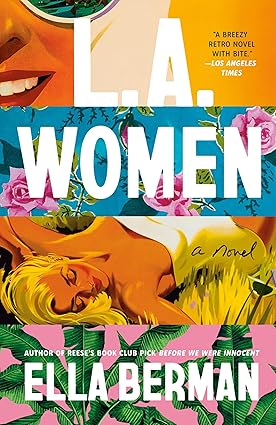
L.A. Women by Ella Berman
Two ambitious writers in 1960s LA face betrayal when one writes a novel based on the other's life.






Your guide toexceptional books
BookBrowse seeks out and recommends the best in contemporary fiction and nonfiction—books that not only engage and entertain but also deepen our understanding of ourselves and the world around us.


