
-
Your next favorite book
is waiting.
Summary | Excerpt | Reviews | Beyond the Book | Readalikes | Genres & Themes | Author Bio

A Novel
by Charlotte Runcie Book Reviewed by:
"Ignore Paul. Start with this bit. This observation about the city, where it's like a character. It's kind of beautiful. Move it up top so you start with colour, then get the nut graf out of the way, and shove everything else after that and give it to a different editor to sign off. Relax, it's a nice piece."
He sauntered off for a cigarette. Praise is rare in journalism. That was still the only time anyone at the paper had ever directly complimented my writing.
* * *
Alex told me not to take journalism so seriously, but I was never sure whether he took that advice himself. And this is the third thing to know about Alex. He loved writing about theatre. Theatre really mattered to him.
Theatre, Alex once told me when I made the mistake of say¬ing I wasn't all that into it, because exhibitions were more my kind of thing, is different from any other form of art. It isn't like a film or a TV show where everything's been recorded and cut and edited, and someone has already seen it before you. It's nothing like a painting, which is a single, preserved moment of perspective. Theatre is happening to you right now, made real by the people in front of you, never seen before, not quite like this, and never again. Stage performance is the only storytelling art form created in the present tense, Alex said. These people could do anything. They could make you feel anything. Isn't that wonderful? Isn't that terrifying?
As with everything we love, Alex experienced it first as a child. It was a children's show about penguins, which his mother, the actress and director Judith Lyons, had taken him to when he was six years old. She knew it was on because at the time she was casually seeing the artistic director of the theatre in Hammersmith where it was playing. Here, Alex was baptised into the rituals of theatre, which, like the rituals of any religion, are designed to seduce.
There was, before the night even began, the ritual of the ticket. For Alex, this was a paper key to a door that he had longed to open, and which led to the place that was, he suspected, where his mother really lived. The ticket was a promise that he would be welcome at this theatre, at this time, and there would be a seat prepared for him, and light in the darkness.
(As an adult, Alex could do a good rant on the death of the paper ticket stub in the age of the e-ticket. He really got going on it over Friday drinks in the dark, wood-panelled pub round the corner from our paper's newsroom, eyes shining in the gloom, holding a pint of oyster stout, on and on about how something has been surrendered, and we've now lost forever the printed remains of a time past, a time when magic left real traces in your pocket.)
Alex, at six years old, had arrived at the box office, which was not an office and had no boxes, and was greeted by a front-of-house assistant in a golden waistcoat. She ripped off the perforated ticket stub and bent to stamp his outstretched hand with an inky purple blotch in the shape of a penguin.
This was before his mother had received her damehood. But even then, she was conspicuous, with a fur-trimmed jacket and high leather boots and a familiar face. She enunciated more than other people. She bought him a striped packet of red and green sweets. The sweets were sour inside but coated in crystals of sugar, to be eaten quietly and not rustled. She was approached by two politely giddy women in the foyer and indulged an autograph request with the fountain pen she carried in her handbag.
"You'll have to excuse me." She drew the "J" in "Judith" with a long tail and dotted the "i" with a horizontal line. "I'm here with my son."
This made Alex feel special and important. The whole inte¬rior of the building was velvet, from the carpet to the seats to the curtains to the new texture of his own body in this strange place, and everything was deep red and gold, arched and designed for his delight.
Excerpted from Bring the House Down: A Novel by Charlotte Runcie. Reprinted by permission of Doubleday, an imprint of the Knopf Doubleday Publishing Group, a division of Penguin Random House LLC. Copyright © 2025 by Charlotte Runcie.
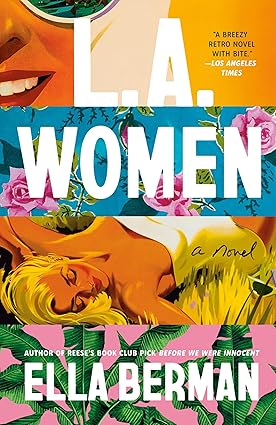
L.A. Women by Ella Berman
Two ambitious writers in 1960s LA face betrayal when one writes a novel based on the other's life.

Your guide toexceptional books
BookBrowse seeks out and recommends the best in contemporary fiction and nonfiction—books that not only engage and entertain but also deepen our understanding of ourselves and the world around us.


