
-
Your next favorite book
is waiting.
Summary | Excerpt | Reviews | Beyond the book | Read-Alikes | Genres & Themes | Author Bio

A Novel
by Charlotte Runcie Book Reviewed by:
Charlotte Runcie's debut, Bring the House Down, is one of those novels that starts off as one thing and then evolves into something else entirely, leaving the reader to feel both slightly off-kilter (in a good way) and constantly wondering where it will zig or zag next.
It begins with a fairly straightforward—if cringe-inducing—premise. Two colleagues from an unnamed British paper ("I can't give you the name of the newspaper, but let's just say it's considered by some people to be the last remaining newspaper of decency, and by other people to be a rag of unforgivable bias") have been assigned to spend the month of August in Scotland, covering the Edinburgh Festival Fringe. Sophie primarily reviews visual art exhibitions, while her colleague Alex has gained quite the reputation for his acerbically written, hypercritical theater reviews. It's rare that he finds a performance praiseworthy—more often, he seems to find a sort of delight in skewering anything that falls short of perfection.
So it's no great shock that Alex—upon seeing a debut play entitled Climate Emergence-She—quickly dashes off a one-star review of the "tedious and derivative" one-woman show by a young American playwright, Hayley Sinclair. What does surprise Sophie, however, is when she wakes up the next morning at the company-procured flat she's sharing with Alex and discovers that the very same Hayley Sinclair has apparently spent the night with Alex, blissfully unaware (until the paper hits newsstands in a few hours, at least) that her one-night stand has publicly skewered her work.
Once Hayley discovers Alex's ethically questionable behavior, however, she doesn't just take the humiliation lying down. Instead, she reinvents her show as The Alex Lyons Experience, in which she stages a dramatic reading of Alex's brutal review accompanied by her account of his unprofessional, callous behavior, followed by burning the paper on stage. Hayley's new show takes on a life of its own, bringing countless other women's stories about horrible male behavior—and about Alex's horrible behavior specifically—out into the open in a piece that becomes part therapy session, part catharsis.
So that's the setup, but where Bring the House Down takes an interesting turn is that as the story progresses, it becomes in many ways less about the psychodrama between Alex and Hayley and more about the novel's narrator, Sophie. She's often struggled with feelings of inferiority—she still grinds out obituaries to make ends meet, and she knows her own reviews of gallery shows are never going to get the kind of attention Alex's theater reviews do. What's more, she's experiencing a jumbled stew of emotions on this work trip, which is the first time she's spent away from her young child. Being back in Edinburgh, where she lived for a while after college, elicits a sense of freedom and nostalgia, as does the mixed pleasure of attending terrible industry parties without having to find a babysitter. And—when seemingly all of Edinburgh, and the culture industry at large, starts to turn on Alex—Sophie indulges a sort of pleasure in being Alex's sole confidante, finding ways to believe and forgive him long after he's become a pariah everywhere else.
Sophie's first-person narration puts readers inside the mental origami she folds in order to justify Alex's behavior and her own complicity in continuing to befriend him, even after ever more damning stories come to light. What's remarkable is that Runcie manages to keep Sophie a predominantly sympathetic character, despite her self-delusions and, at times, ethically questionable behavior. This is largely because of the ways in which Runcie gradually reveals the personal history and circumstances that have shaped who Sophie is and how she relates to others.
Runcie, who did her own time in the trenches writing reviews of Edinburgh Fringe productions, writes credibly about this world, and reflects thoughtfully about what, if anything, a critic owes to creators and to readers. Most remarkable, however, is the painstaking way in which Runcie slyly carves a quiet character study out of a chaotic premise, compelling readers to pay attention.
 This review
first ran in the August 13, 2025
issue of BookBrowse Recommends.
This review
first ran in the August 13, 2025
issue of BookBrowse Recommends.

If you liked Bring the House Down, try these:

by Mischa Berlinski
Published 2026
An exuberant, darkly humorous novel by the National Book Award–nominated author of Fieldwork.
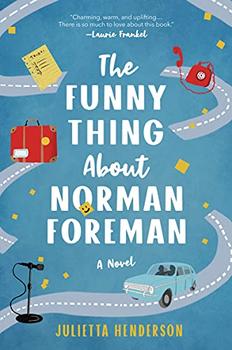
The Funny Thing About Norman Foreman
by Julietta Henderson
Published 2022
Julietta Henderson's delightfully charming, tender and uplifting debut takes us on a road trip with a mother and son who will live in the reader's heart for a long time to come, and teaches us that--no matter the odds--we must always reach for the stars.

by Susan Choi
Published 2020
Pulitzer finalist Susan Choi's multi-part, narrative-upending novel.

L.A. Women by Ella Berman
Two ambitious writers in 1960s LA face betrayal when one writes a novel based on the other's life.






Your guide toexceptional books
BookBrowse seeks out and recommends the best in contemporary fiction and nonfiction—books that not only engage and entertain but also deepen our understanding of ourselves and the world around us.

