
-
Your next favorite book
is waiting.
Summary | Excerpt | Reviews | Beyond the Book | Readalikes | Genres & Themes | Author Bio

A Novel
by Charlotte Runcie Book Reviewed by:
WEEK ZERO
Saturday, 29 July
Alex Lyons opened his laptop and wrote the review in the space of forty-five minutes after the show ended. It was a one-star review. He didn't agonise over that rating—I'd never seen him agonise over anything. The solo performance art¬ist, Hayley Sinclair, had a lot to say about the climate emergency, the patriarchy, and the looming end of the world, which was fair enough, but unfortunately her show was so terrible that, by half an hour in, Alex had decided that he actually wanted the world to end as soon as possible. Then, at least, he'd never have to risk seeing one of her performances again. That was a good line, so he put it in. He wrote hunched on a low wall outside the venue, thinking about where he could get a drink afterwards.
Alex was chief theatre critic for the national newspaper where I was a junior writer on the culture desk. We'd both worked at the paper for years, but that year, for the first time, Alex and I were both away from London, reporting from the month-long arts festival of the Edinburgh Fringe.
I can't give you the name of the newspaper, but let's just say it's considered by some people to be the last remaining newspaper of decency, and by other people to be a rag of unforgivable bias. I'll just call it "the paper"—that's what everyone who worked there called it anyway.
Alex proofread his review and found no errors, so he emailed it to the editor on duty with the star rating at the top in capital letters, for clarity—ONE STAR—and packed his laptop back into his chestnut Italian leather satchel, a birthday present from his mother. He lit a cigarette and walked down Rose Street, which was full of stag dos shouting in vowels and vomiting into the gut¬ters between the cobblestones.
Edinburgh was a city that Alex knew only in August. I know it a little better, having lived there for a while after university. I've seen it stripped back to its gorgeous Enlightenment bones of dark wet stone tenements in the quiet, endless winters, the yeasty smells of the brewery on still nights, the sea mist over Holyrood, the glass-fronted hotels for the rich rising above lines of addicts queu¬ing for methadone on Leith Walk.
For Alex, like most annual festival visitors, Edinburgh was not a real place, but a mirage, a pop-up of banners and posters, cof¬fee vans and burger vans and street performers, the spats of frying meat and the dank smell of lager.
It was gone eleven and the streets were still full. A rat matched his pace along North Bridge, hunting in the night's street rubbish that spilled across the pavement. Suits, who were either TV jour¬nalists or disgraced politicians, strode home from a late broadcast at the BBC studios with their jackets flapping open. Audiences were coming out of theatres.
All this had a glamour for Alex. As he walked, meandering through the streets to absorb the festival air, the city brought him peace after the bad show, and if he doubted his opinion or sus¬pected himself of cruelty, for even a moment, he could rationalise his work as all part of contributing to the culture, to maintaining high standards, and to being in a city full of people chasing their next pleasure. A city situated towards delight, not mediocrity. A place where people wanted only the best of life and it made them honest and free.
It seemed as though everywhere on the Royal Mile, under the clear summer moon in the never-quite-darkness of the Scot¬tish summer night, were actors and actresses coming out of their shows. This gave Alex a jolt of energy. He was always drawn to actresses. All theatre people, with their superficial vanity and deep insecurity, were easy to flatter. But actresses, in particular, offered him something deeper that he couldn't always define. This unset¬tled him in a way that he liked. Actors and actresses had something about them that normal humans lacked. They had large, expressive eyes. They could sing, usually. They had a warmth that made Alex want to reach out his own cold hands towards them. They held, always, the energy of potential transformation. By knowing how to become other people, they knew the terrible truth of what it's like to taste the life of someone else.
* * *
When I first started working in culture journalism, I used to get asked to do a lot of clickbait listicles for the website that nobody else wanted to write—"13 things you never knew about Picasso," and all that. It became a bit of a speciality of mine. So: there are
Excerpted from Bring the House Down: A Novel by Charlotte Runcie. Reprinted by permission of Doubleday, an imprint of the Knopf Doubleday Publishing Group, a division of Penguin Random House LLC. Copyright © 2025 by Charlotte Runcie.
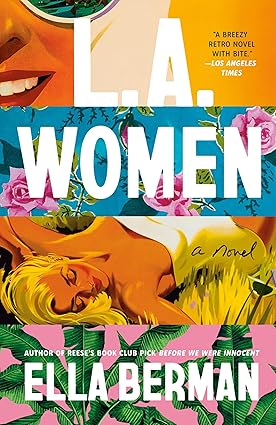
L.A. Women by Ella Berman
Two ambitious writers in 1960s LA face betrayal when one writes a novel based on the other's life.






Your guide toexceptional books
BookBrowse seeks out and recommends the best in contemporary fiction and nonfiction—books that not only engage and entertain but also deepen our understanding of ourselves and the world around us.


