
-
Your next favorite book
is waiting.
Summary | Excerpt | Reading Guide | Reviews | Beyond the Book | Readalikes | Genres & Themes | Author Bio
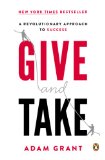
A Revolutionary Approach to Success
by Adam M. Grant Book Reviewed by:
Shader did just that: he spent the next few weeks pitching his idea to other investors. In the meantime, Hornik wanted to make sure he was still a strong contender, so he sent Shader his most valuable resource: a list of forty references who could attest to Hornik's caliber as an investor. Hornik knew that entrepreneurs look for the same attributes in investors that we all seek in financial advisers: competence and trustworthiness. When entrepreneurs sign with an investor, the investor joins their board of directors and provides expert advice. Hornik's list of references reflected the blood, sweat, and tears that he had devoted to entrepreneurs over the course of more than a decade in the venture business. He knew they would vouch for his skill and his character.
A few weeks later, Hornik's phone rang. It was Shader, ready to announce his decision.
"I'm sorry," Shader said, "but I'm signing with another investor." The financial terms of the offer from Hornik and the other investor were virtually identical, so Hornik's list of forty references should have given him an advantage. And after speaking with the references, it was clear to Shader that Hornik was a great guy.
But it was this very same spirit of generosity that doomed Hornik's case. Shader worried that Hornik would spend more time encouraging him than challenging him. Hornik might not be tough enough to help Shader start a successful business, and the other investor had a reputation for being a brilliant adviser who questioned and pushed entrepreneurs. Shader walked away thinking, "I should probably add somebody to the board who will challenge me more. Hornik is so affable that I don't know what he'll be like in the boardroom." When he called Hornik, he explained, "My heart said to go with you, but my head said to go with them. I decided to go with my head instead of my heart."
Hornik was devastated, and he began to second-guess himself. "Am I a dope? If I had applied pressure to take the term sheet, maybe he would have taken it. But I've spent a decade building my reputation so this wouldn't happen. How did this happen?"
David Hornik learned his lesson the hard way: good guys finish last.
Or do they?
According to conventional wisdom, highly successful people have three things in common: motivation, ability, and opportunity. If we want to succeed, we need a combination of hard work, talent, and luck. The story of Danny Shader and David Hornik highlights a fourth ingredient, one that's critical but often neglected: success depends heavily on how we approach our interactions with other people. Every time we interact with another person at work, we have a choice to make: do we try to claim as much value as we can, or contribute value without worrying about what we receive in return?
As an organizational psychologist and Wharton professor, I've dedicated more than ten years of my professional life to studying these choices at organizations ranging from Google to the U.S. Air Force, and it turns out that they have staggering consequences for success. Over the past three decades, in a series of groundbreaking studies, social scientists have discovered that people differ dramatically in their preferences for reciprocity— their desired mix of taking and giving. To shed some light on these preferences, let me introduce you to two kinds of people who fall at opposite ends of the reciprocity spectrum at work. I call them takers and givers. Takers have a distinctive signature: they like to get more than they give.
They tilt reciprocity in their own favor, putting their own interests ahead of others' needs. Takers believe that the world is a competitive, dog-eat-dog place. They feel that to succeed, they need to be better than others. To prove their competence, they self-promote and make sure they get plenty of credit for their efforts. Garden-variety takers aren't cruel or cutthroat; they're just cautious and self-protective. "If I don't look out for myself first," takers think, "no one will." Had David Hornik been more of a taker, he would have given Danny Shader a deadline, putting his goal of landing the investment ahead of Shader's desire for a flexible timeline.
Excerpted from Give and Take by Adam M Grant. Copyright © 2013 by Adam M Grant. Excerpted by permission of Viking. All rights reserved. No part of this excerpt may be reproduced or reprinted without permission in writing from the publisher.

L.A. Women by Ella Berman
Two ambitious writers in 1960s LA face betrayal when one writes a novel based on the other's life.






Your guide toexceptional books
BookBrowse seeks out and recommends the best in contemporary fiction and nonfiction—books that not only engage and entertain but also deepen our understanding of ourselves and the world around us.


