
-
Your next favorite book
is waiting.
Summary | Excerpt | Reading Guide | Reviews | Beyond the Book | Read-Alikes | Genres & Themes | Author Bio

 Book Reviewed by:
This article relates to House of Leaves

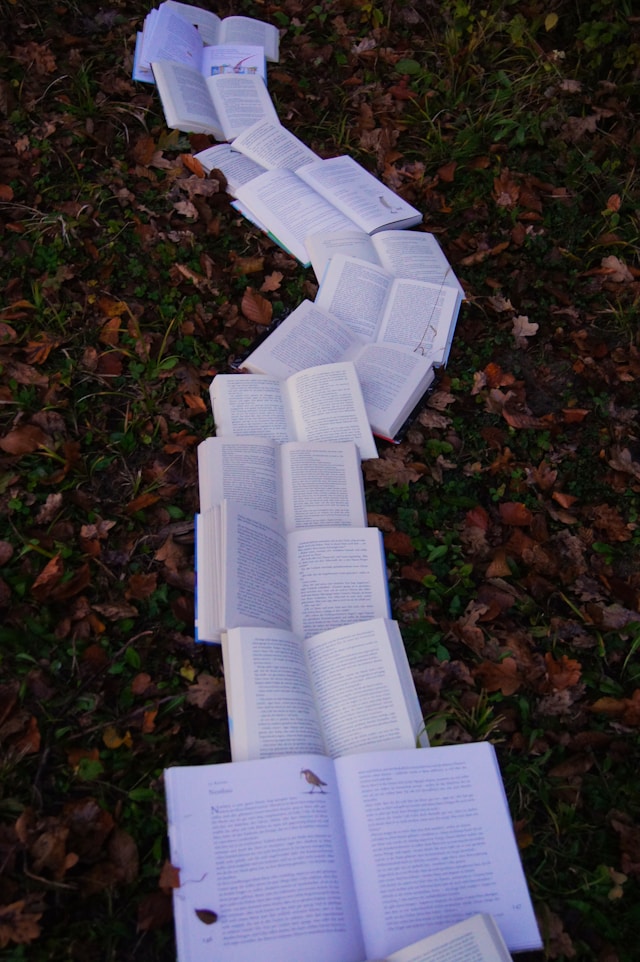 Ergodic literature is defined as fiction where "nontrivial effort is required to allow the reader to traverse the text." Derived from the Greek words ergon ("work") and hodos ("path"), it's a relatively new literary term, coined by Espen J. Aarseth in his 1997 book Cybertext: Perspectives on Ergodic Literature. Mark Z. Danielewski's novel House of Leaves has been frequently cited as a prime example of ergodic literature because of its complex and unusual formatting.
One's first experience with the nonlinear nature of House of Leaves is a physical interruption of the normal reading process. Most books are read sequentially (page one leads to page two which leads to page three and so on). This novel departs from that expectation almost immediately as readers encounter copious footnotes. Some of these are one-sentence references to works the book's fictional author Zampanò is quoting, and these interrupt the narrative flow briefly as one's eyes drop to the bottom of the page to read the citation and then jump back up to the main text. Even more disruptive, though, are the annotations made by the fictional editor Johnny Truant, which form an important subplot, and some of which go on for several pages. Readers are forced to make a conscious choice: does one interrupt the primary story to follow Truant's musings and then flip back to pick up where they left off, or, alternatively, ignore Truant's notes, continue with the main narrative, and return to the skipped section later? Either way, the result is a physical act of turning pages back and forth to get the whole story, because the plotlines aren't integrated.
Danielewski also accomplishes this physical disruption by alluding to exhibits and appendices, prompting readers to turn to the back of the book to view the material. In one footnote, for example, an unnamed editor writes:
"78 Though Mr. Truant's asides may often seem impenetrable, they are not without rhyme or reason. The reader who wishes to interpret Mr. Truant on his or her own may disregard this note. Those, however, who feel they would profit from a better understanding of his past may wish to proceed ahead and read…those letters written by his institutionalized mother in Appendix II-E."
The section referenced comprises more than 50 pages, and again, it's left to the reader when—or whether—to read it.
In short, reading the book might involve perusing two pages of the main story, then becoming involved with five pages of a footnote/subplot, then turning back to continue the first narrative, then skipping to the end to view an appendix, then returning many pages later to the primary story, and so on. This physical effort—something one wouldn't normally encounter when reading—is one feature that lands the book in the ergodic genre.
The way the words are placed on the page in House of Leaves is also a large part of the reading experience. This departure from the standard paragraph layout is considered ergodic because we're trained to read text formatted in a specific way; here, we're presented with something outside the norm. The placement is surprising and unexpected, and therefore more challenging—a little stutter-step introduced in the normal narrative flow. At one point, a character has journeyed through a dark tunnel marked by a series of doors when he hears noises behind him:
all those doors
behind
the man
are slamming shut,
one
after
another
after
another
Each of these lines is on a separate page, prompting the reader to turn them rapidly, thereby heightening the tension. This format creates a resonance that evokes the slamming of the doors—an effect that would be lost if the words had been written in a linear sentence.
In the section noted above, each word or phrase is located lower on the ensuing page than the previous one, which subtly heightens readers' anxiety. Later, a character is crawling through a shrinking tunnel and the narrative describing the experience is laid out in smaller and smaller squares, evoking a claustrophobic feeling. Elsewhere, in a section describing his ascending a ladder, the text must be read from bottom to top, two lines at a time, illustrating the climb:
[etc.]
gulp of water or
stops to take a
with only brief
of climbing,
hours and hours
after presumably
the ladder. But
[He] pulls himself up
At times the book must be rotated to be read. Scattered throughout are pages of braille, lines of music, color-coded text, various typefaces, quotes in multiple languages, and passages that are X'd out and consequently illegible. Some sections, supposedly damaged by something that burned holes in the manuscript, are missing the odd word, while other pages are missing entirely. Again, each of these elements adds a hurdle the reader must overcome to reach the book's conclusion—the very definition of ergodic fiction.
House of Leaves isn't the earliest novel to be considered ergodic literature; Vladimir Nabokov's 1962 Pale Fire is often referenced as a previous example. Nevertheless, it is, perhaps, one of the best illustrations of the technique. Other well-regarded representatives of the genre include Julio Cortázar's Hopscotch (1963), Italo Calvino's Invisible Cities (1972), Steven Hall's The Raw Shark Texts (2007), S. by J.J. Abrams and Doug Dorst (2013), and Alejandro Zambra's Multiple Choice (2014).
Books on ground
Photo by Laura Kapfer, via Unsplash
Filed under Books and Authors
 This article relates to House of Leaves.
It first ran in the November 5, 2025
issue of BookBrowse Recommends.
This article relates to House of Leaves.
It first ran in the November 5, 2025
issue of BookBrowse Recommends.

L.A. Women by Ella Berman
Two ambitious writers in 1960s LA face betrayal when one writes a novel based on the other's life.






Your guide toexceptional books
BookBrowse seeks out and recommends the best in contemporary fiction and nonfiction—books that not only engage and entertain but also deepen our understanding of ourselves and the world around us.

