
-
Your next favorite book
is waiting.
Summary | Excerpt | Reviews | Beyond the Book | Readalikes | Genres & Themes | Author Bio
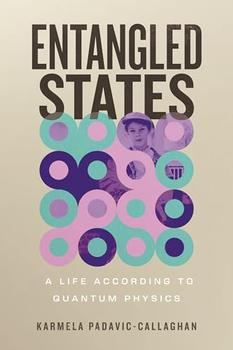
A Life According to Quantum Physics
by Karmela Padavic-Callaghan Book Reviewed by:
They focused on the fact that the arrow of time points in the direction of increasing entropy, and also toward a state of equilibrium. A warm cup of coffee cools down to equilibrate with its surroundings, but a cup at room temperature never spontaneously warms up because that would mean leaving equilibrium. This preferential movement toward equilibrium breaks the symmetry of the two possible directions of time, distinguishing forward from backward. Across several mathematical investigations, focusing on quantum objects, the team argued that what makes an object reach equilibrium is that it becomes increasingly quantum entangled with its environment.
Therefore, the arrow of time points in the direction of an increasing number of entangled objects. If the atoms comprising a coffee cup are entangled with just a few air molecules in your kitchen, you must be ob serving it at an earlier time. If they are entangled with every atom in the room, you are observing it at a later time. A similar argument may explain how humans form the idea of "now." According to this framework, we can only remember something after we become entangled with it, or with the particles of light and sound that communicate its presence to us. Physicist Seth Lloyd once summarized this by saying: "The present can be defined by the process of becoming correlated with our surroundings."
As internal as our sense of time may seem, a more esoteric idea looms large here. It takes just a little propensity for romance to read this theory as the universe imbuing each of us with a sense of time by entangling us into a constantly expanding network of connections—by smearing out the edges of our independent existence, making us inextricably connected with everything else.
This take on the arrow of time, though supported by mathematical arguments, never gained consensus among physicists. It simply joined several other theories concerning the passage of time, including those that posit that we live in a "block universe" in which everything is actually unchanging and in which the arrow of time is either a mental construct or a quantum mechanical illusion. In his 2023 book, Molecular Storms: The Physics of Stars, Cells and the Origin of Life, Liam Graham lays it out simply: "Observers—such as you or me—are collections of molecules in a far from equilibrium state. For such a state to exist the universe must be out of equilibrium. Therefore, the second law means it is tending towards equilibrium and so there must be a thermodynamic arrow of time." In other words, he centers the fact that we exist as part of the reason why we also see time moving forward. When it comes to the arrow of time, this is what the block universe theory and the quantum correlation theory share: both point the finger at the inextricable connection between people and time, which we seem to be stuck having to experience.
I think this is why I keep coming back to music as a container, or a code, for a miniature version of the cosmic arrow of time. In a mathematical sense, the arrow of time exists in music because music is a structure made from sounds and the transitions between them. As a universal reality, this doesn't have to do with me. But on a more personal level, when that arrow takes me through a familiar song, I have to confront my own passage through time and who I was when I heard that song for the first, second, third, and every other time. I can return to one of those past versions of myself, and how that person was connected to the rest of the world and their own loved ones, while also acknowledging that though the song can be rewound, my own motion toward some distant equilibrium cannot. Within a few loud minutes, time and I grapple in the most interdependent of ways, feeling out each other's soft, moldable edges. Neither of us ever really wins—we only grow more intertwined. And the process gifts me just a little more clarity on who I may be in the place where the arrow of time pushes me next.
Excerpted from Entangled States by Karmela Padavic-Callaghan. Copyright © 2026 by Karmela Padavic-Callaghan. Excerpted by permission of Beacon Press. All rights reserved. No part of this excerpt may be reproduced or reprinted without permission in writing from the publisher.

L.A. Women by Ella Berman
Two ambitious writers in 1960s LA face betrayal when one writes a novel based on the other's life.






Your guide toexceptional books
BookBrowse seeks out and recommends the best in contemporary fiction and nonfiction—books that not only engage and entertain but also deepen our understanding of ourselves and the world around us.


