
-
Your next favorite book
is waiting.
Summary | Excerpt | Reviews | Beyond the book | Read-Alikes | Genres & Themes | Author Bio
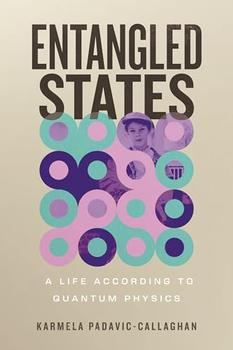
A Life According to Quantum Physics
by Karmela Padavic-Callaghan Book Reviewed by:
Entangled States: A Life According to Quantum Physics is not your typical pop-sci book. Authored by Karmela Padavic-Callaghan, a science journalist and writer who has worked with major magazines like New Scientist, it beautifully blends quantum physics with memoir. Padavic-Callaghan is a Croatian non-binary scientist who moved to the United States for their education when they were sixteen. They hold a PhD in quantum physics, and this is their debut.
Entangled States is neither fully a memoir nor a science book. Each chapter blends key concepts of physics, especially quantum mechanics, with important parts of the author's life. Padavic-Callaghan successfully draws parallels and often indirectly teaches us the lessons various experiences have taught them.
The first chapter, for example, deals with quantum computers and the quantum phenomena that make them work. It describes how they store and process information and why they can be prone to errors and data corruption. From there, Padavic-Callaghan goes on to narrate memories from their childhood, as well as those of their family during the Yugoslav wars. They conclude that our memories are also prone to corruption, since they can become fuzzy or unreliable due to intense feelings and our unconscious efforts to minimize trauma. Another scientific concept, found in multiple chapters, is the indeterminate nature of quantum physics, where exclusive categories do not really exist. The wave-particle duality (see Beyond the Book), for example, states that electrons or photons can behave both like particles and waves. Similarly, Padavic-Callaghan's life is defined by duality and multiplicity. They refuse to place themselves into a single category, be it nationality, gender, profession, or other aspects of identity, and instead embrace every side of who they are.
The book is well balanced between memoir and science, especially in the beginning. As it progresses, it starts leaning more heavily toward the author's experiences. It also indirectly touches on many societal topics, such as immigration, gender, mental health, funding in sciences, the "male-ness" of physics research, and more.
The book is split into three parts. The first deals with concepts of time, the second with space, and the last with interaction. A fresh aspect is the constant changes in style and tone. One chapter is written in the second-person singular as Padavic-Callaghan describes their struggles as a PhD student living away from their country and the difficult early Covid years. This shift raises the emotional impact on the reader. Other chapters, like one on electromagnetism, include "class assignments" to introduce physics concepts, transferring Padavic-Callaghan's passion for teaching to the reading experience. These frequent shifts in style are neither confusing nor wearisome. They work in tandem with the overall theme of fluidity and not having to be just one thing. The only structural drawback is that the book's thematic divisions mean we revisit some events multiple times, making it feel a bit repetitive.
Padavic-Callaghan has a pleasant, engaging, and easy-to-follow voice. The memoir sections are rich in emotion and approach a kind of lyricism, while the science parts remain digestible and free of jargon. Sometimes, however, they become a bit oversimplified. Key aspects of theories are left out, which may make some concepts harder to understand for readers unfamiliar with the topics discussed.
One of the greatest strengths is the writer's honesty and vulnerability as they describe the lessons their experiences have taught them through the years. This focus makes the book quasi-self-help, but without forced optimism or condescension. For me, the way Padavic-Callaghan blends science and memoir in Entangled States is ultimately what makes the book so compelling.
 This review
first ran in the June 10, 2026
issue of BookBrowse Recommends.
This review
first ran in the June 10, 2026
issue of BookBrowse Recommends.

If you liked Entangled States, try these:
by Nell Greenfieldboyce
Published 2024
An astonishing debut from the beloved NPR science correspondent: intimate essays about the intersection of science and everyday life.
by Guido Tonelli
Published 2022
A breakout bestseller in Italy, now available for American readers for the first time, Genesis: The Story of How Everything Began is a short, humanistic tour of the origins of the universe, earth, and life - drawing on the latest discoveries in physics to explain the seven most significant moments in the creation of the cosmos.
by Frank Wilczek
Published 2022
One of our great contemporary scientists reveals the ten profound insights that illuminate what everyone should know about the physical world.

L.A. Women by Ella Berman
Two ambitious writers in 1960s LA face betrayal when one writes a novel based on the other's life.






Your guide toexceptional books
BookBrowse seeks out and recommends the best in contemporary fiction and nonfiction—books that not only engage and entertain but also deepen our understanding of ourselves and the world around us.

