
-
Your next favorite book
is waiting.
Summary | Excerpt | Reviews | Beyond the Book | Read-Alikes | Genres & Themes | Author Bio
A Life According to Quantum Physics
by Karmela Padavic-Callaghan Book Reviewed by:
This article relates to Entangled States

Something I found especially compelling while reading Entangled States by Karmela Padavic-Callaghan was the way it questions rigid categories, both in physics and in how we understand people and the world around us. The double-slit experiment captures this beautifully: matter and light behave as both waves and particles, resisting any attempt to define them as only one thing. It is considered one of the most important experiments in quantum mechanics and physics in general.
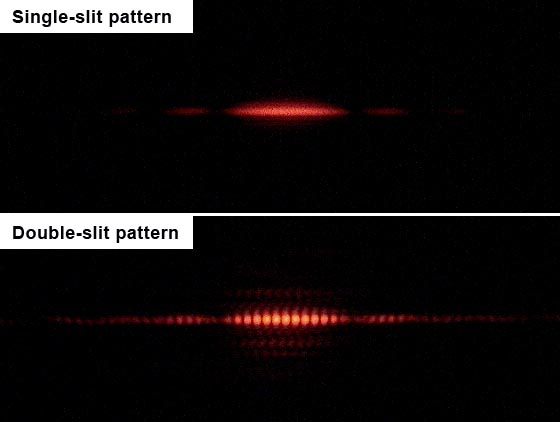 The experiment involves sending a beam of light or particles such as electrons toward a barrier with two narrow slits. A detection screen behind the barrier records where they arrive. When only one slit is open, the result is not a single sharp line but a diffraction pattern: a broad central peak that fades toward the edges. Although this behavior is somewhat consistent with classical expectations, the diffraction distribution, as opposed to a sharply localized band, already hints at wave-like behavior.
The truly surprising result appears when both slits are open and no effort is being made to measure which slit each particle passes through. In this case, the detection screen shows an interference pattern of alternating bright and dark bands. This is characteristic of wave behavior, where contributions from the two paths reinforce in some regions and cancel each other out in others.
Even more strikingly, this pattern appears even when the particles are being sent out one at a time. Each individual detection event looks like a localized impact, but as many such events accumulate, the interference pattern gradually emerges.
The situation changes, however, when a measuring device is introduced to determine which slit the particle passes through. In this case, the interference pattern disappears completely. Instead, the screen shows the combined result of two independent single-slit diffraction patterns, without interference fringes. The change does not depend on a conscious observer, but rather the physical interaction required to detect the particle's activity.
Several interpretations of quantum mechanics try to explain the strange results of the double-slit experiment in different ways.
In the Copenhagen interpretation, a particle does not have a definite path until it is measured. Before measurement, physics can only predict the chances of different outcomes. If nobody checks which slit the particle went through, then the question "which slit did it take?" simply has no definite answer.
The relational interpretation says that a particle's properties only exist through interactions with other things. In other words, what is "real" depends on what is interacting with what. The result depends on the relationship between the particle, the measuring device, and the observer.
In the many-worlds interpretation, every possible outcome actually happens, but in separate versions of reality. When a measurement is made, reality splits into different branches. In one branch the particle may go one way, and in another branch it may go another way. The interference pattern comes from all these possibilities existing together.
In the De Broglie–Bohm interpretation, the particle is always a real object with a definite path. It goes through one slit only, but it is guided by a wave that passes through both slits. That guiding wave affects the particle's motion and produces the interference pattern seen in the experiment.
The experiment was first carried out in 1801 by Thomas Young to demonstrate the wave nature of light and challenge Newton's particle theory. Throughout the twentieth century, quantum physicists performed similar experiments. In 1927, experiments with electrons were carried out by Clinton Davisson and Lester Germer, and also independently by George Paget Thomson, showing that matter displayed wave-like behavior similar to that of light. Later experiments showed interference patterns with neutrons, atoms, molecules, and even antimatter, proving wave-particle duality as a general feature of quantum systems.
Perhaps one of the experiment's greatest impacts is that it reveals how starkly quantum mechanics differs from the classically defined world we imagine; in the classical world, particles are defined by their position and trajectory; in the quantum world, outcomes are probabilistic and can only be known to a certain extent. More importantly, what can be known is constrained by the act of measurement itself. No experiment represents this tension so clearly with so few parts as the double-slit experiment.
Results from the double slit experiment: Pattern from a single slit vs. a double slit
Image by Jordgette, CC BY-SA 3.0
Filed under Medicine, Science and Tech
 This article relates to Entangled States.
It first ran in the June 10, 2026
issue of BookBrowse Recommends.
This article relates to Entangled States.
It first ran in the June 10, 2026
issue of BookBrowse Recommends.

L.A. Women by Ella Berman
Two ambitious writers in 1960s LA face betrayal when one writes a novel based on the other's life.







Your guide toexceptional books
BookBrowse seeks out and recommends the best in contemporary fiction and nonfiction—books that not only engage and entertain but also deepen our understanding of ourselves and the world around us.


