
-
Your next favorite book
is waiting.
Summary | Excerpt | Reviews | Beyond the Book | Readalikes | Genres & Themes | Author Bio
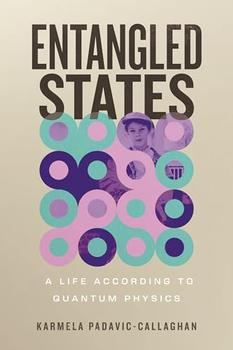
A Life According to Quantum Physics
by Karmela Padavic-Callaghan Book Reviewed by:
When it was time to dance, the class moved to another room where there was only one pole. From a small bag that the instructor referred to as "cosmic," women drew slips of paper with the titles of songs. She called out a specific student to dance, one by one, while the rest of us sat on the floor and watched. That night, the cosmos wanted my mom to dance to "Innuendo."
Before starting the music, the instructor invited each dancer to con sult her inner "yoni," or source of female power. The divine feminine had already been a prominent character in the arc of the class, and the instructor kept implying that this energy was bringing us all together.
With enthusiastic earnestness, and at least some disregard for the way in which she was borrowing spiritual practices from other cultures, she sold the whole thing as honest female empowerment, tinged with a sense of the mystical. The women ate it up. They felt powerful. I only felt my body contract—it was like every one of my muscles wanted to curl up and shrink out of sight. I was grateful that, as a newcomer, I hadn't been asked to dance, as the discomfort that was growing within me would have made doing so absolutely impossible. The instructor dimmed the lights.
When it was my mom's turn, "Innuendo" rang out and, bolstered by Freddie's voice, she worked herself into a frenzy. She soared with the song, moving with its beats as if they had been made just to serve her body. "Re lease your mask," Freddie implored, but she had never even brought one. I huddled in the corner next to a woman sporting several different layers of fishnets, my face growing wet.
I was crying because I was moved by my mother's effervescence and might. And I was crying because of the sense of difference between us; another gendered rift. The grief that this invited felt so tangible that I had to push it out of my body, transmuted into water and salt. There was no divine feminine in me, no female energy, no inner goddess. Wherever it was inside of me that my yoni should have been, all I could find there was Freddie in the track pants, strutting across the Wembley stage.
Later, while we were driving home, my mom told me that she had never felt energy or a sense of power inside of herself when she was younger, but that feeling it now had changed her completely. Her personal arrow of time had taken her from a state of obscured female energy to a state where that energy was everywhere for her, where she was basking in it. I can attest to it: now she cannot enter a room without ushering in awe and glamour as well, and there is power in her colorful dresses and big hair. And she is filled with expressive passion—the protocols for pretending you don't care are simply not coded into her body. At the edge of sixty, she looks remarkably young, like we could be siblings. Yet, I am certain that I am not made of the same stuff as her.
In the car after class, presuming that she knew how I felt, she told me how she'd been self-conscious of her body in the past and how that may have held her back. Having not yet found the confidence to tell her that I felt nonbinary, I understood why she was saying this. I understood that she wanted me to realize that I could find a way to free myself and find my own flavor of deeply embodied female empowerment. Maybe I would have made myself believe that too, had I not seen her dance.
So, another pair of markers along my arrow of time: loving Queen when I was too young to understand the word "queer," and loving the band again in that dance studio, when I very much did. Here, too, the arc of my life in between the two markers felt firmly irreversible.
Eddington's discussion of the arrow of time is now almost a hundred years old, but the question that it raises—of how this arrow emerges from laws of physics that are indifferent to time's direction—remains open. What is especially troublesome is that these are laws that apply to the smallest building blocks of our world, or the quantum particles that everything is made from. In 2014, an international team of theoretical physicists suggested that the quantum property of entanglement may be a big part of the answer.
Excerpted from Entangled States by Karmela Padavic-Callaghan. Copyright © 2026 by Karmela Padavic-Callaghan. Excerpted by permission of Beacon Press. All rights reserved. No part of this excerpt may be reproduced or reprinted without permission in writing from the publisher.

L.A. Women by Ella Berman
Two ambitious writers in 1960s LA face betrayal when one writes a novel based on the other's life.







Your guide toexceptional books
BookBrowse seeks out and recommends the best in contemporary fiction and nonfiction—books that not only engage and entertain but also deepen our understanding of ourselves and the world around us.


