
-
Your next favorite book
is waiting.
Summary | Excerpt | Reviews | Beyond the book | Read-Alikes | Genres & Themes | Author Bio

Five Families and One Hundred Years of Blood, Migration, Race, and Memory
by Jazmine Ulloa Book Reviewed by:
El Paso may be Jazmine Ulloa's first book, but she is far from new to writing. As a national reporter for the New York Times, where she covers national politics with a focus on immigration, she has built a career defined by in-depth political reporting, award-winning coverage, and a strong commitment to ethical and fair journalism. In this debut, she brings her investigative skills and her talent for viewing sociopolitical issues through the lives of ordinary people back to her hometown of El Paso.
Early in the book, Ulloa explains that although El Paso sits at the heart of US immigration debates and has played a crucial role in American history, it is often overlooked in these contexts. Her goal is to place the city at the center of national attention and highlight its importance by exploring how it fits into the intertwined histories of the US and Mexico, and its relationship with major historical events and the lives of people who have settled there or passed through.
To achieve the above, she traces more than a century of the city's history, beginning in the mid-1800s and moving to the present day. The first part focuses on Herlinda and Antonio Chew, and Victoria and Miguel Martinez, whose lives were impacted by early US immigration laws and shifting borders. It then follows the Rubio sisters and the Holguín brothers, as they became involved in politics and created businesses during the War on Drugs, an era that brought strict anti-migration policies. Finally, the third part tells the story of Kaxh Mura'l, a Maya Ixil activist who fled Guatemala as conflicts over immigration escalated into generalized attacks on migrants.
Each of the above sections begins with accounts of the 2019 Walmart shooting in El Paso, one of the deadliest assaults against Latinos in the United States. Ulloa also looks at earlier historical events, such as the Magonista revolt, the Mexican Revolution, and Pancho Villa's raids, to explore how they reshaped borders and perceptions of immigrants. For example, during World War II, American immigrants were seen as essential laborers, building railroads and filling farm labor shortages under the Bracero Program (see Beyond the Book). However, during the anti-communist McCarthy era, they were viewed with suspicion and hostility. Other important topics covered in the book include the Great Depression repatriations that forced thousands of families out of Texas, the Cold War interests that led the US to support right-wing regimes in Latin America, contributing to instability and migration, and the War on Drugs, which further hardened the border and brought violence and hard anti-migration policies. For me, the key takeaway is that history has shaped both physical borders and social attitudes. The economy, wars, and power struggles continuously influence who is welcomed, who is expelled, and how entire communities are perceived.
The greatest structural strength is perhaps Ulloa's ability to merge personal stories into historical events. One such story is that of Herlinda Wong Chew, who was born in Guadalajara, Mexico, in 1894 to a Chinese father and a Mexican mother. She moved to Juarez, a city close to the Mexican border, with her husband, where they ran a grocery store during the Mexican Revolution. Due to the increase in violence against Chinese people, she later relocated to El Paso with her family, where she helped Chinese immigrants by translating for them and assisting with their immigration papers. Through the experiences of Herlinda and others like her, the book makes clear the actual effects immigration laws, racism, and border changes have on everyday people. Furthermore, this examination of history through the eyes of the people who lived it feels fresh, engaging, and compelling.
The book is packed with information and historical detail, and covers extensive time periods and locations. Although it might be a bit heavy for some readers, Ulloa's vivid, narrative-driven prose and novel-like descriptions reward our attention. El Paso is well-researched and passionately told, essential for understanding contemporary debates on immigration. It will be of interest both to readers who appreciate analytical history books and those who prefer emotionally driven stories.
 This review
first ran in the March 25, 2026
issue of BookBrowse Recommends.
This review
first ran in the March 25, 2026
issue of BookBrowse Recommends.

If you liked El Paso, try these:
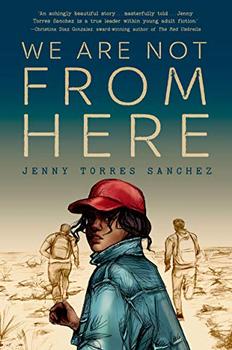
by Jenny Torres Sanchez
Published 2021
Winner of the 2020 BookBrowse Award for Best Young Adult Novel
A poignant novel of desperation, escape, and survival across the U.S.-Mexico border, inspired by current events.
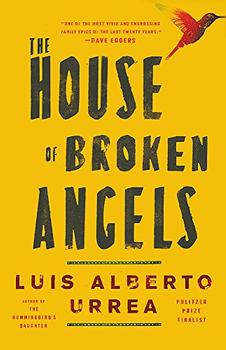
by Luis Alberto Urrea
Published 2019
The definitive Mexican-American immigrant story, at once intimate and epic, from an acclaimed storyteller.

by Sonia Nazario
Published 2007
A true story from award-winning journalist Sonia Nazario recounting the odyssey of a Honduran boy who braves hardship and peril to reach his mother in the United States.
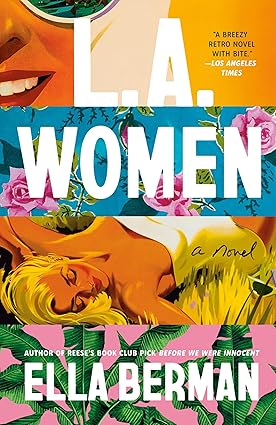
L.A. Women by Ella Berman
Two ambitious writers in 1960s LA face betrayal when one writes a novel based on the other's life.


Your guide toexceptional books
BookBrowse seeks out and recommends the best in contemporary fiction and nonfiction—books that not only engage and entertain but also deepen our understanding of ourselves and the world around us.

