
-
Your next favorite book
is waiting.
Summary | Excerpt | Reviews | Beyond the Book | Read-Alikes | Genres & Themes | Author Bio

Five Families and One Hundred Years of Blood, Migration, Race, and Memory
by Jazmine Ulloa Book Reviewed by:
This article relates to El Paso

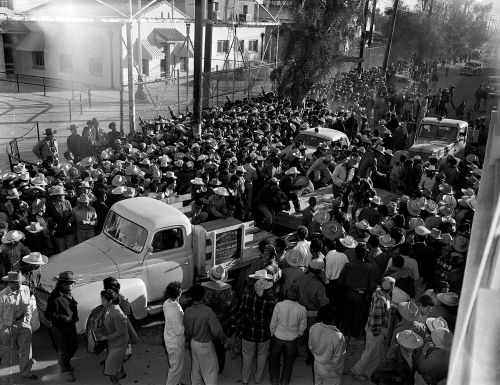 The Bracero Program, a joint US–Mexico labor agreement, began during World War II and ran from 1942 to 1964. It was created to address severe farm labor shortages in the United States due to the war draft, while also providing jobs for unemployed Mexican farm workers. It was formally established by the 1942 Farm Labor Agreement, and contracted many braceros (manual laborers) as temporary agricultural (and railroad) workers throughout the US. During its 22-year span, about 4.5 million detailed government-negotiated contracts were issued, covering wages, housing, and other conditions. Hundreds of thousands of Mexican men participated in the program, with many returning for multiple contracts. The later, large-scale migration of the 1980s–2000s was influenced by the cross-border networks that were first built during the Bracero era.
In theory, braceros were to receive the same pay as US workers and be protected from discrimination. In practice, however, many employers exploited them by paying low wages, often well below what domestic workers made, while also having them work for longer. They were furthermore often charged extra for food, lodging, and transportation, while in many farming communities, they faced overt discrimination and racism. For example, segregation in housing, exclusion from local businesses, and denial of access to public accommodations were common practices even though the agreements outlawed them. A large scandal involved the withholding of 10% of the braceros' wages into a savings fund, which the workers were supposed to eventually receive, but many never did. These widespread abuses and the lax enforcement of rules eventually brought the program under severe criticism and played a role in its termination.
However, the US labor market had already become reliant on braceros. The increasing demand for their labor, in combination with other dynamics, such as networks of recruiters and workers (that would persist after 1964), and the continued desire of Mexican workers to seek better wages in the US, created large inflows of unauthorized immigration. This led to strained relationships between the two countries and more restrictive immigration enforcement policies, lasting until today. One attempt to control unauthorized flows while the program was still in force was the 1954 Operation Wetback. Even though it was officially aimed at unauthorized workers, this enforcement campaign targeted many legal residents and US-born citizens of Mexican descent, and was named after a derogatory term for Mexican migrants that is still widely understood as a racial slur. The program also set a long-lasting precedent for formal labor agreements between the US and Mexico, such as today's H-2A guest worker visa system.
For Mexico, while the Bracero Program relieved domestic unemployment and generated a strong remittance income, according to some historians, it also created agricultural stagnation and dependency on the US labor market by draining the country of workers. With most of the braceros being male, the program had profound impacts on Mexican families and communities as well. Men were leaving their wives and children behind for months or years at a time, disrupting family structures and leaving women to shoulder the full burden of household labor, child care, and financial management, and often to take on additional labor in the local economy in their husbands' absence. Despite the strained marriages and emotional scars that the separation created, it also led women to form mutual support networks and strong communities for sharing resources and watching over each other's families during the migration season.
Finally, the controversies surrounding the program fueled political mobilization, with labor unions, civil rights groups, and agricultural workers criticizing it on both sides of the border. In Mexico, for example, political discourse around the program created debates about migration governance, state intervention, and the role of remittances in national development, while in the US, it raised the issues of undercutting domestic wages and enabling exploitation. Most notably, farm worker organizers such as Cesar Chavez argued that the program enabled the systematic exploitation of migrant labor and made it harder for farm workers to organize for better conditions. Criticisms like these helped bring national attention to the abuses within the system and contributed to the growing political pressure that eventually led to the program's termination in 1964.
The Bracero Program's social and political consequences were far-reaching for both the US and Mexico, and understanding its history is crucial for understanding today's immigration issues.
Mexican workers await legal employment in the United States, Mexicali, Mexico (1954)
From the Los Angeles Photographic Collection at the UCLA Library, via Wikimedia Commons, CC BY 4.0
Filed under People, Eras & Events
 This article relates to El Paso.
It first ran in the March 25, 2026
issue of BookBrowse Recommends.
This article relates to El Paso.
It first ran in the March 25, 2026
issue of BookBrowse Recommends.

L.A. Women by Ella Berman
Two ambitious writers in 1960s LA face betrayal when one writes a novel based on the other's life.






Your guide toexceptional books
BookBrowse seeks out and recommends the best in contemporary fiction and nonfiction—books that not only engage and entertain but also deepen our understanding of ourselves and the world around us.


