
-
Your next favorite book
is waiting.
Summary | Excerpt | Reading Guide | Reviews | Beyond the Book | Read-Alikes | Genres & Themes | Author Bio

A Novel
by Caro Claire Burke Book Reviewed by:
This article relates to Yesteryear

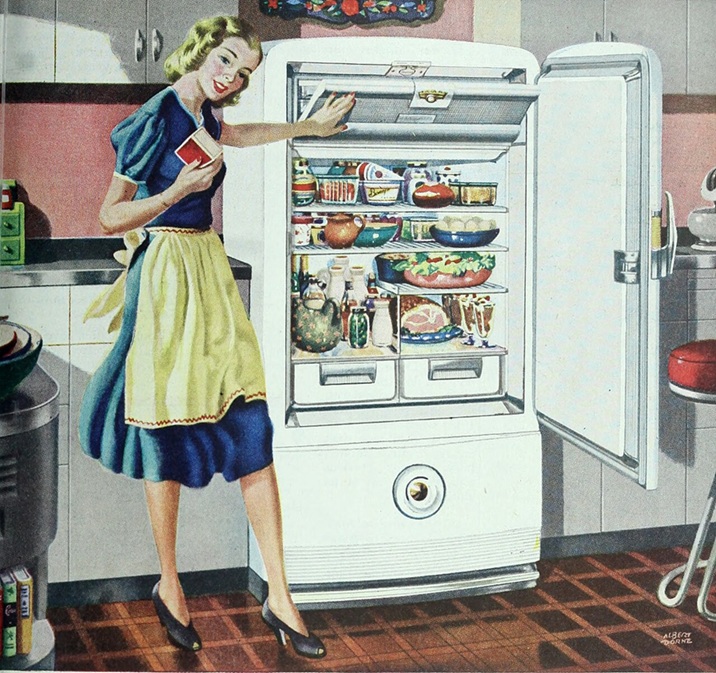 The protagonist of Caro Claire Burke's novel Yesteryear is a social media influencer who promotes her lifestyle as a "tradwife." A portmanteau of the words "traditional" and "wife," the term is defined by Dictionary.com as "a married woman who chooses to be a homemaker as a primary occupation and adheres to or embodies traditional femininity and female gender roles, often associated with conservative or alt-right political values." This phenomenon is especially prevalent in the United States but is becoming popular throughout Europe as well.
Women have assumed the role of homemaker for millennia, and a large part of being a tradwife is indeed accomplishing the daily tasks one would generally expect of a housewife, such as bearing and rearing children, cleaning the house, and feeding the family. Stay-at-home moms (SAHMs) continue to fill this role in many cultures. A tradwife, however, goes beyond what one would expect from a SAHM, doing things like making food from scratch, sewing their own clothes, and eschewing modern appliances like microwaves and blenders. In addition, tradwives usually espouse conservative political and/or religious values that may or may not be shared by SAHMs, and these values often include submitting to the will of their husbands. Broadly, this community wants to recreate what they imagine were the lifestyle and gender roles of women in the United States in the 1950s (a storybook existence lifted from television shows like Leave It to Beaver).
The tradwife trend is a staple of the social media age, and it's important to differentiate between the online influencers and those who attempt to assume the role in real life. As with Natalie's Instagram account in Yesteryear, what shows up online is heavily edited. Seldom seen are the times that the children misbehave or the tradwife loses her temper; everything seems stress-free and idyllic. Even pregnancy and childbirth (often done at home and without pain medication) are depicted as easy, joyful experiences.
Yesteryear is based in part on the experiences of one of the earliest and most popular social media tradwives: Hannah Neeleman (b. 1990). She met her husband, Daniel, at a college basketball game and they were married three months later—a whirlwind romance the novel parallels. Together they purchased the 328-acre Ballerina Farm in Utah in 2018, and she began posting videos in 2020 about her lifestyle and her children (the couple has nine as of 2026). Neeleman claims about 20 million followers across TikTok and Instagram and makes about $850,000 a year in revenue from her TikTok account.
Regardless of how "real" the lives of tradwives might be, the trend is popular. Some attribute this to society's expectations that a working woman simultaneously manage her career and her household, and do both flawlessly. In reaction to the expectation that they somehow reconcile these impossible demands, some women have opted for a simpler lifestyle, abandoning their jobs to concentrate on caring for their families. Another theory is that the popularity of the tradwife movement is a backlash against fourth-wave feminism. With feminism often viewed as a liberal initiative, many conservative women say they don't feel "seen" by modern culture, and don't believe their values are reflected in current trends.
Many participants in this movement find a great deal of joy caring for their children on a day-to-day basis and cite a contentment with their lives that was unavailable to them when they were employed outside the home. Often these women feel like their homelives are more stable than they would be otherwise, and they relish the structure the lifestyle provides. In some cases, it eases a financial burden as well, since professional childcare has become unreasonably expensive for many, particularly those who have large families. And then there are those like Neeleman who adopt the lifestyle because they believe they're "doing what God wants."
That being said, a large number of women who attempt the tradwife lifestyle eventually abandon it upon realizing it's so much harder to maintain than online influencers make it appear. Many women in this situation find that their identities revolve around how well they live up to an unrealistic ideal; depression and dissatisfaction with the lifestyle can result.
Critics express concern that the trend could undermine the progress toward equality that women have made over the last several decades. Most women identifying as tradwives weren't alive during the era in which women lacked autonomy and were completely dependent on their husbands for financial stability (e.g., women were routinely denied lines of credit without a male cosigner until 1974). This romanticized view of the past belies the fact that many women were trapped in untenable situations with no realistic way to escape until the very recent past.
Another downside to the tradwife culture is that it's given rise to a parallel conservative movement geared toward men (although which social media campaign came first is up for debate). Men who take part in the various online communities known collectively as the "manosphere" typically believe in exerting dominance in their relationships and promote a version of masculinity that emphasizes male superiority.
Frigidaire ad from Ladies' Home Journal by NC Wyeth, 1948, courtesy of Flickr
Filed under Cultural Curiosities
 This article relates to Yesteryear.
It first ran in the March 25, 2026
issue of BookBrowse Recommends.
This article relates to Yesteryear.
It first ran in the March 25, 2026
issue of BookBrowse Recommends.
Theo of Golden by Allen Levi
One spring morning, a stranger arrives in the small southern city of Golden. No one knows where he has come from…or why…






Your guide toexceptional books
BookBrowse seeks out and recommends the best in contemporary fiction and nonfiction—books that not only engage and entertain but also deepen our understanding of ourselves and the world around us.

