
-
Your next favorite book
is waiting.
Summary | Excerpt | Reading Guide | Reviews | Beyond the Book | Read-Alikes | Genres & Themes | Author Bio

A Novel
by Patrick Ryan Book Reviewed by:
This article relates to Buckeye

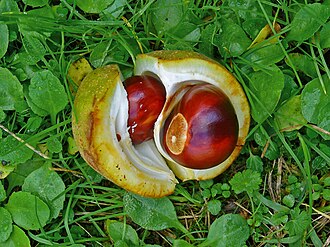 The title of Patrick Ryan's novel, Buckeye, is the nickname of one of the book's characters. Two young boys, Skip and Tom, gather buckeye nuts from their yard, sneak into an abandoned mill, and slingshot them at various targets from its roof. Just when Skip thinks they'll have to stop because they're out of ammunition, he discovers Tom stowed a bunch in his socks. "He called Tom 'Buckeye' from that day on."
The Ohio buckeye, Aesculus glabra, is a tall, medium-to-fast-growing tree native to the Midwest. Its soft, lightweight wood is ideal for crafting into small objects like knife handles or bowls, and it was also used for artificial limbs until the advent of lightweight plastics. The tree is named after the nut it produces (also called a buckeye): a shiny, dark brown seed with a light brown center, resembling the eye of a deer. The word for the tree in the Shawnee language is "hetuck," which translates to "eye of the buck."
Although the nut resembles the horse chestnut (and the tree is in the same family), buckeyes are poisonous if eaten raw. Nevertheless, they were an important tool for the Native nations in the Midwest. They steamed and then peeled the nuts, which were then ground into a paste. This was then thrown into still water to stun fish. The resulting catch would then be boiled in fresh water at least three times to leach out the toxins.
According to the Cincinnati Enquirer, the first person to be nicknamed "Buckeye" was Colonel Ebenezer Sproat in 1788. When he arrived in Marietta, Ohio (the first permanent settlement in the Northwest Territory, located at the confluence of the Muskingum and Ohio Rivers), the Shawnee, impressed by his uniform and stately bearing, dubbed him "Hetuck."
The term was eventually applied to anyone born in Ohio, and then, over time, became a derogatory nickname. Later arrivals to the territory considered those born in the state to be socially backward and untaught, and likened them to the buckeyes: native and soft. In an 1833 speech, Dr. Daniel Drake, a Cincinnati physician, writer, and historian, advocated for the buckeye tree to be the symbol of Ohio and claimed that being called a "buckeye," instead of being an insult, should be a badge of honor, as "buckeyes were valuable as resources, pleasing to the eye and difficult to kill."
The metaphor might have ended there, but the Ohioan and future US President William Henry Harrison was in Drake's audience. When he ran for office nearly a decade later, he adopted the tree to help promote his campaign. Supporters created necklaces of buckeye nuts and handed them out as campaign souvenirs. When Harrison won the presidency in 1840, the buckeye became forever associated with Ohio.
The buckeye also became the symbol of The Ohio State University, founded in 1870. Newspapers were referring to its students and athletes as buckeyes by 1919. The school officially adopted the nickname for its sports teams in 1950. Their mascot, Brutus Buckeye, was created in 1965; the costume consists of a person in a scarlet and grey-striped retro uniform with a fiberglass head that looks like a buckeye nut. The football team also decorates players' helmets with buckeye leaf stickers to celebrate outstanding plays.
The same year Brutus Buckeye made his debut, the edible buckeye was also created. This holiday treat is a peanut butter ball dipped in chocolate (kind of like a spherical Reese's Cup), with the peanut butter showing through the top, making it look like the nut. The original recipe is credited to Ohioan Gail Tabor, and it became a sensation after the candies were served at the Ohio State-Michigan game that autumn.
Image of buckeye nuts by H. Zell, CC BY-SA 3.0.
Filed under Cultural Curiosities
 This "beyond the book article" relates to Buckeye. It originally ran in August 2025 and has been updated for the
September 2025 edition.
Go to magazine.
This "beyond the book article" relates to Buckeye. It originally ran in August 2025 and has been updated for the
September 2025 edition.
Go to magazine.





I am what the librarians have made me with a little assistance from a professor of Greek and a few poets
Click Here to find out who said this, as well as discovering other famous literary quotes!

Can you name the title?
Test your book knowledge with our daily trivia challenge!
Your guide toexceptional books
BookBrowse seeks out and recommends the best in contemporary fiction and nonfiction—books that not only engage and entertain but also deepen our understanding of ourselves and the world around us.

