
-
Your next favorite book
is waiting.
Summary | Excerpt | Reviews | Beyond the Book | Readalikes | Genres & Themes | Author Bio
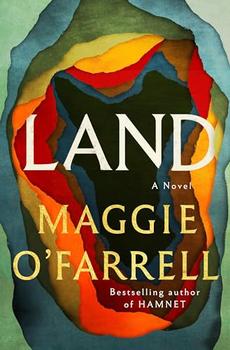
A Novel
by Maggie O'Farrell Book Reviewed by:
Without warning, his gaze, passing over the landscape, is arrested by a curious fissure in the southernmost slope. Filled with a dense copse, from which flows a reasonable-sized stream, it is a geographi¬cal feature not shown on the existing map sheet, making it Tomás's responsibility to measure and survey it for the necessary revision.
Tomás sighs. He removes his own cap and uses it to wipe the moisture from his forehead. He doesn't feel the cold, doesn't mind the rain. I am waterproof, he likes to say to the scarlet-jacketed sol¬diers who employ him for their great mapping project. The redcoats, who come from over the water, bare their teeth in a smile and roll up the charts and sketches he creates. Tomás is useful to them, he knows, not so much for his surveying and draughtsman skills—there are plenty to be found over the water who can do such things—but harder to find someone who has these abilities and can also speak to the locals in their own language. Tomás may be classified in their accounts and ledgers as a "labourer" but the soldier-men cannot do without him. He is the only one of their division who can measure and calculate, draw detailed draft maps in ink for the engravers to copy, and also converse with the people about where the boundar¬ies lie, who owns which field, what this valley or that bluff is called and why, where might the ruins of this building be. He alone is able to parse a polysyllabic string comprehensible only to those who have lived here for generations: he makes the-crossroads-under-the-bluff-where-once-a-hailstorm-killed-a-cockerel read "Bluff's Cross" and renders the-strand-where-the-yellow-periwinkles-gather-in-spring into "Yellowcove." In a tent set up in a field or a town square, the redcoat sappers and surveyors will mill around behind Tomás, half listening, while he negotiates with a crowd of people a toponymic compromise over a mountain known by one name to those who live on its eastern slopes and quite another to those on its north. Or he untangles from several shouted accounts who the landowner was before this one, and the one before that. Then the redcoats step forward; they take these revisions away to their barracks and their camps; they collate them; they sign their names to Tomás's work; they print their maps and put them in a cabinet somewhere in their city.
So lost is he in his reverie that when he gains the higher ground and someone taps him on the elbow, he is startled to find a person of short stature, looking up at him, mouthing something.
"What?" Tomás yelps.
His son, Liam, quivering like a wet hound, speaks again but his words are whirled away into the fog. Tomás permits the child to cling to his damp jacket hem as he looks around them: a good vantage point, this. The land slopes away from the drumlin in all directions, as if he and his son are standing on a bolt of cloth tweaked aloft by immense and invisible fingertips. They are ninety feet or so above the unmapped copse to the south, a comparable distance to an old field boundary with a gatepost to the west, the volcanic outcrop behind them, the clutter of the village—or what remains of it—to be seen below. On an elevated piece of ground, a quarter of a mile away, stands the ruin of an isolated dwelling place, also absent from the map—roofless, walls bared to the sky, like crumbling teeth, a sapling sprouting from what would have been the chimney breast.
Anyone observing Tomás at this moment would see the muscles in his jaw tighten. It is a necessary but unenviable part of his cur¬rent task to distil into inked symbols and ordered lines what has taken place here since the first maps were drawn. These new revisions must contain a cartographic record of the Great Hunger, the disaster that struck this land more than a decade ago now. Tomás must amend the hundreds of households in a barony to the handful that now remain; he must erase row after row of tenant cottages on landowner estates, which have been emptied and dismantled. The redcoats turn their eyes from this task; they prefer never to acknowledge the crisis that befell the country, the losses and deprivations it has suffered. They do not wish to make such marks upon their maps, which might lead to certain admittances. Tomás has determined, however, that his maps will bear an account of what happened, what was lost, if it kills him.
Excerpted from Land by Maggie O'Farrell. Copyright © 2026 by Maggie O'Farrell. Excerpted by permission of Knopf. All rights reserved. No part of this excerpt may be reproduced or reprinted without permission in writing from the publisher.
Theo of Golden by Allen Levi
One spring morning, a stranger arrives in the small southern city of Golden. No one knows where he has come from…or why…





Your guide toexceptional books
BookBrowse seeks out and recommends the best in contemporary fiction and nonfiction—books that not only engage and entertain but also deepen our understanding of ourselves and the world around us.


