
-
Your next favorite book
is waiting.
Summary | Excerpt | Reviews | Beyond the Book | Read-Alikes | Genres & Themes | Author Bio
A Novel
by Maggie O'Farrell Book Reviewed by:
This article relates to Land

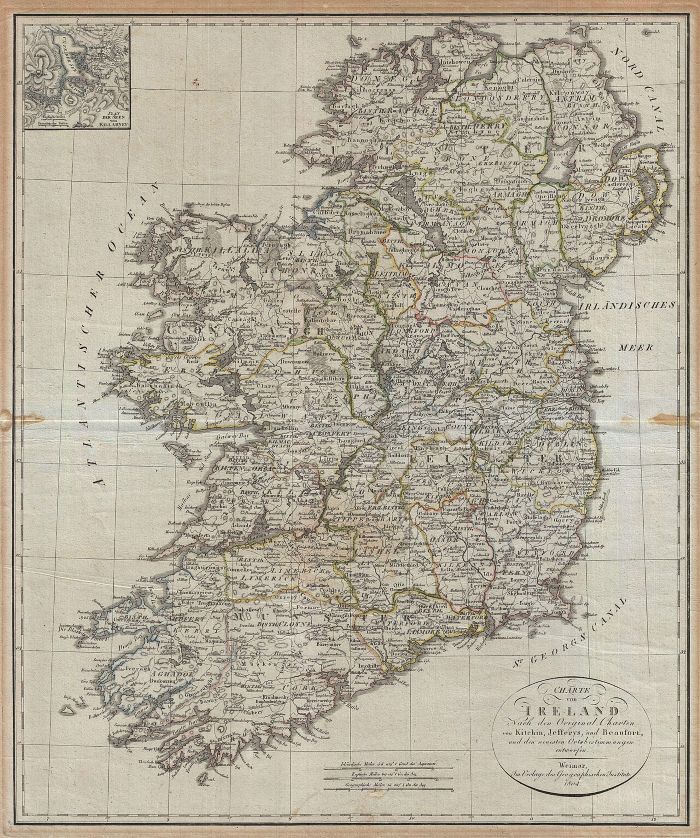 In the early nineteenth century, Ireland was newly under British rule due to the Act of Union of 1800, which abolished Ireland's parliament, and led the British government to have an interest in recording Irish tenement valuations for taxation purposes. In 1824, a historic ordnance survey commenced—Ireland was about to become the first country to be mapped in its entirety on a scale of six-inches-to-one-mile.
The Ordnance Survey was headed by Thomas Colby, a Colonel in the British military, who worked for the British Board of Ordnance. Colby instructed his workers that this process was to be recorded in great detail in a series of memoirs, which is why we have accounts that have survived to this day. A group of engineers was assembled to perform an initial boundary survey of Irish town lines, which was then mapped by Colby's team of engineers, sappers, miners, and local civilian recruits.
Colby and his team first divided Ireland into a series of triangles, using mountains as a rough framework, and calculated land areas with trigonometry. For Colby, it was important that the first side of the first triangle, or the baseline (specifically chosen on a flat area of land in the east), was measured with the utmost accuracy, so the task of measuring this 7.89 mile stretch of land took sixty days. (It was remeasured with modern technology in 1960, and determined that Colby's measurement was off by only one inch.)
Two notable pieces of technology emerged from this project, both invented by Scottish engineer Thomas Drummond. The first, known as Colby's compensating bar, was an apparatus of two interlinked bars, which used the principle of thermal expansion in different metals to account for the bar expanding and retracting in different weather conditions in order to provide the most accurate reading. The second was known as the Drummond light, a long-distance illuminator, which was adapted from limelight, and allowed surveyors to measure over great distances.
The Ordnance Survey was not met favorably by the Irish people. In addition to the British colonial presence straining Irish resources, it had another catastrophic effect: aiding in the eradication of the Irish language. Throughout this project, surveyors transliterated thousands of Irish place names into English phonetics; Cnoc Dubh became Knockduff; Baile Beag became Ballybeg. For Irish citizens, already subjugated and starving under Britain's imperialism, the remapping of Ireland contributed to a growing loss of cultural identity that was taking place in the nineteenth century.
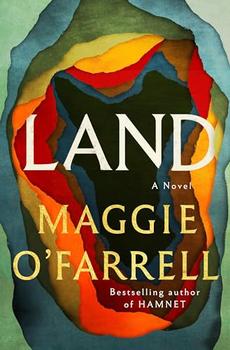
As the initial field survey was completed in 1842, and included every occupied house or cabin, these maps—many of which we still have access to—act as a time capsule of what Irish land ownership looked like directly before the Great Hunger, which decimated Ireland's population from 1845 to 1852. This necessitated a massive revision of the maps, the project that Tomás and his son Liam work on in Maggie O'Farrell's novel Land, which provides insight into the meticulous process of surveying, as well as a sharp commentary on the effects of colonialism on the Irish communities being surveyed under British rule.
A map of Ireland dating to 1804, via Wikimedia Commons
Filed under People, Eras & Events
 This article relates to Land.
It first ran in the June 24, 2026
issue of BookBrowse Recommends.
This article relates to Land.
It first ran in the June 24, 2026
issue of BookBrowse Recommends.

L.A. Women by Ella Berman
Two ambitious writers in 1960s LA face betrayal when one writes a novel based on the other's life.






Your guide toexceptional books
BookBrowse seeks out and recommends the best in contemporary fiction and nonfiction—books that not only engage and entertain but also deepen our understanding of ourselves and the world around us.


