
-
Your next favorite book
is waiting.
Summary | Excerpt | Reading Guide | Reviews | Beyond the Book | Readalikes | Genres & Themes | Author Bio
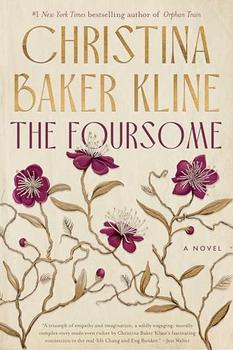
A Novel
by Christina Baker Kline Book Reviewed by:
Prologue
Surry County, North Carolina
1886
Whose story is this to tell?
Most would agree it isn't mine. I'm not the hero or the villain, the pursuer or even, really, the pursued. I'm just the one who went along.
But maybe the story doesn't belong to anyone. Maybe it's a question of who has the nerve and the need to tell it.
* * *
My mind holds memories like constellations, each glowing with its own light. Some brighten as the sky goes dark; others fade, their edges blurring. The older I get, the more these memories merge, forming shifting patterns. I sift through them slowly, gauging the weight of emotion, the gravitational pull of significance. Trying to make sense of it all.
* * *
Sinful. perverted. mad.
Those were some of the things people said about us. When word spread that the four of us shared one bed, our good neighbors' imaginations ran wild. Rumors flew about incest, unnatural relations, adultery, all kinds of depravities. No respectable woman would permit such an abomination. No God-fearing family would allow it.
Eventually our neighbors got used to us. They stopped asking questions. Even so, we were never fully accepted. We existed in an uneasy in-between, on the fringes of polite society yet bound by its rules.
* * *
Our husbands wanted many children. They wanted to leave a legacy. They wanted to create a community of people who resembled them—people to whom their differences didn't seem an abomination. And indeed, the twenty-one children born into our way of life accepted it as normal. Two fathers joined at the ribs: it was all they knew.
Twenty-five people is an entire village. There is comfort—and safety—in numbers.
* * *
All these years later, when the choices we've made have played out across our lifetimes, I can say I have learned some things. For one, I understand how complicated a marriage can be—how, as days and months and years pass, you can fall in and out of love with your husband again and again, sometimes finding yourself bound to a person whose actions you can neither condone nor escape.
For another, even if you think you know where you are going, you cannot predict what lies ahead. I could not have foreseen the feuds and jealousies, the alliances and fractures, the long-held beliefs I had to learn to let go. The moral compromises I would witness and, God help me, even participate in.
* * *
Most of us take for granted that, at the very least, we come into this world alone and die our own deaths. But this was not true for my husband and his brother. They could not escape each other.
It changes your perception of the world to realize that people can, and do, live in all kinds of arrangements. That few of us, when it comes down to it, are truly normal. That civility is a thin veneer.
* * *
Here's the truth: even the most extraordinary life feels ordinary when you're living it.
Part One
Mulberry Farm, Wilkes County, North Carolina
Early 1940s
Chapter One
Despite the extravagance of Fanny's lace wedding gown, ordered from France, the profusion of pink peonies, grown in a side garden for the occasion, and the three-hundred-pound hog turning on a spit, all anyone could talk about were the twins from Siam. They'd been living in Wilkesboro for four months and had already bought land and begun construction on a plantation.
Though we had yet to meet them, my sister Adelaide and I knew all about the Siamese Double Boys. Everybody did. They were the most famous men ever to land on our small patch of earth. For the past decade, since their arrival in the United States, the press had scrutinized their every move. Newspapers debated whether they were cursed by God or proof of His glory. They'd been called an omen, a marvel, a monster. They were measured against other joined twins throughout history: the twelfth-century Biddenden Maids, fused at the cheekbones, who needed a looking glass to meet each other's gaze; seventeenth-century Scottish brothers who shared a lower half, with separate heads, torsos, and arms; eighteenth-century Hungarian girls joined back-to-back at the pelvis, immortalized by Alexander Pope as "two sisters wonderful to behold, who have thus grown as one."
Excerpted from The Foursome by Christina Baker Kline. Copyright © 2026 by Christina Baker Kline. Excerpted by permission of Mariner Books. All rights reserved. No part of this excerpt may be reproduced or reprinted without permission in writing from the publisher.

L.A. Women by Ella Berman
Two ambitious writers in 1960s LA face betrayal when one writes a novel based on the other's life.





Your guide toexceptional books
BookBrowse seeks out and recommends the best in contemporary fiction and nonfiction—books that not only engage and entertain but also deepen our understanding of ourselves and the world around us.


