
-
Your next favorite book
is waiting.
Summary | Excerpt | Reading Guide | Reviews | Beyond the Book | Read-Alikes | Genres & Themes | Author Bio
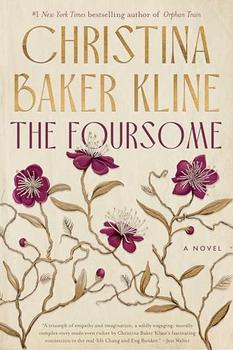
A Novel
by Christina Baker Kline Book Reviewed by:
This article relates to The Foursome

 Christina Baker Kilne's latest novel, The Foursome, is a fictionalized version of the story of Sarah Yates, one of two sisters who married one of the original "Siamese twins," Chang and Eng Bunker. As the wife of a conjoined twin, Sarah must navigate not only the emotional complexities of her marriage but also the complications of a physical relationship with a husband who is physically attached to another.
The Mayo Clinic defines conjoined twins as "two babies who are born physically connected to each other." If the babies were born separate, they would be identical twins, but because of developmental complications, the babies remain connected, most often at the chest, abdomen, or pelvis. There are currently two theories regarding the cause of conjoined twins; one theory suggests that an embryo splits late in development (13-15 days post conception instead of 8-12 days), and thus separation stops before the process is complete. The second theory suggests that two separate but identical embryos somehow fuse back together during early development, creating a physical connection. The cause of either event remains unknown, and because of the rare incidence of conjoined twins—one in every 50,000 to 60,000 births—scientists have been unable to determine any genetic or environmental causes that would make conjoined twins more likely.
Historically, conjoined twins were often stillborn or died shortly after birth. Today, while many conjoined twins are still stillborn, early detection in pregnancy via ultrasound, advanced surgery techniques, and multidisciplinary care has somewhat increased twins' survival rates. Chances of survival increase up to an average of 60% with surgical separation, which may be possible depending on where the twins are connected and whether or not vital organs are shared. If a heart or a brain is shared, surgical separation is not usually possible, but most conjoined twins are joined somewhere around the chest or upper abdomen (known as thoracopagus and omphalopagus twins) and are mostly eligible for separation surgery. Separation surgery is performed as early as possible, typically within a year of birth.
Despite the benefits of separation, there are ethical quandaries around the surgery, particularly if one twin would be unable to survive on their own. Such an ethical dilemma arose in England at the start of the millennium. In 2000, conjoined twins Gracie and Rosie Attard were born in Manchester, England. The two girls shared an aorta, a bladder, and circulatory systems; furthermore, Rosie had only a premature brain and no functioning heart or lungs, thus relying on Gracie's body to survive. Doctors gave the pair a life expectancy of six months unless they were surgically separated. However, separation would certainly kill Rosie, and thus arose the question: should the girls be separated to save Gracie's life at the cost of her sister? The girls' parents refused the separation due to religious beliefs, but the hospital took the case to court, where it eventually made it to the Court of Appeal of England and Wales. There, the three justices ultimately ruled that the girls should be separated, stating that the surgeons' intentions were to save Gracie's life and that the surgery was necessary to avoid causing her inevitable and irreparable harm. The 20-hour surgery took place when the girls were three months; Rosie passed away after the surgery, as doctors expected, and Gracie was able to thrive on her own.
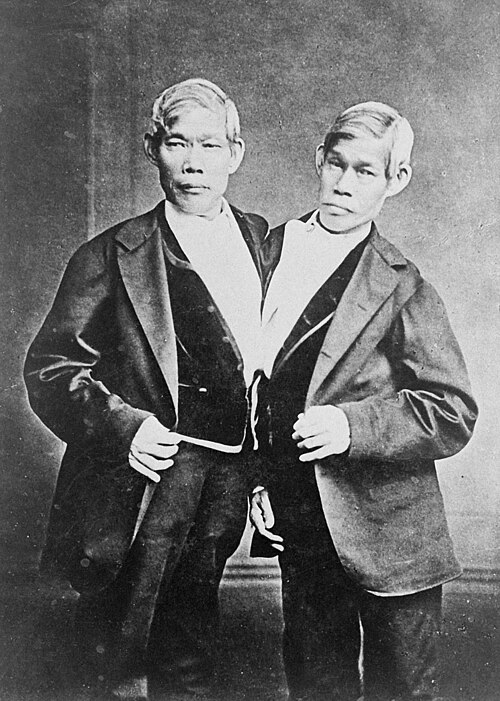
Chang and Eng Bunker, who are fictionalized in The Foursome, were the first widely known conjoined twins. (Indeed, the term "Siamese twins" originates with them; as they were from Siam, now Thailand.) They were connected at the lower part of the sternum by a 4–5-inch band of flesh and shared connected livers. Today, it's likely that Chang and Eng could have been safely separated, especially due to their minimal connection. However, in the mid-1800s, the twins were advised not to separate at the risk of death via blood loss, and thus lived together their entire lives.
A portrait of Chang and Eng Bunker
Filed under Medicine, Science and Tech
 This article relates to The Foursome.
It first ran in the June 24, 2026
issue of BookBrowse Recommends.
This article relates to The Foursome.
It first ran in the June 24, 2026
issue of BookBrowse Recommends.
Theo of Golden by Allen Levi
One spring morning, a stranger arrives in the small southern city of Golden. No one knows where he has come from…or why…






Your guide toexceptional books
BookBrowse seeks out and recommends the best in contemporary fiction and nonfiction—books that not only engage and entertain but also deepen our understanding of ourselves and the world around us.


