
-
Your next favorite book
is waiting.
Summary | Excerpt | Reviews | Beyond the Book | Readalikes | Genres & Themes | Author Bio

An African Childhood
by Patrice Nganang Book Reviewed by:
My sister was no exception. She was deep into another local habit: buying things by using her phone to show a picture of the product she wanted. In front of Score, we passed many vendors, most of them Hausa, with their merchandise stretched on the pavement. Every time she stopped at one, she would remove her phone and scroll down the screen picture before the man's curious eyes. Both would talk excitedly about an absent shoe, as if she had it in her hands, with its right color but unmatching size, and not the new Android she was holding. Same when we reached Pharmacie du Soleil. Distracted, since we passed the Hollando Building near the Central Market, by the fact that the wall paint had not been renewed for years, I thought first that she wanted me to see all that was lacking on the shelves and what I should buy for her in the United States, until I realized all the customers did as she did, "the new fashion, o."
Being chatted up by jackals about virtual merchandise—now, that was certainly new. More than the bend-skin, or the moto-taxis with three passengers each that had passed us along the route. If only Mama could have seen it all! In front of Shop 64, where she had spent the rest of her life, I felt that the city center was a living festival of the 1980s. The shop system too had not changed, and new ones had not been added to the old. It all composed a bouquet of colors and people that rose to the sky in a mixture of noise, dust, and debris. All the languages that were spoken around us reminded me of the Law of the City: in Yaoundé, if you understand half the things people say, you are lucky. The cars honking to pass through the disappeared Kennedy Avenue were still mostly the beaten and rusty Toyotas of before. People now called the road Bandits Avenue because you were sure to have something snatched from you while walking through the throng. Cellphones were the preferred prey around, as Gisèle reminded me, "Chep yu telephone mebwo." Hold on to your phone.
She was holding her bag on her breast, with both hands crossed, as one would a baby. It was not long before we saw a mustachioed man in an azure suit walk pass us. I shook my head and smiled, for the day was quite sunny. I remembered how we used to welcome such figures, whom we deemed regime chic. "Hot! Hot! Hot-hot!" was the mocking chant. And as if to rhyme with the walking pastiche of the past that he was, in my mind I heard the children's parade song of before:
Paul Biya Paul Biya, Paul Biya Paul Biya
Our president, father of the nation
Paul Biya, always the hot guy!
Hot! Hot! Hot-hot!
A country at a standstill; the drama of tall people who do not stand tall, of intelligent people who have stopped thinking. My sister could not get the joke of it all, so I did not insist. Photos of the youthful Paul Biya were on display everywhere on the street for sale, next to Pope John Paul II's, unchanged like a North Korean–style Photoshop. The one that was hung on living room walls after the 1984 coup attempt and never taken down. Like Archangelo de Moneko's marching band sound that marked our midday. The usual music vendor was also filling the air with songs from the past, Joe Dassin, Nana Mouskouri. Kenny G's "Songbird," then Julio Iglesias's "Une nuit de carnaval." Don Williams's "Listen to the Radio." Kenny Rogers's "The Gambler." The best of country music we call western.
"Ridiculous," I said, and now it was me sucking my teeth.
Hawkers were still selling Sony cassette tapes, no joke. And then suddenly this: we were walking back toward the Subaru car that I was using at home to go local, when a boy stopped before me.
"Grand," he said, "you don't want to weigh yourself?"
I hadn't heard well. My mind was full of all the 1980s playlist, the retro of it all, or a reflex had made me think it was one of the many Hausa child beggars who rendered circulation in the city impossible. I raised my face to ask him to please leave me alone; the churlish Cameroonian had crept back into me, the one who answers questions with questions and is perpetually on the verge of spitting an insult. One day in the country is usually enough for transplants like me to catch up on nasty.
Excerpted from Scale Boy by Patrice Nganang. Copyright © 2026 by Patrice Nganang. Excerpted by permission of Farrar, Straus & Giroux. All rights reserved. No part of this excerpt may be reproduced or reprinted without permission in writing from the publisher.
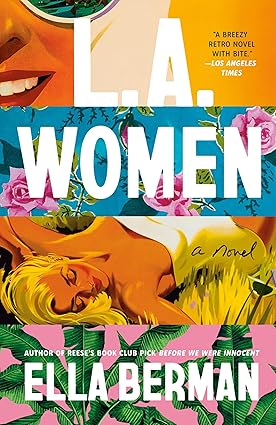
L.A. Women by Ella Berman
Two ambitious writers in 1960s LA face betrayal when one writes a novel based on the other's life.






Your guide toexceptional books
BookBrowse seeks out and recommends the best in contemporary fiction and nonfiction—books that not only engage and entertain but also deepen our understanding of ourselves and the world around us.


