
-
Your next favorite book
is waiting.
Summary | Excerpt | Reviews | Beyond the Book | Readalikes | Genres & Themes | Author Bio

An African Childhood
by Patrice Nganang Book Reviewed by:
A Quick Geographical and Historical Background
In the beginning was Guinea. That is, from 1441. It was a land of fantasies and coasts and rivers and waters, which we know today as West and Central Africa.
It was involved in inter-European, trans-African commerce and competition. Its boundaries split many West and Central African states between south and north, charting the oldest and most enduring African frontier. The German foothold on the Gulf of Guinea, Kamerunstadt, Cameroontown, became Douala, and then burgeoned into a country, Cameroon, that is still reeling from those conflicting competitions.
Yaoundé is Cameroon's third capital—the first was Douala, then Buea. It became the capital in 1921, when the northern and southern parts of Cameroon were under French colonial rule—the western part was under British rule. Yaoundé functions even today as the seat of government.
The city is made of neighborhoods, we call them quartiers, that are themselves divided into sous-quartiers. Although the term sous-quartier has evolved in the language in Cameroon and is now linked to economic duress, in colonial city planning it simply designated the subparts of a quartier. I was born in one, Nkomkana.
Yaoundé is in the south of Cameroon, in a region populated by the Ewondo, a subgroup of the Beti community. The Bulu are another subgroup of the Beti. Similarly, the Bangangté and Bazu are subgroups of the Bamiléké, whose linguistic and cultural characteristics relate them more to populations in the English-speaking part of the country. Although the Hausa are a subgroup of the northerners—another group are the Fulani—in the south all northerners are colloquially called Hausa, and this even indistinctively includes Chadians—anyone whose origins are traced beyond Old Guinea.
The city has a population of two million inhabitants. Their historical distribution mostly happens across ethnic lines, with quartiers and sous-quartiers functioning as attraction poles for specific ethnic, linguistic, or religious communities—the northerners in the Briqueterie, the Bamiléké in Nkomkana.
The city center is known locally as Ongola, and at its top is the former Presidential Palace. Despite having been downgraded to the status of a museum because of the story I narrate here, it remains so mythical in its projection of a New Paris in our swamps that another city quartier just built a second, exactly look-alike one.
Although Cameroon is made of many small and large communities that can be organized around four supra-communities, this book mostly focuses on the conflicting relationship between three of them, the northerners, the southerners, also called the Beti, and the Bamiléké, because they are pertinent not only to my own upbringing, but also to the events that happened around me during the 1980s.
In the Yaoundé of the 1980s, the fourth supra-community, the anglophones, were still trickling in, as the city is in the interior of the country, in the heart of the mostly francophone regions that colonials used to call the hinterland.
It all starts there.
Answering the Question of Where My Accent Comes From
I had a happy childhood. The surprising achievement of tyranny is that it kept those years around as a museum for me to visit. When as an adult I came back to Yaoundé, the only African city that has a German name with French accent aigu, I immediately became like a baby in a toy store, so much so that I had forgotten it was still forbidden to take photos of public spaces. It dawned on me when we went to Ongola to buy gifts for my trip back to the United States. I saw a man being arrested by the police for taking a picture of the green-red-yellow-painted Unity Boulevard grandstand. But Gisèle shrugged her shoulders when I told her and said she thought things had changed nevertheless, "no selfies back then, nor." Such banning was a remnant from the time, she continued, forgiving, when the place was an amalgamation of construction sites. On every site there was a red sign that said INTERDIT DE FILMER. Forbidden to take pictures. She laughed when I reminded her that regular people also threatened you if you took a picture that included them in the background. "What do you think you are filming?" they'd say. "Your mama?" Or they'd hide their face and wave you away. Those were times! Yet in a certain way, it was still typical to the place. Everyone went too easily overboard.
Excerpted from Scale Boy by Patrice Nganang. Copyright © 2026 by Patrice Nganang. Excerpted by permission of Farrar, Straus & Giroux. All rights reserved. No part of this excerpt may be reproduced or reprinted without permission in writing from the publisher.
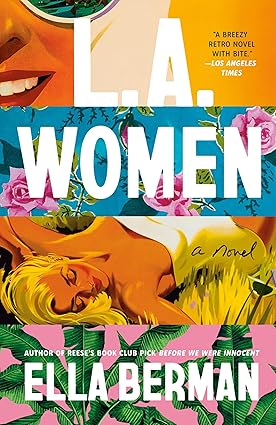
L.A. Women by Ella Berman
Two ambitious writers in 1960s LA face betrayal when one writes a novel based on the other's life.






Your guide toexceptional books
BookBrowse seeks out and recommends the best in contemporary fiction and nonfiction—books that not only engage and entertain but also deepen our understanding of ourselves and the world around us.


