-
Your next favorite book
is waiting.
Summary | Excerpt | Discuss | Reviews | Beyond the book | Read-Alikes | Genres & Themes | Author Bio

A Novel
by Ray Nayler Book Reviewed by:
In Ray Nayler's speculative novel of the recent past, four young teens caught between Nazis and the Red Army survive winter in the woods with the help of a flock of highly intelligent crows with a magnificent secret of their own to protect.
Neriya, a young Jewish girl who dreams of becoming a biologist, has befriended a local flock of crows in her shtetl. Czeslaw is an underage Polish soldier who deserts the Red Army and runs into the freezing Lithuanian woods. Kezia is a Roma horse trader whose family is on the run from Soviet collectivization. As the German blitzkrieg crashes across the border in June 1941, all three are caught up in the onslaught. Along with Innokentiy, an abandoned boy who cannot speak, they are driven into the primeval forest, where they survive by forming an unbreakable bond with one another―and with Neriya's intelligent crows, who for years have been bringing her intricate gifts suggesting they are no ordinary corvids.
As the war goes on, the crows warn the children of danger and help them hide from the human threats of the forest―not only the Germans but also Russian deserters, Polish partisans, fascist Lithuanian police, and the other bandits and outcasts wandering the benighted landscape.
From the Ray Bradbury Prize and Arthur C. Clarke Award finalist, and Hugo and Locus Award winner, Ray Nayler, Palaces of the Crow blends history and haunting speculative wonder into a story of survival, loyalty and the fragile beauty of life in the darkest of times.
Excerpt
Palaces of the Crow
We become real only at the moment of our ruin. Our shtetl takes form at dusk, as the Cossacks ride into its outskirts.
We become solid as the shutters slam, as our shaking hands extinguish candles and the pogrom begins.
All between is shadow. The silversmith taps at his mold, a sound as spectral as the finger of a séance ghost behind a wall. Grain is bought and sold by spirits. Tinsmiths guide their shears through metal as frail as cobwebs.
From Tu B'Shevat through Yom Kippur and Hanukkah the holidays cycle, year after orbiting, insubstantial year. A dream of home and safety.
We wake to reality and the reek of fire.
—from The Autobiography of a Burned Village (found manuscript, author unknown)
1
NERIYA
June 1941
Buster stood at the open gate, his head cocked, watching Neriya with a black and glossy eye.
He was waiting for her to follow. He turned and walked several steps, then stopped and looked over his shoulder at her again.
Neriya hesitated.
Buster walked ...
What are you reading this week? And what did you think of last week’s books? (5/7/2026)
...the first five-star book I've read for the program. Then there was https://www.bookbrowse.com/reviews/index.cfm/book_number/5214/palaces-of-the-crow Palaces of the Crow by Ray Nayler. Wow. It was fantasic . I'm super irritated that because Nayler won a Hugo for a previous book, this one is being billed as speculative fiction. It's...
-kim.kovacs
In Ray Nayler's outstanding WWII novel, Palaces of the Crow, Neriya, a young Jewish girl, spends her summers at her family's home outside Vilnius, Lithuania's capital. She passes her time befriending the crows there, feeding them, teaching them games, and studying their intelligence. One day, as Neriya wanders in the nearby woods, one of the birds refuses to let her return home, flapping violently and pecking at her, driving her farther and farther into the forest. When she's permitted to return the next day, she finds the town has been burned to the ground, its residents apparently slaughtered. Trapped in a war zone between the German and Russian armies, she hides in the forest, soon encountering others affected by the conflict. They become a family of sorts, learning to depend on each other—and their avian friends—for protection and survival. The novel is a page-turner, not because there's a lot of action (months go by while the children simply try to stay alive) but because Nayler's prose draws readers in so completely. That said, it's not a feel-good book; happy scenes are nearly nonexistent here. It's this intensity, though, that makes Palaces of the Crow such a remarkable achievement. Its memorable characters and affecting plot make it a must-read for fans of WWII–set historical fiction...continued
Full Review
 (671 words)
(Reviewed by Kim Kovacs).
In Palaces of the Crow, four children escaping war in a Lithuanian forest are aided and protected by a flock of intelligent crows. While the actions of the birds in the story are remarkable, they're really not that far off the mark from what modern crows can accomplish.
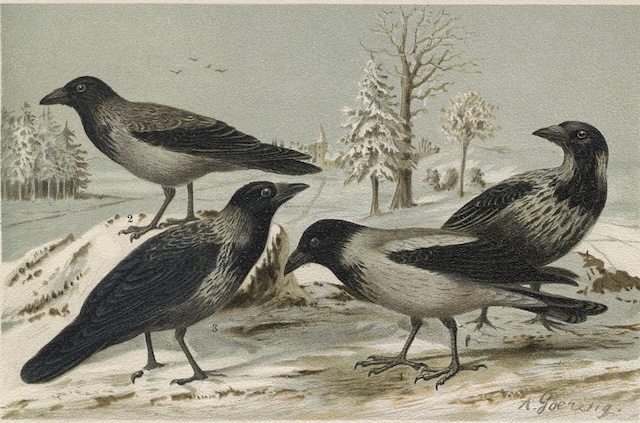 There are two types of crows in the European region where the novel is set: Carrion crows (Corvus corone) and hooded crows (Corvus cornix); those in the book are of the latter species. The two are very closely related, and in some literature the hooded crow is referred to as a subspecies of the carrion crow. Unlike the all-black carrion crow, the hooded crow has a grey body with glossy black tail, wings, and head (hence the "hood").
Crows are members of ...
If you liked Palaces of the Crow, try these:

by Gabrielle Sher
Published 2026
In a powerfully imagined Russia at the height of the pogroms, a grief-stricken family turn to ancient magic to bring their daughter back from the grave.
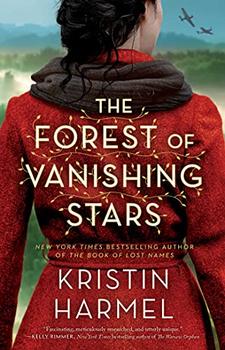
by Kristin Harmel
Published 2022
The New York Times bestselling author of the "heart-stopping tale of survival and heroism" (People) The Book of Lost Names returns with an evocative coming-of-age World War II story about a young woman who uses her knowledge of the wilderness to help Jewish refugees escape the Nazis—until a secret from her past threatens everything.

by Kate Atkinson
Published 2016
The stunning companion to Kate Atkinson's #1 bestseller Life After Life, "one of the best novels I've read this century" (Gillian Flynn).
Theo of Golden by Allen Levi
One spring morning, a stranger arrives in the small southern city of Golden. No one knows where he has come from…or why…