
-
Your next favorite book
is waiting.
Summary | Excerpt | Discuss | Reviews | Beyond the book | Read-Alikes | Genres & Themes | Author Bio

A Novel
by Marie NDiaye Book Reviewed by:
In a small French town, a mediocre witch trapped in a cruel marriage cries watery tears of blood as she passes on her gifts to her twin daughters, who soon must make a choice: stay close to the nest and the mother who nourished them, or soar away from the dead-end claustrophobia their selfish father has imposed?
Lucie comes from a long line of witches, with powers passed down from mother to daughter. Many of them have hidden or repressed their gifts to appease disgusted or fearful men. But against the wishes of her controlling husband, Lucie initiates her twins into their family's peculiar womanhood when they reach the age of twelve. In a few short months, Maud and Lise are crying rich crimson tears, their powers quickly becoming more potent than their mother's, opening them to liberation and euphoria beyond what Lucie and her foremothers ever considered.
Equal parts dreamlike and disquieting, The Witch tells a tale as old as time, with a dark twist: Without looking back, children fly the nest, laying bare the tenuous threads of family that have long threatened to snap. With simmering tension and increasing panic, NDiaye's latest novel in English captures the terror and precarity of motherhood and marriage, and the uncertainty of slowly realizing that your progeny are more dangerous—to the world and to your heart—and freer than you ever could have dreamed.
Excerpt
The Witch
When my daughters turned twelve I initiated them into the mysterious powers. Mysterious not so much in that they didn't know those powers existed, or in that I'd kept them secret (I hid nothing from my daughters, since we were of the same sex), but rather in that, having grown up dimly and apathetically aware of that reality, they no more understood the need to care about it or suddenly somehow master it than they saw the interest in learning to cook the dishes I served them, the product of a domain just as remote and unenticing. Nonetheless, they never thought of rebelling against the tedious instruction involved. Not once, some sunny afternoon, did they try to invent a pretext to get out of it. I liked to think that this docility in my undocile daughters, my unruly, impulsive twins, was born of a recognition that in spite of everything they had a sacred obligation to uphold.
We gathered in a spot well away from their father's eye, down in the basement. There, in that ...
What are you reading this week? And what did you think of last week’s books? (4/30/2026)
...Hazzard. This was a fascinating tale of the crew that transported the American doctor and nurse working in Liberia after they contracted ebola. Read The Witch by Marie NDiaye. I just noticed this is a BB editor's feature this week it was an interesting tale that started strong but for me it kind of fizzled by the end. A st...
-Anne_Glasgow
International Booker Prize 2026 longlist
...ory of love between two women, nested in an artful exploration of language, history and power." Buy from Bookshop.org https://www.awin1.com/cread.php The Witch by Marie NDiaye, translated from French by Jordan Stump: "A mediocre witch, in a mediocre marriage, tries to pass on her gifts to her twin daughters, who, it becomes...
-Anne_Glasgow
The Witch begins with a supernatural premise: Lucie, who has inherited certain powers of vision and foresight from her mother, tasks herself with passing on these powers to her twin preteen daughters. And while additional otherworldly events occur, the focus is not primarily on the powers themselves, but on how her daughters respond to them and how Lucie feels about everything that happens next. The story is thoroughly steeped in modern French society—in neighborly rumors and gossip, in class aspirations and pretensions, in female solidarity and lack thereof—so readers of realist literary fiction who aren't immediately sold on reading a story about "a witch" won't necessarily stumble over the magical elements. This is a profound, moving, and extremely funny story about a woman searching for stability as everything she knows careens out of control...continued
Full Review
 (722 words)
(Reviewed by Elisabeth Cook).
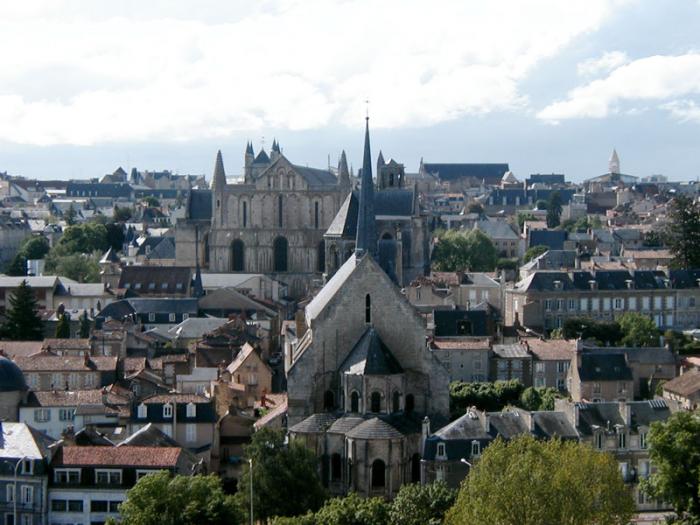 In Marie NDiaye's The Witch, main character Lucie's husband, Pierrot, leaves Lucie and their two daughters—initially to visit his mother in the suburbs of the city of Poitiers, though it ends up being a longer absence. Poitiers is a university town (home to the University of Poitiers) in west-central France in the Nouvelle-Aquitaine region with a population of around 80,000.
Unassuming but respected for its blend of medieval history and modernity, Poitiers is played for laughs in The Witch, portrayed as being representative of all that is dreary and distasteful, insignificant and dull by comparison to cosmopolitan Paris. When Lucie's daughters find out their father has gone to visit their grandmother, one of them says, "Yuck," and...
If you liked The Witch, try these:

by Katie Kitamura
Published 2026
One woman, the performance of a lifetime. Or two. An exhilarating, destabilizing Möbius strip of a novel that asks whether we ever really know the people we love.

by Danzy Senna
Published 2025
A brilliant dark comedy about love and ambition, failure and reinvention, and the racial- identity-industrial complex from the bestselling author of Caucasia.

by Yasmin Zaher
Published 2025
A bold and unabashed novel about a young Palestinian woman's unraveling as she teaches at a New York City middle school, gets caught up in a scheme reselling Birkin bags, and strives to gain control over her body and mind





The library is the temple of learning, and learning has liberated more people than all the wars in history
Click Here to find out who said this, as well as discovering other famous literary quotes!

Can you name the title?
Test your book knowledge with our daily trivia challenge!