
-
Your next favorite book
is waiting.
Summary | Excerpt | Reviews | Beyond the Book | Read-Alikes | Genres & Themes | Author Bio

A Novel
by Marie NDiaye Book Reviewed by:
This article relates to The Witch

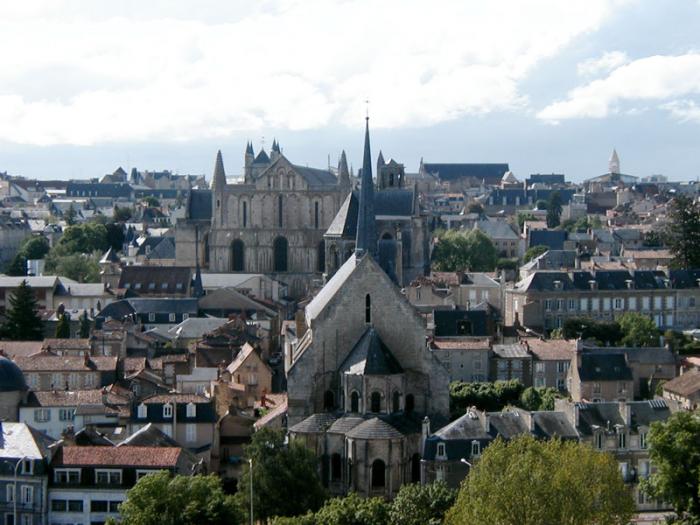 In Marie NDiaye's The Witch, main character Lucie's husband, Pierrot, leaves Lucie and their two daughters—initially to visit his mother in the suburbs of the city of Poitiers, though it ends up being a longer absence. Poitiers is a university town (home to the University of Poitiers) in west-central France in the Nouvelle-Aquitaine region with a population of around 80,000.
Unassuming but respected for its blend of medieval history and modernity, Poitiers is played for laughs in The Witch, portrayed as being representative of all that is dreary and distasteful, insignificant and dull by comparison to cosmopolitan Paris. When Lucie's daughters find out their father has gone to visit their grandmother, one of them says, "Yuck," and the other remarks, "I'd rather die right here where I sit than go to Poitiers."
Lucie has her own horror of the place, describing her mother-in-law as "mired in that sad little hole of a house in distant Poitiers, on a modest street lined with similar little holes, from which sometimes emerged the suspicious faces of small-minded, fastidious retirees." Pierrot's mother and the space she inhabits seem to represent a kind of familial cage, along with conservative family values that Lucie feels suffocated by but also torn about, unsure if she wants to be part of a family unit or be free, unsure if she wants her daughters to flee the nest and do as they please or remain a part of her world forever.
The literary and symbolic utility of Poitiers in NDiaye's book is probably not meant to be a complete or accurate reflection of the city itself, which is known for its Romanesque architecture, including Notre-Dame-la-Grande church and its meticulously sculpted 12th-century facade. The Saint-Pierre cathedral includes a crucifixion window that is believed to have been commissioned by Henry II. The Musée Sainte-Croix houses collections ranging from prehistory to recent years and has a special focus on women's art.
Poitiers also boasts restaurants serving a variety of French, international, and regional cuisine, and the larger Nouvelle-Aquitaine region is a world-renowned area for wine production. But its greatest appeal for Lucie's tween daughters is no doubt that it is connected by rail to the cities of Paris and Bordeaux, and this is likely true for Lucie herself, too.
In the end, Lucie's feelings about Poitiers are personal. Modest, flexible places like this—mid-sized, in-between cities that lack the peace and charm of rural areas and also the amenities and constant diversions of urban life—may become blank canvases onto which people's own experiences are projected, or spaces where they find themselves confronted with repressed thoughts and feelings. Speaking of Pierrot's mother's kitchen, Lucie declares that "just setting foot on the warm, gleaming linoleum was enough to fill everyone but Pierrot's mama with such boredom and dejection that all civility went out the window, all gentility, giving free reign to ugly thoughts of criminal acts, bloody but lifesaving, a distraction."
Poitiers in 2007, photo by Mario Vercellotti, courtesy of Wikimedia Commons
Filed under Places, Cultures & Identities
 This article relates to The Witch.
It first ran in the April 22, 2026
issue of BookBrowse Recommends.
This article relates to The Witch.
It first ran in the April 22, 2026
issue of BookBrowse Recommends.

L.A. Women by Ella Berman
Two ambitious writers in 1960s LA face betrayal when one writes a novel based on the other's life.







Your guide toexceptional books
BookBrowse seeks out and recommends the best in contemporary fiction and nonfiction—books that not only engage and entertain but also deepen our understanding of ourselves and the world around us.


