
-
Your next favorite book
is waiting.
Summary | Excerpt | Reviews | Beyond the book | Read-Alikes | Genres & Themes | Author Bio

 Book Reviewed by:
Annalee Newitz's Automatic Noodle is a sly, quirky, and satisfying novella that stirs together post-revolutionary politics, robot labor rights, food culture, and internet trolling into a whip-smart satire of San Francisco's tech-fueled future. Compact at just 160 pages, the story is light on length but rich with commentary and flavor—especially the hand-pulled, chili-oil-laced flavor of Shaanxi noodles.
Set in a near-future San Francisco, the plot begins after California has successfully fought a war of independence against the United States. That war, crucially won with the help of a class of artificially intelligent humanoid robots—called Human Equivalent Embodied Intelligences (HEEIs)—has birthed a new nation with its own contradictions. The robots, once soldiers, are now second-class citizens. They have more rights in California than in America, where they are not recognized as legal entities at all, but they still face legal barriers to self-ownership, employment, and personhood. Against this backdrop, four ex-military robots—Staybehind, Sweetie, Hands, and Cayenne—team up with Robles, an undocumented human from America, to open a noodle restaurant called Authentic Noodle.
Each robot has a distinct role in the operation: The chef is Hands, who was inspired by watching humans pull noodles at a local spot called Xi'an Spices, a fictional cross between New York's Xi'an Famous Foods and San Francisco's Terra Cotta Warrior (see Beyond the Book); Sweetie handles logistics; Staybehind does security; and Cayenne is the marketing genius. Robles, the only human, is their legal fig leaf, because robot-owned businesses are banned under California law. Their concept quickly becomes a buzzy hit in San Francisco's trendy food scene, and eager lunch crowds line up down the block even before the soft open.
But their success is short-lived when the restaurant becomes the target of a coordinated online smear campaign. The name "Authentic Noodle" is twisted by anonymous trolls into "Automatic Noodle," mocking the robots' attempt to create "authentic" human food. Claims that "robot paste" causes cancer flood GrandoSando, a fictional food app that combines social media, ratings, and food delivery in one monopolistic platform. The restaurant's rating plummets, and with it, its visibility and viability.
Newitz, known for both science fiction and nonfiction about government surveillance, psychological warfare, and misinformation, is clearly in their element here. Automatic Noodle is a natural evolution of their earlier work, blending speculative futurism with biting cultural critique. The narrative is quirky and humorous, but beneath the banter lie deeply relevant themes: who gets to work high-demand, prestigious jobs; who gets to be a citizen; and who gets to define "authenticity." Robots here are obvious proxies for immigrants and other marginalized laborers who are legally precarious, socially suspect, and economically vulnerable; the parallels, while well-considered and highly relevant, can be a little on-the-nose.
The novel also affectionately lampoons both foodie culture and Bay Area tech culture. GrandoSando is a clear jab at the dominance of apps like Yelp, DoorDash, and Uber Eats, which all too often dictate restaurant success. The obsession with buzz, hype, and branding—especially around food—is skewered, along with "soft openings," the theater of artisanal authenticity, and crypto-economics (the cryptocurrency Ethereum, called simply ETH, is a popular currency in the book). Robots are critiqued for lacking ancestral ties to Shaanxi, raising sly questions about cultural gatekeeping and who is allowed to participate in specific culinary traditions. And the story is deeply embedded in San Francisco, providing a rewarding specificity and, no doubt, some chuckles of acknowledgement to those readers who are familiar with the area. Neighborhoods as varied as the Mission, the Castro, the Sunset, and the Richmond all play a role; Walnut Creek, an affluent suburb, is positioned as a bastion of conservative suspicion where the restaurant's main troll "SuzyQ" is believed to live.
Despite its short length, Automatic Noodle is layered and thoughtful. Newitz has created robot characters who are complex and funny; they have strong personalities, anxieties, and pride, and it's interesting to follow along as they navigate a world that was not built for them: They debate the authenticity of TV shows ("Are there bots in it? Because I'm sick of watching shit that exclusively centers the human perspective") and bristle at double standards. Each one is also navigating a different form of legal bondage and contract debt—a grim parallel to modern-day gig economy precarity and historical systems of indenture.
In the end, Automatic Noodle isn't just about robots serving food—it's about building something meaningful in a world designed to exclude you. Through clever prose and deep empathy, Newitz shows how even "non-human" characters can hunger for connection, purpose, and a seat at the table.
 This review
first ran in the August 13, 2025
issue of BookBrowse Recommends.
This review
first ran in the August 13, 2025
issue of BookBrowse Recommends.

If you liked Automatic Noodle, try these:

by Kotaro Isaka
Published 2025
A gripping novel mixing mythology, family drama, espionage, and high technology from the international bestselling author of Bullet Train, already in development for a major film starring Anne Hathaway and Salma Hayek.

by Rebecca Kauffman
Published 2026
For fans of The Bear, Elizabeth Strout, and Jennifer Egan, The Reservation explores the loves and labors of an ensemble of more than a dozen restaurant workers as they strive to get a perfect meal to the table.
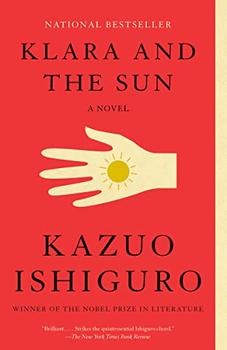
by Kazuo Ishiguro
Published 2022
Klara and the Sun is a magnificent novel from the Nobel laureate Kazuo Ishiguro--author of Never Let Me Go and the Booker Prize-winning The Remains of the Day.



Be careful about reading health books. You may die of a misprint.
Click Here to find out who said this, as well as discovering other famous literary quotes!

Can you name the title?
Test your book knowledge with our daily trivia challenge!
Your guide toexceptional books
BookBrowse seeks out and recommends the best in contemporary fiction and nonfiction—books that not only engage and entertain but also deepen our understanding of ourselves and the world around us.
