
-
Your next favorite book
is waiting.
Summary | Excerpt | Reviews | Beyond the Book | Read-Alikes | Genres & Themes | Author Bio

 Book Reviewed by:
This article relates to Automatic Noodle

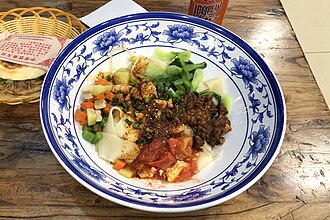 Shaanxi cuisine, also known as Qin cuisine, originates from Shaanxi province in north-central China, a region historically significant as the starting point of the ancient Silk Road and home to Xi'an, one of China's oldest capitals. Its geography, straddling the Loess Plateau and bordered by the Central Plains, has contributed to a cuisine that blends bold northern flavors with influences from western China and Central Asia.
Characterized by its hearty, robust flavors, Shaanxi cuisine features a prominent use of vinegar, garlic, chili oil, and spices such as cumin. Unlike the sweeter flavors of Jiangnan or the spicier Sichuan cuisine, Shaanxi dishes often emphasize sourness and umami, with a rich, oily mouthfeel and chewy textures, especially from wheat-based staples.
A hallmark dish is biang biang mian (or biang biang noodles), named for the onomatopoeic "biang" sound made when slapping the wide, hand-pulled noodles on a countertop. These thick, belt-like noodles are typically served with chili oil, garlic, and sometimes vegetables or braised meat. Other signature dishes include roujiamo (often dubbed a "Chinese hamburger"), yangrou paomo (crumbled flatbread in lamb soup), and hulatang (spicy peppery soup).
Outside of Shaanxi, the cuisine has gained popularity in major urban centers like Beijing and Shanghai, and overseas in Chinatowns across the US, Canada, and Australia. Most notably, Xi'an Famous Foods brought Shaanxi-style noodles and street food to mainstream attention in New York City, helping elevate the cuisine's profile internationally.
Xi'an Famous Foods was founded in a Flushing, Queens basement food stall in 2005 by Shaanxi‑born immigrant David Shi (later joined by his son Jason Wang). The fast-casual restaurant, which now has multiple locations, was one of the first to introduce the Shaanxi region's bold flavors to US consumers, when they were were relatively unknown compared to neighboring Szechuan's mouth-numbing spice. Today, the restaurant stands as a beacon of Chinese cuisine in New York; it was featured on Anthony Bourdain's No Reservations and has been lauded by The New York Times, New York Magazine, and others. It was Xi'an Famous Foods' hand-ripped noodles that sparked Annalee Newitz's idea for Automatic Noodle.
Biang biang noodles at a Shaanxi-style restaurant in Beijing. Photo by user N509FZ, CC BY 4.0. Image courtesy of Wikimedia Commons.
Filed under Places, Cultures & Identities
 This article relates to Automatic Noodle.
It first ran in the August 13, 2025
issue of BookBrowse Recommends.
This article relates to Automatic Noodle.
It first ran in the August 13, 2025
issue of BookBrowse Recommends.






Don't join the book burners. Don't think you are going to conceal faults by concealing evidence that they ever ...
Click Here to find out who said this, as well as discovering other famous literary quotes!

Can you name the title?
Test your book knowledge with our daily trivia challenge!
Your guide toexceptional books
BookBrowse seeks out and recommends the best in contemporary fiction and nonfiction—books that not only engage and entertain but also deepen our understanding of ourselves and the world around us.

.jpg)