
-
Your next favorite book
is waiting.
Summary | Excerpt | Reviews | Beyond the book | Read-Alikes | Genres & Themes | Author Bio

A Journey into Consciousness
by Michael Pollan Book Reviewed by:
During Michael Pollan's research for This Is Your Mind on Plants (2021), which discusses the use and effects of psychedelic substances, the author ingested a handful of magic mushrooms while relaxing in his garden. He writes that he became "certain of the sentience of the flowering plants around [him]," and in pondering the experience later, he began to wonder about consciousness in general (what defines it, which beings possess it, how did it evolve, etc.). His curiosity led him to want to learn more, and what he discovered over the course of his investigations is the focus of his new book, A World Appears: A Journey into Consciousness.
Pollan divides his subject into "four different dimensions of consciousness, beginning with its earliest and most elementary manifestation in nature and ending with its most complex and rare creation: selves like ours." He starts with sentience ("the ability of living beings to register sensations and respond intelligently"), demonstrating that even plants can exhibit this quality. (He cites several examples of this, including the chameleon vine—Boquila trifoliata—that he says "changes its leaf shape to mimic the plant it climbs on, even when that plant is plastic.") He follows that chapter with one on feeling, then moves on to conscious thought, finally discussing the emergence of the self ("the intuitive sense that we each have located somewhere within our heads a continuous, stable, and abiding 'I' that is the subject of all our experiences").
It quickly becomes apparent that although people have been aware of consciousness for centuries, it really hasn't been studied much until recent decades. The author blames this in part on early scientists (Galileo in particular), who chose to define reality as comprised of measurable characteristics: size, shape, mass, motion, etc. Focusing on provable data minimized the Roman Catholic Church's condemnation of these investigations but also had the effect of setting a direction for future research. As a result, the "easy problems" of consciousness—inner workings like learning and memory—have been widely examined, but the "hard problem" of consciousness—"why any of these mental operations are accompanied by any conscious experience whatsoever"— remains very much open for debate.
One of the biggest issues standing in the way of our understanding of consciousness, the author suggests, is the fact that we can only look at it from inside the subject. He uses the analogy of a fish trying to understand water, or humans looking at the cosmos. It can only be done from within the thing we're trying to study, creating an insurmountable bias—a blind spot. Throughout the book Pollan states his belief, backed up by several scientists whose research he cites, that some psychedelic drugs like LSD, mescaline, and psilocybin can alter reality in such a way that the self disappears (see Beyond the Book). He speculates that such out-of-body experiences might be the only way humans can gain enough distance to truly study the subject.
Pollan also discusses how "poets and priests" are perhaps better suited than scientists for developing an understanding of consciousness. One section focuses on how literature captures human thought ("We probably know more about Emma Bovary's thinking than we do any person in our world, perhaps even ourselves"), and how a stream-of-consciousness narrative such as In Search of Lost Time by Marcel Proust comes close to emulating the process. Additionally, the author touches on how both Buddhism and meditation have the potential to enhance our understanding of the self.
While the book is fairly accessible, it's also denser than many of Pollan's works. As he seeks to understand and illuminate his subject, his prose grows increasingly complex. The author's extensive use of personal experiences, concrete examples, and metaphors help illustrate the concepts he's trying to get across to the layperson, but I found that serious contemplation was often required in order to understand the point he was making. It's consequently an entertaining and thought-provoking read, but not a fast one.
Pollan offers no conclusions regarding the nature of consciousness. He writes, "Nearing the end of this journey, I find myself not at all sure what to believe, if anything. I'm abashed to say I know less now than I did when, naively, I set out to unravel the mystery of consciousness." A World Appears, then, can be thought of more as a survey of what we currently know—and don't know—than a definitive explanation of the subject. Beyond the science, though, Pollan strives to help his readers share his awe for how truly remarkable we are. Through his research he comes to view consciousness "less as a scientific or philosophical puzzle to be solved and more as a practice, a way to once again be altogether here, present to life…That, I guess, is the prize won on this quest…Consciousness is a miracle, truly, and remains the deepest of mysteries." In A World Appears, the author welcomes us to join him in his wonderment.
 This review
first ran in the February 25, 2026
issue of BookBrowse Recommends.
This review
first ran in the February 25, 2026
issue of BookBrowse Recommends.

If you liked A World Appears, try these:
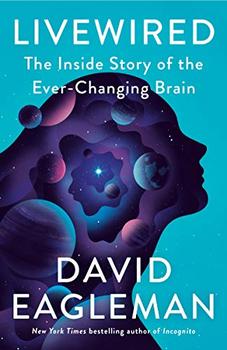
by David Eagleman
Published 2021
From the best-selling author of Incognito and Sum comes a revelatory portrait of the human brain, based on the most recent scientific discoveries about how it continually adapts, recreates, and formulates new ways of understanding the world we live in.
by Anil Ananthaswamy
Published 2016
A tour of the latest neuroscience of schizophrenia, autism, Alzheimer's disease, ecstatic epilepsy, Cotard's syndrome, out-of-body experiences, and other disorders—revealing the awesome power of the human sense of self from a master of science journalism
by Benedict Carey
Published 2015
In the tradition of The Power of Habit and Thinking, Fast and Slow comes a practical, playful, and endlessly fascinating guide to what we really know about learning and memory today—and how we can apply it to our own lives.
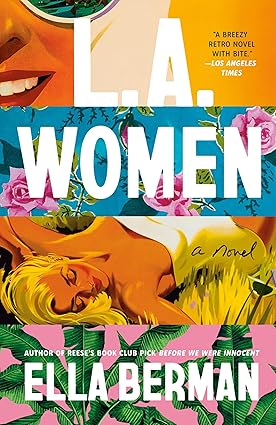
L.A. Women by Ella Berman
Two ambitious writers in 1960s LA face betrayal when one writes a novel based on the other's life.




Your guide toexceptional books
BookBrowse seeks out and recommends the best in contemporary fiction and nonfiction—books that not only engage and entertain but also deepen our understanding of ourselves and the world around us.

