
-
Your next favorite book
is waiting.
Summary | Excerpt | Reviews | Beyond the book | Read-Alikes | Genres & Themes | Author Bio
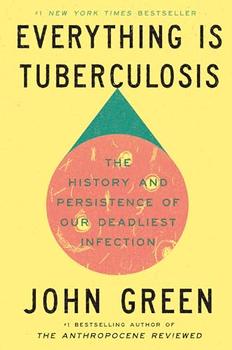
The History and Persistence of Our Deadliest Infection
by John Green Book Reviewed by:
Most of you reading this are probably already familiar with John Green as a fiction writer, and may have even read and loved his widely successful young adult books such as The Fault in Our Stars, Turtles All the Way Down, and Looking for Alaska. With Everything Is Tuberculosis, the award-winning author steps for a second time (after The Anthropocene Reviewed) into the world of nonfiction.
The book starts as a quirky read about, well, tuberculosis (TB). It shares a wide array of facts and trivia about the disease, ranging from its history to its science. Green shows us how it interweaves with various historical figures and events before delving into the science behind the bacteria, their physiology, their life cycle, and the development of vaccines. He includes fun tangents about shoes, fashion, and Arthur Conan Doyle. This is how the author captures our attention. And once he has it, he reveals what the book is truly about and why he is so obsessed with tuberculosis: the injustices that surround it.
It is clear that Green's goal is to raise awareness of a grave health crisis that is often overlooked in wealthier countries. Many of those living in places where TB isn't an everyday concern have forgotten about the disease, and when it does enter the conversation, it's frequently framed by racism and stigmatization. These views are so entrenched in a certain understanding of TB that people may not even realize that they're perpetuating them. Green's book seeks to change all that by posing a pressing question: why does a disease for which we have a cure still kill millions?
Even though tuberculosis is curable in rich countries where it has almost vanished, it continues to kill mercilessly in many poorer nations. According to Green, the main culprits are not the bacteria, but inequality, racism, and human greed.
When TB was common in Europe and the US, for example, it was romanticized; associated with beauty, fragility, and artistic temperament. But once it nearly vanished from the Western world and moved to its former colonies, it became stigmatized as an illness of poverty, and blame shifted to the sick, portrayed as being ignorant or careless, instead of to the social inequalities that forced them to live in conditions that helped the disease to thrive, such as overcrowded buildings, undernourishment, and limited access to clean water. What's more, Green points out, because of structural inequalities, those who need treatment the most are practically excluded from healthcare systems, aggravating the problem.
Richer nations also stopped caring once their citizens stopped getting sick. For decades, research into better cures stagnated because it was deemed not cost-effective, and due to the artificially inflated cost of drugs, delivering diagnostic tools and treatments to poorer countries is considered unprofitable. Thus, poorer countries (and sometimes minorities and immigrants within wealthier countries) cannot access newer, safer, and better drugs and must rely on outdated diagnostic tools and medicines that are not as effective, a situation that causes preventable deaths from a disease that, as Green often notes, we already know how to cure. The above not only has a devastating human cost but also allows drug-resistant strains to spread further.
Green makes this human cost of TB painfully clear by sharing stories of doctors, health workers, patients, and their families, whose lives and struggles illuminate what statistics cannot. Most notably, he tells us of Henry, a man who was a 17-year-old patient with drug-resistant TB when Green first met him. His story captured Green's attention and prompted him to write Everything Is Tuberculosis. Snippets of his experience exemplify why we must care about the book's subject, and his recovery is a reminder that the barriers to curing TB are artificial.
Henry is a warm, curious, and energetic young man whose kindness and perseverance make him unforgettable. He loves learning, writing poems, and making people smile. Starting when he was six, he battled with multi-drug-resistant tuberculosis, which kept him in hospitals for most of his life, away from school and his family and friends. He had to receive toxic treatments that kept his TB in check but caused him other significant health issues. He had to see others suffer and succumb to the disease, and he would have too, had he not received a better treatment plan with safer and more effective drugs. After he got funding and the tailored treatment he needed, he quickly started recovering (thanks to the efforts of Dr. Girum and the nonprofit organization Partners in Health).
Green's writing is simple yet engaging, effectively conveying his frustration with and passion for the subject. While at times Everything Is Tuberculosis doesn't delve as deeply as I would have liked into the many issues it introduces, this breadth over depth is part of the book's strength, since it makes its topic clear even to those who may have never thought about it before. In short, by keeping things simple, it gets its points across and makes its lessons stick. And those of us interested enough to delve deeper into any of the many aspects of this disease are given an excellent starting point.
All in all, the book hits its target: it makes the quiet persistence of a major disease and its true, socioeconomic causes harder to ignore.
 This review
first ran in the December 10, 2025
issue of BookBrowse Recommends.
This review
first ran in the December 10, 2025
issue of BookBrowse Recommends.

If you liked Everything Is Tuberculosis, try these:

by Thomas Levenson
Published 2025
The centuries-long quest to discover the critical role of germs in disease reveals as much about human reasoning—and the pitfalls of ego—as it does about microbes.
So You Want to Talk About Race
by Ijeoma Oluo
Published 2019
In this New York Times bestseller, Ijeoma Oluo offers a hard-hitting but user-friendly examination of race in America
by Meredith Wadman
Published 2018
The epic and controversial story of a major breakthrough in cell biology that led to the conquest of rubella and other devastating diseases.

L.A. Women by Ella Berman
Two ambitious writers in 1960s LA face betrayal when one writes a novel based on the other's life.






Your guide toexceptional books
BookBrowse seeks out and recommends the best in contemporary fiction and nonfiction—books that not only engage and entertain but also deepen our understanding of ourselves and the world around us.

