
-
Your next favorite book
is waiting.
Summary | Excerpt | Reviews | Beyond the book | Read-Alikes | Genres & Themes | Author Bio

A Novel
by Gish Jen Book Reviewed by:
After Gish Jen's mother, Agnes Jen (née Loo Shu-Hsin), died during the early days of the COVID-19 pandemic, Jen began what she thought would be a straightforward memoir. As she wrote of her own life, however, she found herself contemplating how it had been shaped by the difficult relationship she had had with Agnes. "All my life," Jen writes, "I have wanted to know how our relationship went wrong—how I became her nemesis, her bête noire, her lightning rod, a scapegoat." Bad Bad Girl became her attempt to answer that question: to understand why her mother was so emotionally and physically abusive, and to forgive her for the pain she inflicted.
Jen had asked her mother about her life in China many times, but Agnes "was not anxious to be known," Jen writes. She speculated that her mother hadn't wanted to relive trauma ("Who wanted to revisit the Battle of Shanghai, or the Japanese occupation, or the privations of immigration?") and also that "women of her background simply do not have the autobiographical impulse we in the West tend to assume is universal." She was consequently compelled to fictionalize much of Agnes' life, and it's this story, inferred from the few facts Jen could glean, that makes up the first half of the book. It's fascinating reading: Jen constructs Agnes' world vividly, beginning with the milieu of wealthy Shanghai residents of Agnes' childhood, through her emigration to the United States, her marriage to fellow Chinese immigrant Jen Chao-pe, and the births of their children.
Jen also imagines Agnes' contentious relationship with her own mother, envisioning that when Agnes asks questions, her mother responds, "Bad bad girl! You don't know how to talk… With a tongue like yours, no one will ever marry you." Her mother hits her frequently and often remarks that it's a shame she was born a girl. Agnes is neglected, unappreciated, and subjected to nonstop criticism.
In the second half of the book, Jen moves to her own life: her childhood, marriage, children, the deaths of her parents, and, across the years, her journey to become a writer. This part reads closer to true memoir, unlike the fictionalized speculation of the first section, although we can't necessarily assume that it's all true: in her introductory note, Jen says that her goal is to convey the "troubled relationship" she had with her mother "as honestly as possible," but that in order to do that, the book is not simply a record of events but is, instead, "reality transmuted."
Running through this section is the same kind of abuse Agnes experienced, but now Agnes is the perpetrator and Jen the victim. Jen recalls being beaten, neglected, and told she was a "bad bad girl" whenever she dared to open her mouth. The second of five children, Jen recounts the many times she was treated differently than her siblings, down to the way Agnes interacted with Jen's children. "Some grandchildren were babysat, but not mine. Some grandchildren got pianos, but not mine. Some grandchildren were included in Chinese New Year, but not mine," she writes.
One gets the sense that Jen is trying to rationalize her mother's behavior—Agnes is only reflecting what she, herself, learned as a child. Jen also seems to blame some of her mother's actions on cultural differences, as when she and her mother talk about love:
"Chinese people don't say love this, love that, she says. Chinese people say you did something wrong.
Was that all Chinese people or just you? I ask. Because I've always wondered.
Chinese people are like that, she insists. They like to criticize."
And she readily acknowledges that her mother did not have an easy life and sacrificed much. But although Jen seems to want to find a way to forgive her mother, by the book's conclusion it feels like she still has a way to go toward that end. She has thrived, but not so much because of her mother as in spite of her.
Although Agnes is dead as Jen writes, she remains an active part of the storytelling process, interjecting comments as if she's watching over Jen's shoulder. "I knew what this book was going to say even before you wrote it," Jen imagines her mother observing. "I knew it was going to say I was a terrible mother, blah blah blah blah. The first part explains how I became so terrible. The second part says how terrible I was." ("And you don't feel a little bad, looking back?" Jen responds.) Even after death, Jen seems to say, a mother's voice is present in many a daughter's head forever.
Bad Bad Girl may sound as if it's not covering any new ground—after all, many books have been written about difficult mother-daughter relationships—but Jen's entry in the genre is exquisite. I envision many women especially will relate to the author's yearning for connection with her mother—for more closeness, for understanding, to be understood—and will find the book to be a poignant catalyst for contemplation and discussion.
 This review
first ran in the October 22, 2025
issue of BookBrowse Recommends.
This review
first ran in the October 22, 2025
issue of BookBrowse Recommends.

If you liked Bad Bad Girl, try these:

by Eve J. Chung
Published 2025
A propulsive, extraordinary novel about a mother and her daughters' harrowing escape to Taiwan as the Communist revolution sweeps through China, by debut author Eve J. Chung, based on her family story.
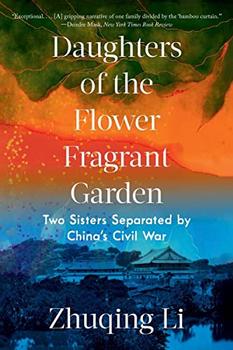
Daughters of the Flower Fragrant Garden
by Zhuqing Li
Published 2023
Sisters separated by war forge new identities as they are forced to choose between family, nation, and their own independence.
Battle Hymn of the Tiger Mother
by Amy Chua
Published 2011
An awe-inspiring, often hilarious, and unerringly honest story of one mother's exercise in extreme parenting, revealing the rewards - and the costs - of raising her children the Chinese way.
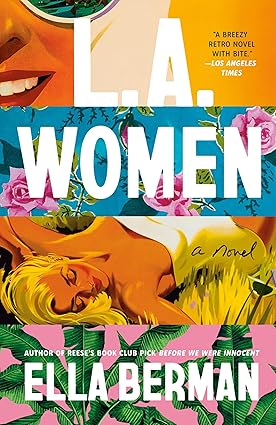
L.A. Women by Ella Berman
Two ambitious writers in 1960s LA face betrayal when one writes a novel based on the other's life.






Your guide toexceptional books
BookBrowse seeks out and recommends the best in contemporary fiction and nonfiction—books that not only engage and entertain but also deepen our understanding of ourselves and the world around us.

