
-
Your next favorite book
is waiting.
Summary | Excerpt | Reviews | Beyond the book | Read-Alikes | Genres & Themes | Author Bio
A Novel
by R. F. Kuang Book Reviewed by:
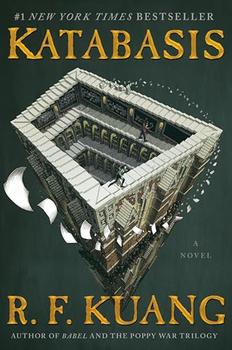
R.F. Kuang has continued her blisteringly productive streak with her latest novel, Katabasis, which, like 2022's Babel, imagines a world in which academia and magic are intertwined. The book follows Alice Law and Peter Murdoch, two Cambridge postdocs who study "Analytic Magick," as they journey into Hell to recover the soul of their tyrannical advisor, Professor Jacob Grimes. Kuang riffs on ancient journeys to the underworld, like those of Aeneas, Orpheus, and Dante, but reimagines them in a distinctly modern register and layers them with a biting satire of academia and the trauma of abusive mentorship.
The story begins in the wake of Grimes' death, for which Alice secretly blames herself. Burnt out, haunted, and armed only with her catechisms ("I am Alice Law I am a postgraduate at Cambridge I study analytic magick") to keep her thoughts from unraveling, she and Peter set off into the underworld. Alice's only desire in life is to become a magician, and working at Professor Grimes' lab should have guaranteed any tenure track position she wants in her field; but Grimes' death means that she now won't be able to receive his coveted letter of recommendation. She's come too far in her career to forfeit now, she thinks—and so Grimes must be brought back to life.
Alice and Peter descend through Hell searching for Grimes, and as they do, Kuang builds a geography of its circles, or courts, that mirrors both Cambridge and, metaphorically, the structures of academia: Pride is a library in which scholars must defend their theories; Desire is a storm-battered student union. Later circles mock the absurdities of research culture, tenure battles, and intellectual pretension. As they proceed, Alice begins to question both her motivation for finding her advisor and her desire to become a magician, and wonders if her dream has been worth all the sacrifices she's made; and as her rigidly defined goals slip away, she must seek a new sense of purpose. At the same time, Alice and Peter, competitive colleagues turned reluctant allies, are forced to reckon with the ways Grimes pitted them against each other, even as their intellectual brilliance drew them closer. Their relationship—one of rivalry, yearning, and mutual recognition—becomes the emotional core of the book, and representative of one of Kuang's thematic preoccupations, which is that intellectual pursuit alone cannot sustain life; what matters is companionship and vulnerability.
Encounters with other figures represent facets of Kuang's critique. Elspeth Bayes, a former student of Grimes who died by suicide after becoming disillusioned with the farce of academia, serves as both mirror and warning for Alice. The Kripkes, rogue magicians whose unethical research represents academia without oversight or conscience, become her adversaries. John Gradus, Alice and Peter's guide through Hell, collects stories from his living visitors and revels in their details—their favorite foods, current events, the minutiae of life—so that he can experience life without having to confront his sins (a requisite, in Kuang's world, for being reborn and leaving Hell). He embodies one of Kuang's central concerns in Katabasis: What is it, exactly, that makes life worth living?
As the descent deepens, Alice must confront her past with Grimes—his charisma, his abuse, and her complicity. Unlike in many stories of predatory mentorship, Kuang refuses simplicity: Alice is neither wholly victim nor villain, neither powerful nor powerless, but someone whose hunger for knowledge left her vulnerable to exploitation. The climax arrives in Dis, the final court of Hell, where Alice is faced with a choice: the messiness and uncertainty of life, if she returns to the world, or the seductive promise of academic immortality if she remains in Hell.
Kuang's prose style is dazzling—erudite yet irreverent, punctuated by sardonic humor. Her satirical critiques give the book a sharp edge; the novel is as funny as it is devastating, mocking academia's pomp and bureaucracy (Kuang is a doctoral student herself, and has degrees from both Oxford and Cambridge) while laying bare its toxic pressures in an era of scarcity and competition. Deftly balancing satire, myth, and psychological realism, Katabasis is both intellectually rich and emotionally raw. For anyone who has felt crushed by institutions, devoured by ambition, or trapped in the orbit of a brilliant mentor, the novel will cut close to the bone. Yet it also offers a vision of survival, of choosing life over oblivion, by asking what kind of hells we inhabit today—and how we might return from them. It is, in every sense, a descent worth taking.
 This review was originally published in The BookBrowse Review in September 2025, and has been updated for the
July 2026 edition.
Click here to go to this issue.
This review was originally published in The BookBrowse Review in September 2025, and has been updated for the
July 2026 edition.
Click here to go to this issue.

If you liked Katabasis, try these:

by Tesia Tsai
Published 2026
A sweeping debut inspired by the Chinese folk practice of necromancy, Deathly Fates is perfect for fans of Descendant of the Crane, The Bone Shard Daughter, and A Magic Steeped in Poison.

by Emily J. Taylor
Published 2025
The New York Times bestselling author of Hotel Magnifique returns with another glittering dark fantasy about a deadly mystery that spans worlds and a teenage girl who must risk everything to uncover the truth.
by Mark Lawrence
Published 2024
Two strangers find themselves connected by a vast and mysterious library containing many wonders and still more secrets, in this powerfully moving first book in a new series from the international bestselling author of Red Sister and Prince of Thorns.

L.A. Women by Ella Berman
Two ambitious writers in 1960s LA face betrayal when one writes a novel based on the other's life.






Your guide toexceptional books
BookBrowse seeks out and recommends the best in contemporary fiction and nonfiction—books that not only engage and entertain but also deepen our understanding of ourselves and the world around us.

