
-
Your next favorite book
is waiting.
Summary | Excerpt | Reviews | Beyond the Book | Read-Alikes | Genres & Themes | Author Bio

A Novel
by Hallie Cantor Book Reviewed by:
This article relates to Like This, But Funnier

 Hallie Cantor's novel, Like This, But Funnier, is about a TV writer who, in 2023, is stalled in her career and hasn't been able to find steady work—a situation that makes her feel ashamed and financially anxious. In a letter to the reader at the beginning of the book, Cantor is up front that this is based on her own life: "I felt like a massive failure. I hadn't had a staff job in years." What she couldn't see, because she was so mired in her own personal anxiety, was that the entertainment industry was "teetering on an inflection point prior to the 2023 writers' strike." At the end of the novel, Caroline, Cantor's protagonist, hears murmurings of a writers' strike about to happen, and everyone she knows starts "comparing notes on how the industry had screwed them over and they could barely make a living." "She wished she'd understood earlier that she wasn't the only one failing," Cantor writes. Cantor's novel is about one woman's experience, but her story is symptomatic of larger industry and economic changes.
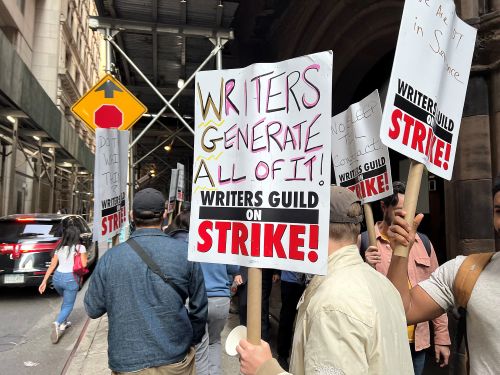
In April of 2023, the Writers Guild of America (WGA) authorized a strike for its members—approximately 11,500 Hollywood television and movie writers—to begin on May 2, the day after their contract with the Alliance of Motion Picture and Television Producers (AMPTP) expired. The guild had been negotiating a new contract with the AMPTP, but couldn't come to a fair deal, especially "given the existential crisis writers are facing," as the negotiation committee wrote in a letter. Writers' incomes had been falling and their employment had become more precarious. Almost 98% of WGA membership voted to authorize a strike, representing a historic margin.
The two big components that were changing the industry and the ways writers made money were—and continue to be—the prevalence of streaming services and the advent of AI. Streaming shows tend to have fewer episodes per season, which means writers are paid less for each job; writers also make less in residuals from streaming shows than from broadcast shows—the executive director of the WGA East called residuals for streaming shows "pitiful." (Interestingly, part of the reason that residuals were first negotiated by the WGA was because if a network is re-running a previously created show in a time slot, that means it's taking away work and income from a writer who could be working on something new for that time slot.) Additionally, writers were worried that executives might try to use new AI technology to eliminate human writing jobs. An AI tool could punch up a script, or come up with a formulaic story, or more—or at least, plenty of people think it could, and production companies would use writers' perceived obsolescence as a way to pay them less and slash jobs.
In July 2023, SAG-AFTRA (the Screen Actors Guild and American Federation of Television and Radio Artists) voted to order their own strike, making for Hollywood's first double strike in 63 years. The WGA strike ended in late September (the SAG-AFTRA strike wouldn't end until November), after 148 days, making it the second-longest strike in the union's history. The new contract established bonuses to writers based on streaming views, set minimum staffing requirements in writers' rooms, and imposed limits on the use of AI. The WGA said that the contract represented "meaningful gains and protections for writers."
Picket line formed by writers that are on strike in New York City. Outside on location of the Marvel Studios Disney+ TV show, Daredevil: Born Again (filming/working title of Out the Kitchen).
Photo by Fabebk, CC BY-SA 4.0
Filed under People, Eras & Events
 This article relates to Like This, But Funnier.
It first ran in the April 8, 2026
issue of BookBrowse Recommends.
This article relates to Like This, But Funnier.
It first ran in the April 8, 2026
issue of BookBrowse Recommends.
L.A. Women by Ella Berman
Two ambitious writers in 1960s LA face betrayal when one writes a novel based on the other's life.




Your guide toexceptional books
BookBrowse seeks out and recommends the best in contemporary fiction and nonfiction—books that not only engage and entertain but also deepen our understanding of ourselves and the world around us.


