
-
Your next favorite book
is waiting.
Summary | Excerpt | Reading Guide | Reviews | Beyond the Book | Read-Alikes | Genres & Themes | Author Bio

A Novel
by María Ospina Book Reviewed by:
This article relates to Only a Little While Here

 Near the beginning of a section in María Ospina's novel Only a Little While Here that chronicles the southward migration of a scarlet tanager, the bird narrowly escapes a fate that dooms dozens of his fellow migrators. Traveling through the landscape of New York City on the way from Connecticut to the forests of Colombia, the tanager and others grow confused by the skyscrapers, becoming "disoriented wings and weary bodies that before this trap were all purpose and thirst for their destination."
Nestled inside the poetic language with which Ospina describes this scene is a very real phenomenon. According to the NYC Bird Alliance, whose Project Safe Flight helps document victims of urban bird strikes, between 90,000 and 230,000 birds are killed in the city each year in these tragic collisions with skyscrapers. This problem isn't confined to New York City, either; the group estimates that nationwide up to a billion birds die from collisions with glass windows each year—the second highest cause of bird death after free-roaming domestic cats.
What contributes to these bird strikes? Most birds that migrate in spring and fall do so at nighttime. Scientists believe they use the stars for navigation, and consequently bright artificial lighting reflected off glass surfaces like those on many modern skyscrapers creates a disorienting environment. Under foggy or cloudy nighttime conditions, in particular, confused birds divert from their customary paths and literally go round in circles, often eventually colliding with a building or other structure.
Fortunately, advocacy groups, equipped with data from citizen scientists and organizations like NYC Bird Alliance, have begun raising awareness around this issue, and some innovative remedies are already underway. Some recommended solutions that can be implemented year-round include turning off interior lights in office buildings, particularly in atrium areas that include greenery; turning off outdoor lighting fixtures and/or using motion sensor lights; and choosing warmer-hued, less bright light bulbs.
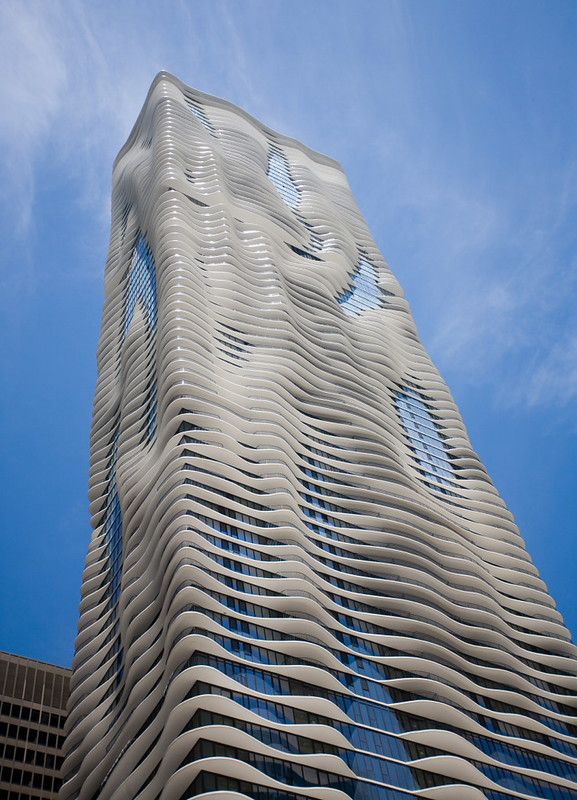
Architects are also getting in on the act. A growing number of cities will only issue new building permits if bird safety is factored into the design. Architects and designers are choosing to utilize translucent panels instead of reflective glass, or, since birds rarely fly into a gap smaller than 2"x4", installing dots, etchings, or other embellishments on windows in decorative arrays. Some buildings, like Chicago's Aqua Tower, use features such as undulating balconies to help alleviate birds' confusion. New ultraviolet coatings are proving successful at giving humans an unobstructed view while being perceptible to birds who can see UV wavelengths, though they are not uniformly visible to all birds across species. An added benefit is that many of these solutions also make buildings more energy efficient—a boon for birds and humans alike.
During spring and fall migration seasons, Canada's Fatal Light Awareness Program (FLAP) and the Cornell Ornithology Lab's BirdCast in the US both monitor bird flight data and can send alerts to commercial building owners, encouraging them to turn off interior and exterior lighting on nights with the highest migratory activity. Slowly but surely, humans are helping our feathered friends complete their migratory journeys more safely, despite our architectural impediments.
Aqua Tower in Chicago, an example of bird-friendly architecture
Photo by Ray Dumas, CC BY-SA 2.0
Filed under Nature and the Environment
 This article relates to Only a Little While Here.
It first ran in the April 8, 2026
issue of BookBrowse Recommends.
This article relates to Only a Little While Here.
It first ran in the April 8, 2026
issue of BookBrowse Recommends.
Theo of Golden by Allen Levi
One spring morning, a stranger arrives in the small southern city of Golden. No one knows where he has come from…or why…






Your guide toexceptional books
BookBrowse seeks out and recommends the best in contemporary fiction and nonfiction—books that not only engage and entertain but also deepen our understanding of ourselves and the world around us.

