
-
Your next favorite book
is waiting.
Summary | Excerpt | Reviews | Beyond the Book | Read-Alikes | Genres & Themes | Author Bio

How Night of the Living Dead Saved My Life and Changed the World
by Daniel Kraus Book Reviewed by:
This article relates to Partially Devoured

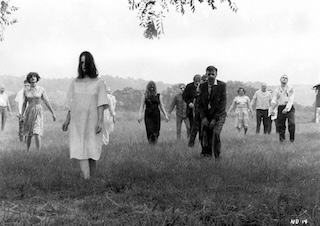 Novelist Daniel Kraus's first nonfiction book, Partially Devoured, is a paean to the movie Night of the Living Dead (1968), a film that has been meaningful to him since his childhood and which helped inspire his writing career. He credits the movie's writer-director, George A. Romero, with creating the being most think of when we hear the term "zombie"—a lurching, mindless, reanimated corpse that hunts the living, intent on eating their brains. But while it's true that Romero spawned the modern zombie film genre, stories of similar creatures appear in folktales across the globe.
The first known reference in literature to zombie-like beings was recorded in The Epic of Gilgamesh, where Ishtar threatens to "make the dead rise, and they will devour the living" if her father Anu (the sun god) won't allow the Bull of Heaven to kill the titular hero. In other words, the first allusion to a zombie apocalypse appeared between 2700 and 2500 BCE.
People feared the return of the dead well before that, however. Perhaps the earliest evidence for this comes from graves in Cyprus. During excavations there, archaeologists found several burials, dating from 4500–3800 BCE, where the remains were weighed down with massive stones. Anthropologists speculate that ancient Greeks believed that those who died unnatural deaths, were murdered, or died by suicide could return as revenants—living dead who walk the Earth seeking revenge or closure—and the stones were employed to keep that from happening.
While many cultures have myths about corpses rising from their graves, most of these undead are more like vampires than what we think of as zombies. They're creatures of intention, often returning because they've been mistreated in some way (generally murdered), and many are said to return to suck the lifeforce out of those who've wronged them. The German Nachzehrer ("afterwards devourer"), Romanian strigoi, and Scandinavian draugr are examples of this type of living corpse.
Zombies, on the other hand, have historically been mindless beings. This concept seems to have arisen in Haiti among practicers of the Vodou religion, and indeed, many Haitians believe in "zombification" today. The zombi or zonbi is said to be a human reanimated by a sorcerer (bokor) for the express purpose of enslaving them. Haitians view zombies not as monsters but as victims, robbed of their humanity and free will (and no brain-eating is involved). The individual can only be freed by the death of the bokor.
Hundreds of reports about these undead creatures are filed in Haiti each year, and there have been documented cases of this phenomenon. According to a 1997 case study in The Lancet, a 30-year-old Haitian woman died after experiencing a fever. She was found three years later, wandering her village. "She was thin, walked extremely slowly and stiffly, would occasionally murmur a few incomprehensible words to answer questions, and required assistance to feed herself," according to an article published by the NIH. It's believed she had catatonic schizophrenia. The article goes on to cite other isolated instances of zombification, with those impacted often diagnosed with psychological disorders. It goes on to point out that this type of condition can also be caused by external influences, such as drugs or viruses. In one case, 33 people in Brooklyn exhibited zombie-like behavior after smoking a batch of synthetic marijuana.
Regardless of whether or not zombies are real, Americans in particular seem enthralled by them. The U.S. Centers for Disease Control (CDC) is one agency that took advantage of this fascination, in 2012 creating a tongue-in-cheek web page devoted to surviving a zombie apocalypse. Dr. Ali Khan, the interim director at the time, explained their decision to post the information: "If you are generally well equipped to deal with a zombie apocalypse you will be prepared for a hurricane, pandemic, earthquake, or terrorist attack." The site was so popular it kept crashing the day it was launched.
Still from Night of the Living Dead (1968), courtesy of The Museum of Modern Art
Filed under Cultural Curiosities
 This article relates to Partially Devoured.
It first ran in the March 11, 2026
issue of BookBrowse Recommends.
This article relates to Partially Devoured.
It first ran in the March 11, 2026
issue of BookBrowse Recommends.
Theo of Golden by Allen Levi
One spring morning, a stranger arrives in the small southern city of Golden. No one knows where he has come from…or why…



Your guide toexceptional books
BookBrowse seeks out and recommends the best in contemporary fiction and nonfiction—books that not only engage and entertain but also deepen our understanding of ourselves and the world around us.

