
-
Your next favorite book
is waiting.
Summary | Excerpt | Reading Guide | Reviews | Beyond the Book | Read-Alikes | Genres & Themes | Author Bio

A Novel
by Tayari Jones Book Reviewed by:
This article relates to Kin

 In Tayari Jones's novel Kin, Black characters have varying experiences of class and privilege in the South in the 1950s and '60s. Coincidentally, I was reading Margo Jefferson's 2015 memoir Negroland at the same time, and in it I came across a reference to E. Franklin Frazier's Black Bourgeoisie (1957). The title intrigued me and seemed to fit the Atlanta milieu Jones's character Vernice enters when she enrolls in Spelman College. So I decided to dig a little deeper.
Frazier was a sociologist, elected as the first Black president of the American Sociological Association in 1948. Black Bourgeoisie was controversial, according to his UK publisher, New Beacon Books (the UK's first Black publisher), because it was "a critical analysis of the black middle class." Despite backlash from the Black middle and professional class, "Frazier stood solidly by his argument that the black middle class was marked by conspicuous consumption, wish fulfillment, and a world of make-believe." He accused the Black bourgeoisie of simply reproducing white social structures and encouraging elitism. There was no concern for poorer Black people in this atmosphere of assimilation into white society, he pointed out.
These allegations hold true for the characters Vernice encounters in 1960s Atlanta. "Atlanta is a Negro soap opera," Vernice observes. She is an orphan from an impoverished background, but when Mrs. McHenry, her future mother-in-law, takes her under her wing, she molds the young woman into a model bourgeois wife. When Vernice's childhood friend Annie comes to visit, Mrs. McHenry adopts a snobbish attitude (saying to Vernice, "you do not want to transfer the squalor of your childhood to your new life. … What happens back home is country mess") and refuses to help when Annie is in desperate need.
Atlanta has had a large African American population since Reconstruction days. Morehouse College (established 1867) and Spelman College (1881), both Historically Black Colleges and Universities and two of around 40 single-gender institutions remaining in the USA, produced generations of graduates who became part of Atlanta's rising middle class. During segregation, when "separate but equal" was the motto, Black entrepreneurs and politicians found success in Atlanta. Because the city did not resist Civil Rights legislation to the same degree as many other Southern cities, it avoided the major race riots that plagued others; it remained relatively peaceful and continued to receive Northern investment. Its economy was strong and there were many Black-owned businesses.
A 1987 Christian Science Monitor article bore the headline "Atlanta becomes mecca for black middle class in America," but it had already been so for decades by that point. In that same year, Black Enterprise magazine named Atlanta one of the five best cities for Black people in business, and called it "the city of the next generation." Along with other metropolitan areas such as Washington, DC, Miami, Charlotte, and Dallas, Atlanta continues to have a high density of high-income, majority-Black neighborhoods.
Tayari Jones's novel Kin depicts Atlanta when its Black middle class was on the rise, and cleverly uses her characters' experiences to reflect Frazier's misgivings about the potentially arrogant, exclusive attitudes of the Black bourgeoisie.
E. Franklin Frazier in 1922, via Wikimedia Commons
Filed under Society and Politics
 This article relates to Kin.
It first ran in the March 11, 2026
issue of BookBrowse Recommends.
This article relates to Kin.
It first ran in the March 11, 2026
issue of BookBrowse Recommends.
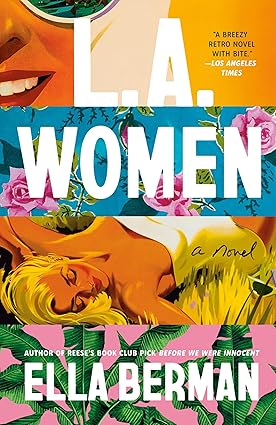
L.A. Women by Ella Berman
Two ambitious writers in 1960s LA face betrayal when one writes a novel based on the other's life.






Your guide toexceptional books
BookBrowse seeks out and recommends the best in contemporary fiction and nonfiction—books that not only engage and entertain but also deepen our understanding of ourselves and the world around us.


