
-
Your next favorite book
is waiting.
Summary | Excerpt | Reading Guide | Reviews | Beyond the book | Read-Alikes | Genres & Themes | Author Bio

A Novel
by Tayari Jones Book Reviewed by:
Honeysuckle, Louisiana is home to "cradle friends" Vernice Davis and Annie Kay, who cling to each other all the more because they are motherless. Vernice was raised by her Aunt Irene after being orphaned by her parents' murder–suicide. Annie's mother, Hattie Lee, disappeared when she was just three days old. Annie has lived with her grandmother ever since. The townspeople still gossip about Hattie Lee's drinking and gallivanting, using the contemptuous epithet "trifling." She returns to town briefly when Annie is 16 and leaves a Memphis address with Mr. Daniel, the bartender at her favorite drinking hole. The girls soon set off on separate journeys: Vernice to get an education at Atlanta's Spelman College; and Annie to find her mother.
Annie runs away to Memphis with her friend Clyde, Mr. Daniel's nephew; Clyde's girlfriend, Babydoll; and Clyde's cousin, Bobo. Clyde steals an old clunker of a car that breaks down in rural Mississippi, leaving the quartet stranded at what they soon realize is a brothel run by a shrewd, no-nonsense woman named Lulabelle. It's a complex of shacks that once housed sharecroppers. Clyde and Bobo do odd jobs around the place to earn money to fix the car, while Annie and Babydoll wash a never-ending mountain of bedding. Lulabelle tells them about the several strategies for dealing with pregnancies among her "girls," and one day they find sheets so bloodied that they know that an attempted abortion must have gone wrong.
Meanwhile, Vernice makes it to Atlanta, but not without mishap. She accidentally sits in the last row of the white section on the bus, and its driver throws her off. She loses not just what she spent on the ticket, but all of her luggage. Her church congregation back in Honeysuckle passes the offering plate around again to get her enough money for a new start. Mrs. Ola Mae, the town midwife, and Miss Jemison, Vernice's schoolteacher, drive her to Spelman—Miss Jemison's alma mater. Vernice doesn't realize at first that the ladies are a couple. It's a piece of ironic foreshadowing in that Vernice and her roommate, Joette Cunningham, who affectionately calls Vernice "country mouse," become lovers before long.
The novel's late-1950s to early-1960s setting coincides with the height of the Civil Rights movement. Vernice's bus incident echoes Rosa Parks's, and at Spelman she meets various young people who take part in protests. Joette's cousin, Marylinda, is a key organizer. Marylinda can pass as white and comes from a wealthy family, so she has more privilege than average. Joette comes from a mortuary fortune and has maids. Her parents encourage her engagement with a business associate. Vernice, too, will move up in Atlanta society through a marriage to Franklin McHenry. Although she still has feelings for Joette, Vernice also feels real love and desire for Franklin, which seems to indicate that she is bisexual.
Through Vernice and her new acquaintances, readers get a window onto a rising Black bourgeoisie (see Beyond the Book). Annie's experience of class is very different. When she finally makes it to Memphis, she works as a bartender at the nightclub where Bobo, now her boyfriend, is a jazz pianist. Her obsession with finding her mother continues, taking her to seedy parts of the city. The quest involves many setbacks and heartbreaks, and Bobo urges her to give up on Hattie Lee.
Questions surrounding being mothered and mothering are central to the novel. Jones carefully weaves in mother figures for both protagonists in addition to their guardians, such as (mother-in-law) Mrs. McHenry for Vernice and Lulabelle for Annie. The kindness of women and the building of sisterhoods—with men mostly proving to be weak or unreliable—reminded me of Toni Morrison's work. I also felt that Kin is consciously in the tradition of other greats of African American literature: Nella Larsen's characters pose as white and straight in Passing; Alice Walker wrote about a community of queer women in the South in The Color Purple.
As in Jones's third novel, Silver Sparrow, the first-person narration is shared between the two protagonists. Like in her previous work, the Women's Prize-winning An American Marriage, letters between the main characters fill in gaps and give insight into their thoughts and interactions. The structure of alternating between two narrators (the same as in An American Marriage) is effective, but, like I found with Silver Sparrow, the two voices aren't always distinctive enough from each other.
Kin is a touching novel that gives a sweeping sense of Black history and Southern culture. It gives a clear sense of intersectional challenges: race, class, poverty, and sexuality always overlap. However, certain historical details (mentions of Civil Rights movement protests, for example) felt added in to acknowledge the context without being organically developed as part of the story. There is also some hokey phrasing, such as "Annie was my best friend even though we took different tines at the fork in the road." The plot is slightly melodramatic, too, with a heartbreaking ending. But the themes of female friendship, the persistence of grief, the longing to find or become a mother resonate. Running all through is the yearning for someone to call one's next of kin.
 This review
first ran in the March 11, 2026
issue of BookBrowse Recommends.
This review
first ran in the March 11, 2026
issue of BookBrowse Recommends.

If you liked Kin, try these:

by Mia McKenzie
Published 2025
In this vibrant, gratifying novel, a pious, small-town teenager travels to Atlanta to get an abortion and finds herself smack in the middle of the civil rights movement and the secret lives of queer Black people.

by Diane Oliver
Published 2025
A bold and haunting debut story collection that follows various characters as they navigate the day-to-day perils of Jim Crow racism from Diane Oliver, a missing figure in the canon of twentieth-century African American literature, with an introduction by Tayari Jones
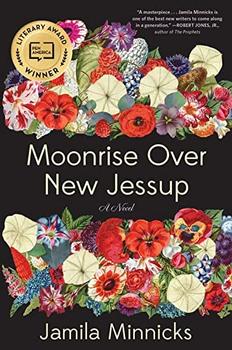
by Jamila Minnicks
Published 2023
Winner of the 2021 PEN/Bellwether Prize for Socially Engaged Fiction, a thought-provoking and enchanting debut about a Black woman doing whatever it takes to protect all she loves at the beginning of the civil rights movement in Alabama.
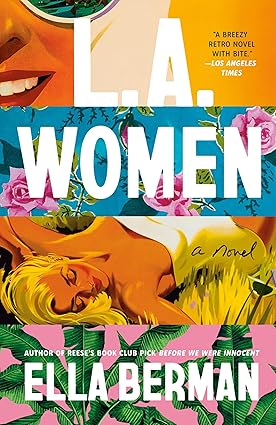
L.A. Women by Ella Berman
Two ambitious writers in 1960s LA face betrayal when one writes a novel based on the other's life.






Your guide toexceptional books
BookBrowse seeks out and recommends the best in contemporary fiction and nonfiction—books that not only engage and entertain but also deepen our understanding of ourselves and the world around us.

