
-
Your next favorite book
is waiting.
Summary | Excerpt | Reviews | Beyond the Book | Read-Alikes | Genres & Themes | Author Bio

 Book Reviewed by:
This article relates to The Sound and the Fury

 William Faulkner's 1929 masterpiece, The Sound and the Fury, is a work of modernist literature, and one of the best examples of stream-of-consciousness narrative ever written. This technique attempts to mimic the way a person's mind works, with one thought flowing into another, often sparked by an external stimulus that brings up a past event or sends thoughts spinning in another direction.
Faulkner uses this method of writing during the first three sections of the novel. One noteworthy aspect of the book is that the author employs multiple first-person perspectives to tell his story, each supplying a piece of the mosaic until the full picture is assembled. Also remarkably, each character's inner monologue is completely distinctive.
We first encounter Benjy, a 33-year-old man with intellectual disabilities, who can only communicate with grunts and groans. His thoughts are simplistic but chaotic, and he has no understanding of time; his past and present overlap. The book begins:
"Through the fence, between the curling flower spaces, I could see them hitting. They were coming toward where the flag was and I went along the fence…They took the flag out, and they were hitting. Then they put the flag back and they went to the table, and he hit and the other hit. Then they went on, and I went along the fence."
This sets the stage for the type of narrative readers can expect going forward. Faulkner dumps us right into Benjy's mind with no orientation, no preparation. It's not until much later that we figure out that he's watching people play golf. Triggered by sensory input—the golfers yell for their "caddie"—Benjy then begins looking for his lost sister, Caddy, and his mind jumps to experiences with her. One of the book's major themes is the subjectivity of time, and Faulkner illustrates this in part by the way Benjy's thoughts range fluidly between past and present with no segue. Benjy also represents a truly reliable narrator, since he's unable to interpret events around him, and it's through his eyes that we first see his family's decline.
We next encounter the Compsons' eldest son, Quentin, as he finishes his first year at Harvard. The character is consumed by the myth of southern chivalry, romanticizing life during the antebellum era and obsessed with notions of family honor, courage, masculinity, and—for women—chastity. He's consequently unable to come to terms with his alcoholic father's nihilism and his sister's promiscuity, and the collapse of his moral code leads him to suicide. His narration is largely practical as he prepares to take his life (for example, he buys two six-pound flat-irons, although we're not told why). Much of his contemplations recall his father's opinions:
"Father said why should Uncle Maury work if he father could support five or six [servants] that did nothing at all but sit with their feet in the oven he certainly could board and lodge Uncle Maury now and then and lend him a little money who kept his Father's belief in the celestial derivation of his own species at such a fine heat then Mother would cry and say that Father believed his people were better than hers that he was ridiculing Uncle Maury to teach us the same thing she couldnt see that Father was teaching us that all men are just accumulations dolls stuffed with sawdust swept up from the trash heaps where all previous dolls had been thrown away the sawdust flowing from what wound in what side that not for me died not."
Even when Quentin takes action, it's ineffectual. In defending feminine honor both in the past and present, Quentin sparks fights but is trounced both times. He is, in effect, the failed knight errant, the embodiment of false and impractical ideals. He never thinks to himself, "I'm going to kill myself," or "I'm depressed," but his disordered mind is apparent throughout this section.
Jason Compson IV's mental musings comprise the third part of the book. He represents the last of the Compsons, and Faulkner uses this character to demonstrate the family's final collapse, financially, intellectually, and morally. Jason's thoughts, largely focused on the present, are much more coherent but also cynical, bitter, and downright mean-spirited. He's racist, misogynistic, and antisemitic, perpetually feeling wronged. While still formatted as stream-of-consciousness, this chapter is more traditional; it also relies more heavily on dialogue than the previous two, as Jason interacts with his mother, his niece (Caddy's illegitimate child), co-workers, and others. Here, Jason reacts to Benjy's presence in a scene that echoes the book's opening:
"'Take him on round to the back,' I says. 'What the hell makes you want to keep him around here where people can see him?' I made them go on, before he got started bellowing good. … He's going to keep on running up and down that fence and bellowing every time they come in sight until first thing I know they're going to begin charging me golf dues."
Jason's inner monologue here makes it clear he resents having to care for Benjy, and in general, the rancor of his thoughts often spills over into conversation as he belittles everyone around him.
Although few authors today employ stream-of-consciousness either as completely or as masterfully as Faulkner, it's by no means uncommon. Modern authors who employ the technique include Colson Whitehead, Cormac McCarthy, Louise Erdrich, Toni Morrison, and Jonathan Safron Foer.
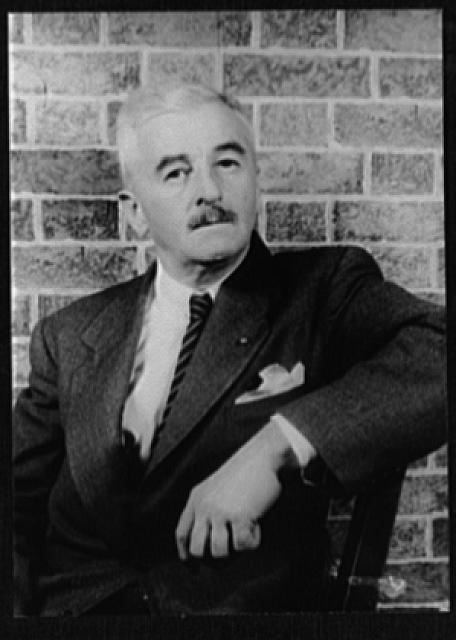
Photograph of William Faulkner, 1951, courtesy of Library of Congress, Prints & Photographs Division, Carl Van Vechten Collection, LC-USZC2-6403
Filed under Books and Authors
 This article relates to The Sound and the Fury.
It first ran in the January 28, 2026
issue of BookBrowse Recommends.
This article relates to The Sound and the Fury.
It first ran in the January 28, 2026
issue of BookBrowse Recommends.
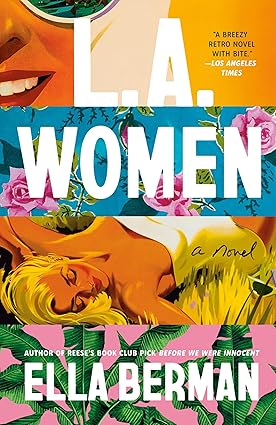
L.A. Women by Ella Berman
Two ambitious writers in 1960s LA face betrayal when one writes a novel based on the other's life.






Your guide toexceptional books
BookBrowse seeks out and recommends the best in contemporary fiction and nonfiction—books that not only engage and entertain but also deepen our understanding of ourselves and the world around us.

