
-
Your next favorite book
is waiting.
Summary | Excerpt | Reading Guide | Reviews | Beyond the Book | Read-Alikes | Genres & Themes | Author Bio

 Book Reviewed by:
This article relates to The Seas

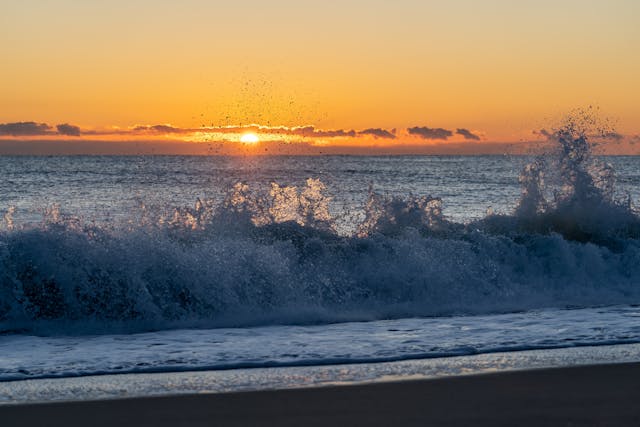 "That is how a small northern town in America works. It enlists one beautiful thing like the ocean or the mountains or the snow to keep people stuck and stagnant and staring out to sea forever. I watch the blue in the mirror. It is so beautiful that it is hard to look away," muses the unnamed speaker of Samantha Hunt's The Seas. It's not an idle statement so much as it is a summary of the novel, which relies on seaside isolation to mimic the speaker's own stagnation.
The ocean's omnipresence stands in for the speaker's inability to achieve escape velocity. While it's never stated what specific, concrete obstacles keep her from moving away from where she is living, it's clearly not an option for her. The book opens with the revelation that her town is so far north that all the roads go south, establishing her constrained existence. "Then there is the ocean, mean and beautiful," she says, and we know the two can be synonymous. The beauty of the ocean keeps her there, which is a kind of cruelty, given the circumstances of her life. That metaphor also extends to the main character's relationship with her love interest, Jude. Her love for him is vast, deep, and breathtakingly beautiful (at least to her), but it also holds her back.
As much as the ocean represents the massive complications the narrator faces in her life, including Jude, it's also a representation of her inner turmoil. The most obvious demonstration of that is her conviction that she's a mermaid, something her father told her before he disappeared at sea. She identifies with myriad aspects of the ocean, including the eyeless life found down deep. "But I don't see so well and I think my trouble seeing might be a characteristic of the depth of the sea where I am from," she explains to Jude. Her theory about her vision is not the only time she traces elements of her life back to her underwater origins. Elsewhere, she remembers her French grandmother fleeing to America during World War II: "I can trace my hatred of the dry land back to her. She had more reasons than anyone to hate the dry land, having lived through a war that she had nothing to do with."
Whether the ocean represents the narrator's external stagnating factors or feelings of otherness, it's always impossible to escape. She imagines a rock she sees is King Neptune, cautioning her, "Don't forget that the ocean is full of everything except mercy." Which is, perhaps, another way of saying that it's so mean and beautiful that morality is irrelevant. Naturally, that echoes how she feels about Jude, that her beautiful love for him also cruelly keeps her tied to the land. She can neither be with him nor escape him: "Jude won't marry me and I'll never be able to kill him and so I'll never be able to go back to the ocean, and who knows what will happen to me without a husband?"
The main character is aware of her limitations, and how her self-destructive traits are mirrored back to her in the ocean. That awareness just makes it sadder in moments when she acknowledges the urgent need to escape her surroundings but is thwarted by external factors. Whatever state the ocean conjures at a given moment is not the point. Rather, the ocean matters most because it's always there. Like the tide, it's always pushing her out and pulling her back, but never letting her go.
"Dramatic Sunset Over Mediterranean Sea Waves," by Rafael Minguet Delgado courtesy of Plex
Filed under Books and Authors
 This article relates to The Seas.
It first ran in the November 5, 2025
issue of BookBrowse Recommends.
This article relates to The Seas.
It first ran in the November 5, 2025
issue of BookBrowse Recommends.

L.A. Women by Ella Berman
Two ambitious writers in 1960s LA face betrayal when one writes a novel based on the other's life.






Your guide toexceptional books
BookBrowse seeks out and recommends the best in contemporary fiction and nonfiction—books that not only engage and entertain but also deepen our understanding of ourselves and the world around us.

