
-
Your next favorite book
is waiting.
Summary | Excerpt | Reviews | Beyond the Book | Read-Alikes | Genres & Themes | Author Bio

Adventures in Human Anatomy
by Mary Roach Book Reviewed by:
This article relates to Replaceable You

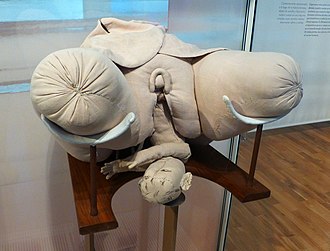 In Replaceable You, author Mary Roach talks about the use of medical manikins—lifelike practice dummies—in training doctors and surgeons. These manikins are designed to replicate human anatomy and physiology realistically, so that healthcare professionals can refine their skills in a controlled environment. As medical science has progressed over the years, so too has the complexity of manikins available to train up-and-coming physicians.
Before the turn of the 18th century, human figures were widely used in medicine across many cultures. Anatomically correct doll-sized models were made of clay as a way to illustrate the placement of human organs and the effects of various diseases on the human body. These were manufactured only for illustration, however; it wasn't until around 1700 that manikins were devised on which medical personnel could practice. One of the earliest such devices was created by Paris-trained midwife, Marguerite Angelique le Boursier du Coudray, who established the first national rural simulation-based training for midwives. She created such realistic and well-designed cloth training dummies of the lower part of a woman's anatomy that local hospitals started purchasing them from her so they could hold their own training sessions.
The first full-sized manikin specifically designed for training health care workers was the Mrs. Chase doll, which started out life as a child's toy. Rhode Islander Martha Jenks Chase (1851-1925) was the mother of seven young children and disappointed by the dolls being sold in stores: their heads were made of porcelain and subject to breakage; the paint would wash off their faces; and they were heavy. So, in 1899, she created her own versions out of cloth, which were much more cuddly and resilient. They became so popular that by 1913 she owned a business—MJ Chase and Company, aka The Doll House—which employed several seamstresses and painters, and she was selling her dolls to companies like Macy's and F.A.O. Schwarz.
The toys came to the attention of Lauder Sutherland, the principal of the Hartford Training School for Nurses in Connecticut. Sutherland had been using straw-filled dummies for teaching her students, but she was impressed with Chase's work. She reached out to the company and asked if they'd create a life-sized version for her. Chase (whose husband, brother, and father were physicians) designed a 5'4" model with jointed limbs. The doll, now known as "Mrs. Chase," was used to teach the nurses how to dress patients, turn them over, change the bedlinens of immobile patients, and transfer them from bed to bed. Later versions included an arm injection site and an internal reservoir for urethral, vaginal, and rectal treatments.
Mrs. Chase was demonstrated at a nursing convention in St. Louis in 1914, where it was immediately popular, and its use ultimately spread to hospitals worldwide. Additional models were created, including a Baby Chase. During WWII, the MJ Chase Company (which continued to manufacture dolls into the 1980s, well after Martha's death) was commissioned by the U.S. Army to produce a male version for training corpsmen to handle and treat men on the battlefield.
Over the decades since, training manikins have gotten progressively more realistic and sophisticated. Today there are literally hundreds of different models available that can help medical students learn pretty much any procedure. For example, one company, Pocketnurse, offers specialty manikins for training tasks like airway management, auscultation (using a stethoscope), bandaging, birthing, breast exams, and more. One can even purchase training dummies for veterinary care. And the manikin business is a big one: in 2023, the healthcare manikin market value was estimated at $2.28 billion, and it's expected to grow to $7.57 billion by 2031.
Photo of manikin by Ji-Elle, CC BY-SA 4.0 International.
Filed under Medicine, Science and Tech
 This article relates to Replaceable You.
It first ran in the October 8, 2025
issue of BookBrowse Recommends.
This article relates to Replaceable You.
It first ran in the October 8, 2025
issue of BookBrowse Recommends.

L.A. Women by Ella Berman
Two ambitious writers in 1960s LA face betrayal when one writes a novel based on the other's life.






Your guide toexceptional books
BookBrowse seeks out and recommends the best in contemporary fiction and nonfiction—books that not only engage and entertain but also deepen our understanding of ourselves and the world around us.


