
-
Your next favorite book
is waiting.
Summary | Excerpt | Reviews | Beyond the Book | Readalikes | Genres & Themes | Author Bio

 Book Reviewed by:
Shahrazad succeeds because she understands that beginnings, middles and ends are only useful when we are working in chronological time – the arrow flight of the day, or the marks that chart the month. Inner time, where our minds live, where we daydream and create, where children play, is not subject to chronological imperatives.
In recognition of this, the stories humans tell have always compressed and expanded time, can fit a life into a single day, unravel a single day into strings that become an instrument – not of measurement, but of music.
We can begin at the end. Or in the middle. We can enjoy multiple beginnings – and see what happens.
The story unfolds in time, just as we do, but not in time as we commonly experience it. In a few hours we can live many lifetimes. More importantly, the freedom from daily time that the story allows, points us towards the strange truth of our hybrid nature: We are mortal but we must live as though we are not.
Shahrazad's genius is to recognise that while her pressing problem sits inside chronological time – in the morning she will die – her solution lies beyond the limits of ordinary time. Her method is to dismantle the Sultan's ticking madness and replace it with the sanity of a story. A story where a year can pass in two seconds and where there is no need to worry about one lifetime when many more are available to us.
Shahrazad refuses the present emergency – the contrived drama of a powerful man. Instead, she rolls out time like a flying carpet. A means of escape. She does not lie weeping on the divan, counting the moments until her death; instead she invites the Sultan to travel with her on a leisurely journey to somewhere more interesting.
Where are we going?
To the desert to meet a man who is in a mess through no fault of his own.
It is possible to open what is closed. To dodge what seems inevitable. To stretch what is shrunk. To counter one story with another.
Walking back from the library, town at the bottom and a hill at the top, a town that might as well have been a walled fortress, set inside a moat guarded by crocodiles, my heart was light. I had found my magic lamp and flying carpet.
Let's put it like this.
I can change the story because I am the story.
Excerpted from One Aladdin Two Lamps by Jeanette Winterson. Copyright © 2026 by Jeanette Winterson. Excerpted by permission of Grove Press. All rights reserved. No part of this excerpt may be reproduced or reprinted without permission in writing from the publisher.
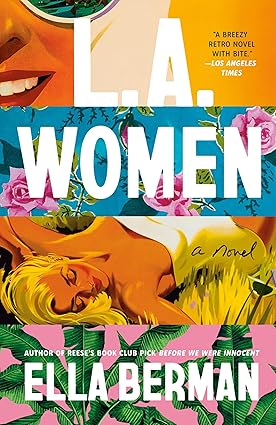
L.A. Women by Ella Berman
Two ambitious writers in 1960s LA face betrayal when one writes a novel based on the other's life.






Your guide toexceptional books
BookBrowse seeks out and recommends the best in contemporary fiction and nonfiction—books that not only engage and entertain but also deepen our understanding of ourselves and the world around us.


