
-
Your next favorite book
is waiting.
Summary | Excerpt | Reviews | Beyond the Book | Read-Alikes | Genres & Themes | Author Bio

 Book Reviewed by:
This article relates to One Aladdin Two Lamps

 Aladdin's Tale: Origins, Adaptations, and Reinterpretation
"Aladdin and His Wonderful Lamp" is arguably the most beloved and well-known tale associated with The One Thousand and One Nights, yet it was not originally part of the collection. Its true origins are lost to time and scholars consider it one of the "orphan tales" along with other stories like "Ali Baba" that entered the Nights through later transmissions.
The story first appeared in the West in the early 1700s when Antoine Galland, the French translator of the collection, heard Aladdin's tale in Paris from a young Syrian from Aleppo, Hanna Diyab. Diyab is the earliest known source of the tale, although whether he invented it entirely himself, drew on many existing versions, or simply passed on an oral legend is unknown. In any case, Galland included it in his French translation of The One Thousand and One Nights, making it the first printed appearance of Aladdin's adventure in the West, though without publicly crediting Diyab.
In this first version, Aladdin is not the Middle Eastern street orphan we know today. He is an idle son of a tailor living with his mother somewhere in China. Despite this, all of the characters have Arabic names and live by Islamic customs, suggesting the story had Arabian influences, and China was selected as the story's setting for exotic appeal or simply to denote a faraway place. Early variations also included references to Africa, suggesting that the tale might have traveled along trade routes and been the product of cross-cultural exchanges.
As the story continued to travel across Europe, it was constantly reshaped to fit its new audiences' values. The first recorded onstage adaptation appeared in 1788, as a pantomime (an English theatrical tradition that mixed fairy tale plots with slapstick comedy, music, and exaggerated characters) and by Victorian times it had become a classic Christmas theater show. In these shows, new characters were added, like Aladdin's brother Wishee-Washee, while others were reimagined. Aladdin's mother, for example, became a loud laundress—the "Widow Twankey"—played by a man in drag for comic effect. (In recent years, some British pantomime productions of Aladdin have been criticized for perpetuating historical racism, by casting white people in roles adhering to Orientalist stereotypes, for example. Much modern pantomime has been informed by discussions around how to adapt performances to retain traditional comic elements while avoiding expressions of racism, misogyny, and transphobia.)
The 20th century saw "Aladdin" advance to the screen and also become presented as a Middle Eastern tale, with the earliest known film version being Aladdin and the Wonderful Lamp (1917), a silent film. Much later, Disney set the story in "Agrabah," a made-up Middle Eastern kingdom. Disney also renamed and reshaped key characters: the princess Badroulbadour became Jasmine, and the original sorcerer, an African magician who poses as Aladdin's uncle, was reimagined as Jafar, a scheming royal vizier. Some characters were also left out completely, like Aladdin's mother and the sorcerer's evil brother. Other important elements from older versions were omitted too, like the lesser genie from a magic ring, and the subplot of a second, fake lamp that Aladdin's mother trades for the real one after being tricked by the evil wizard.
Across these Western adaptations, the story gradually shifted toward a clearer "rags-to-riches" arc: a poor but capable youth uses wit, luck, and magical help to rise in status, win love, and defeat the villain. This aligns closely with European fairytale traditions, which often center on a single hero and upward mobility.
By contrast, stories in The One Thousand and One Nights don't focus on one self-made hero's quest in the same way Western tales do. Instead, they unfold through fate and chance encounters, emphasizing interaction, trust, and communication. The outcome of a situation depends on the skills of many as opposed to the strength of the main hero. In Aladdin's first versions, for example, the princess uses her own wit to defeat the sorcerer, while Aladdin's mother plays a crucial role too. She is the one who accidentally rubs the lamp while cleaning it and summons the genie. In Western retellings these details are dropped, shifting the narrative onto Aladdin's wits and his journey to escape poverty, reshaping how audiences understand heroism, gender, and power.
Winterson's One Aladdin Two Lamps and the Power of Story
The transformation and history of Aladdin's tale exemplify a lot of what Winterson is saying on a larger scale in her book One Aladdin Two Lamps. She is not trying to retell folktales, but rather uses them as starting points to reflect on storytelling, its power, and cultural influence.
For Winterson, stories are not fixed, but evolve and change by adapting to the needs and values of the societies that share them. And because they have the power to change us as much as we change them, it is crucial to understand who tells each story and why.
The title itself, One Aladdin Two Lamps, works as a metaphor for her main argument. As she declares, stories are the magic lamps of our world. In the original story there are two lamps, a fake one and a real one. In our world there is also more than one reading of the same tale. Stories can thus either guide or mislead us. They can be harmful or beneficial. And just as it is crucial for Aladdin to be able to tell the real lamp from the fake one, we too must sharpen our discernment and learn how to recognize the fake stories we are being told. The stories that keep us from reaching our full potential. Or the ones that create false enemies and fake narratives of the "other," enforcing the ideology and morals of those in power.
For example, as we've seen, originally, both Aladdin's mother and the princess had active roles. In some modern retellings of the story, though, female characters become less central, reflecting longstanding patterns in which women's roles have been narrowed, or erased. Winterson connects this to a wider cultural issue: the way dominant groups have historically shaped narratives and influenced how people see others and themselves from an early age.
Similarly, the popularity of rags-to-riches plots can support the comforting idea that talent and effort alone are enough to overcome poverty. While such stories can be inspiring, they can also ignore structural inequalities. The emphasis in Aladdin's tale shifted from his character transformation to escaping poverty to better fit this narrative.
And finally, Western versions of Aladdin appeared alongside colonial expansion and were shaped by biases, fake narratives of "inferiority," and sensationalism, in an example of how storytelling can reinforce unequal power relations and turn cultures into stereotypes.
Learning to recognize these fake lamps is not enough, however. We have to be able to find the right ones as well. One way we can do this, according to Winterson, is by reading literature, because books can help us imagine new worlds and show us that the way things are now is not how they have to be. Stories provide us with the right tools to envision a better future. The right stories also have the power to transform us into better people. They can teach us empathy, love, and acceptance by introducing us to different characters and situations or by teaching us indirectly through the lessons their characters learn.
For Winterson, recognizing the duality of the power of stories is crucial. She warns against accepting stories uncritically and instead asks us to become active readers. To choose the right lamp, reject the fake, and start writing our own stories.
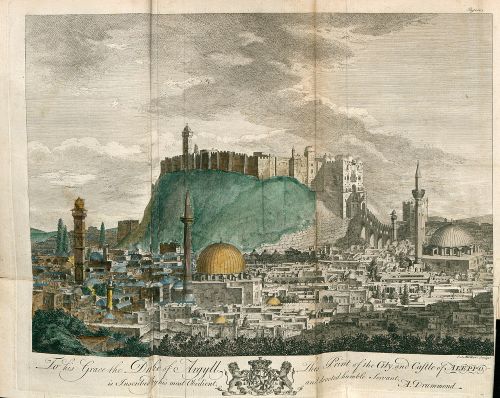
Illustration of Aleppo in the 18th century from the travelogue of Alexander Drummond, via Wikimedia Commons
Filed under Books and Authors
 This article relates to One Aladdin Two Lamps.
It first ran in the February 25, 2026
issue of BookBrowse Recommends.
This article relates to One Aladdin Two Lamps.
It first ran in the February 25, 2026
issue of BookBrowse Recommends.

L.A. Women by Ella Berman
Two ambitious writers in 1960s LA face betrayal when one writes a novel based on the other's life.







Your guide toexceptional books
BookBrowse seeks out and recommends the best in contemporary fiction and nonfiction—books that not only engage and entertain but also deepen our understanding of ourselves and the world around us.


