
-
Your next favorite book
is waiting.
Summary | Excerpt | Reviews | Beyond the Book | Readalikes | Genres & Themes | Author Bio

 Book Reviewed by:
"This isn't the lunch I'd planned for myself," Babette said. "I was seriously thinking yogurt and wheat germ."
"Where have we heard that before?" Denise said.
"Probably right here," Steffie said.
"She keeps buying that stuff."
"But she never eats it," Steffie said.
"Because she thinks if she keeps buying it, she'll have to eat it just to get rid of it. It's like she's trying to trick herself."
"It takes up half the kitchen."
"But she throws it away before she eats it because it goes bad," Denise said. "So then she starts the whole thing all over again."
"Wherever you look," Steffie said, "there it is."
"She feels guilty if she doesn't buy it, she feels guilty if she buys it and doesn't eat it, she feels guilty when she sees it in the fridge, she feels guilty when she throws it away."
"It's like she smokes but she doesn't," Steffie said.
Denise was eleven, a hard-nosed kid. She led a more or less daily protest against those of her mother's habits that struck her as wasteful or dangerous. I defended Babette. I told her I was the one who needed to show discipline in matters of diet. I reminded her how much I liked the way she looked. I suggested there was an honesty inherent in bulkiness if it is just the right amount. People trust a certain amount of bulk in others.
But she was not happy with her hips and thighs, walked at a rapid clip, ran up the stadium steps at the neoclassical high school. She said I made virtues of her flaws because it was my nature to shelter loved ones from the truth. Something lurked inside the truth, she said.
The smoke alarm went off in the hallway upstairs, either to let us know the battery had just died or because the house was on fire. We finished our lunch in silence.
3
DEPARTMENT HEADS wear academic robes at the College-on-the-Hill. Not grand sweeping full-length affairs but sleeveless tunics puckered at the shoulders. I like the idea. I like clearing my arm from the folds of the garment to look at my watch. The simple act of checking the time is transformed by this flourish. Decorative gestures add romance to a life. Idling students may see time itself as a complex embellishment, a romance of human consciousness, as they witness the chairman walking across campus, crook'd arm emerging from his medieval robe, the digital watch blinking in late summer dusk. The robe is black, of course, and goes with almost anything.
There is no Hitler building as such. We are quartered in Centenary Hall, a dark brick structure we share with the popular culture department, known officially as American environments. A curious group. The teaching staff is composed almost solely of New York emigres, smart, thuggish, movie-mad, trivia-crazed. They are here to decipher the natural language of the culture, to make a formal method of the shiny pleasures they'd known in their Europe-shadowed childhoods—an Aristotelianism of bubble gum wrappers and detergent jingles. The department head is Alfonse (Fast Food) Stompanato, a broad-chested glowering man whose collection of prewar soda pop bottles is on permanent display in an alcove. All his teachers are male, wear rumpled clothes, need haircuts, cough into their armpits. Together they look like teamster officials assembled to identify the body of a mutilated colleague. The impression is one of pervasive bitterness, suspicion and intrigue.
An exception to some of the above is Murray Jay Siskind, an ex-sportswriter who asked me to have lunch with him in the dining room, where the institutional odor of vaguely defined food aroused in me an obscure and gloomy memory. Murray was new to the Hill, a stoop-shouldered man with little round glasses and an Amish beard. He was a visiting lecturer on living icons and seemed embarrassed by what he'd gleaned so far from his colleagues in popular culture.
"I understand the music, I understand the movies, I even see how comic books can tell us things. But there are full professors in this place who read nothing but cereal boxes."
Excerpted from White Noise by Don DeLillo. Copyright © 1985 by Don DeLillo. Excerpted by permission of Viking. All rights reserved. No part of this excerpt may be reproduced or reprinted without permission in writing from the publisher.
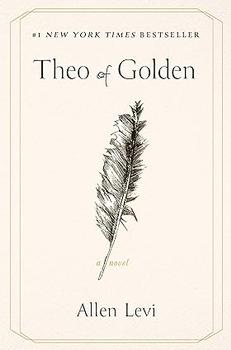
Theo of Golden by Allen Levi
One spring morning, a stranger arrives in the small southern city of Golden. No one knows where he has come from…or why…






Your guide toexceptional books
BookBrowse seeks out and recommends the best in contemporary fiction and nonfiction—books that not only engage and entertain but also deepen our understanding of ourselves and the world around us.


